
The Breakdown: Isomorphic Labs
Inside Isomorphic Labs: Trying to understand the company whose goal is to "solve all disease"

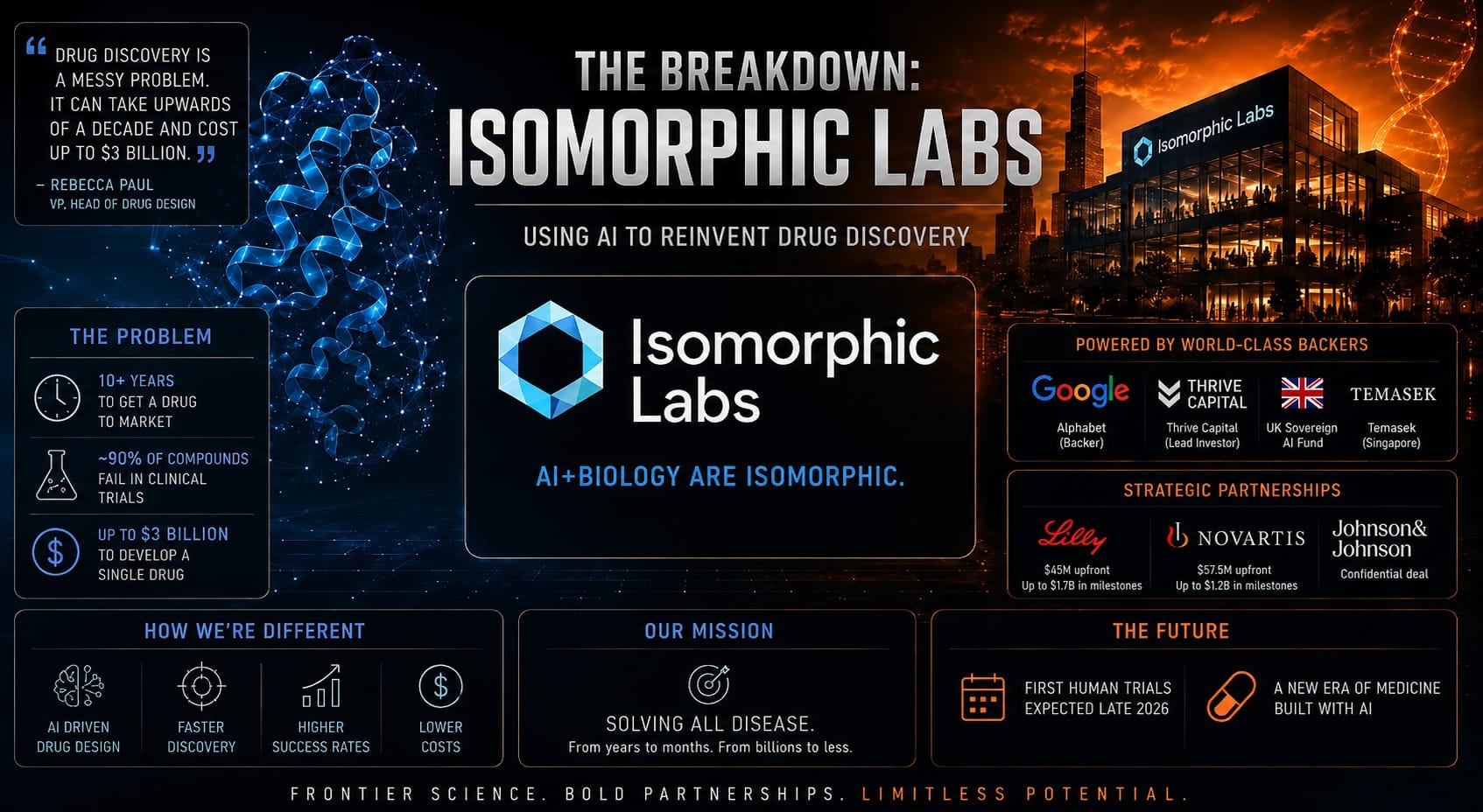
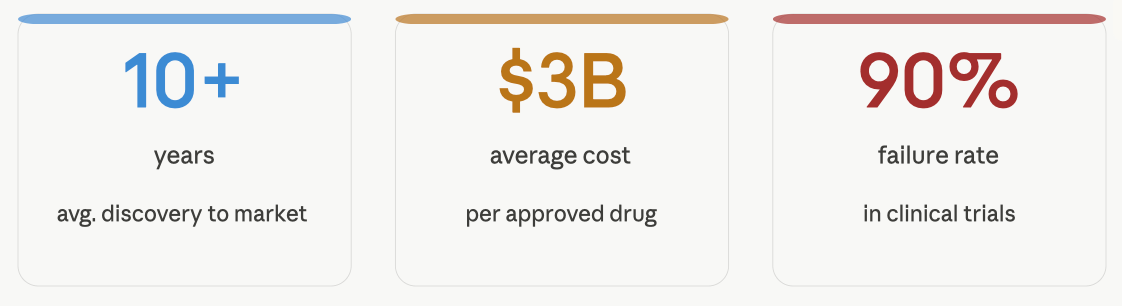
“Drug discovery is a messy problem. It can take upwards of a decade to get a drug all the way from the initial stages of a project all the way through onto the market…. 90% of compounds that enter the clinic don’t come out the other side. The whole process can cost up to $3 billion.” - Rebecca Paul VP, Head of Drug Design, Isomorphic Labs
What if a company could use AI to fundamentally reinvent the drug discovery process? Make it more effective, cheaper to develop and significantly speed up the process. What if the company was founded by a Nobel Prize winner in chemistry? What if this company was a spin-off of Google’s DeepMind? What if you could combine them all together and create one company?
Enter Isomorphic Labs.
Isomorphic comes from a Greek term. It describes two things that are similar or identical in structure even if the outer appearance differs. Isomorphic Labs believes that AI and biology are isomorphic and that frontier AI can “unlock deeper scientific insights, faster breakthroughs, and life changing medicine.”1
Today, Isomorphic Labs is at the forefront of the AI medicine synergy. Their goal, of “solving all disease” may sound far-fetched, but with huge funding from Google as well as the sovereign funds in the UK and Singapore, they are no longer just a pipe dream. Their partners include companies worth hundreds of billions of dollars including Eli Lilly and Novartis. Human trials are expected to take place in late 2026, potentially moving Isomorphic Labs from the theoretical to the real world and provide a real indicator of whether AI can fundamentally change the way that drugs are developed.
By way of a roadmap, this piece will begin by talking about the founding of Isomorphic Labs, and its origin story. We will then continue by explaining what AlphaFold is and how it revolutionized the biotech world. After that, we will explain what Isomorphic Labs actually does, its current partnerships today and look at the founder of the company and assess how a celebrity founder affects the company. We will then continue looking at the company itself and the main question surrounding it, before looking at the TAM, competition and valuation. I will then discuss a potential IPO date and give my final thoughts on the company. This is a fascinating company even for those who don’t frequent the biotech space. Enjoy :)
Welcome to The Private Ledger - an independent, research publication that focuses on breaking down companies in the private market weekly.
📈 You’re reading my latest breakdown into a private company. If you enjoy the research, make sure to like & subscribe to receive much more like this, weekly!
The Birth of Isomorphic Labs:
In 2014, Google acquired DeepMind. Their goal was to “Solve intelligence. Use it to make the world a better place.”2
And while they haven’t exactly solved intelligence, they have made massive strides using artificial intelligence to make the world a better place. In 2020, DeepMind developed AlphaFold2, a protein folding breakthrough where they used AI to map 3D structures of virtually all known proteins.3 By understanding protein structures in greater detail, scientists are able to better design targeted drugs that can solve previously unsolved diseases. Think of proteins as the blueprint of the human body. If you can understand the blueprint perfectly, you can find what is working properly, and what is broken and needs to be fixed.
In 2021, spurred by the success of the AlphaFold2, Google’s DeepMind spun off Isomorphic Labs with the goal of “solving all disease.” The head of the company was the same Demis Hassabis who would go on to win a Nobel Prize for the protein folding breakthrough.
Spinning off Isomorphic Labs from the original DeepMind project allowed it to focus on the highly regulated world of drug manufacturing rather than be an additional biotech project in an AI research laboratory. In addition, drug testing is both extremely expensive and carries a near 90% historical failure rate.4 Spinning off Isomorphic Labs allowed the company to focus and hire on recruiting biology experts while not having the high capital expenditure costs on DeepMind’s balance sheet. Importantly, Google is still massively invested in the company and likely has voting power to make the key decisions as they see fit.
AlphaFold, the Breakthrough.
Isomorphic Labs’ goal is to solve all disease. And in order to do that, they are using AI to rapidly speed up the process. In fact, according to Max Jaderberg, the president of Isomorphic Labs, in a few years, drug design will be synonymous with AI.
“In five years time, doing drug design without AI will be like doing any sort of science without math… If you are not using AI, what are you doing.” - Max Jaderberg.
But before we get to that, we have to backtrack a little bit.
The human body is made up of around 20,000 protein-coding genes5. These proteins combine to create about 80,000 to 400,000 unique protein variants. Everything in the human body comes down to these proteins and how they mutate. Hypothetically, if you could perfectly map out every human body and understand how proteins interact, within it, medicine would be transformed. Scientists could detect diseases earlier and potentially even send deadly diseases into remission, create side effect free cures and even go a step further, and reverse human aging.6 While biology is far more complex than simply proteins alone, protein structures are very useful for rational drug design and the ability to look at a protein and create a drug that fits - almost like a jigsaw piece in a puzzle.
Of course, this is much easier said than done and until a few years ago, working out the structure for one single protein would take months or even years. To complicate matters, each one of these proteins has a unique three-dimensional structure that it can fold into.
The release of AlphaFold in December of 2018 revolutionized the entire field. It essentially used AI to understand and map out highly complex three-dimensional shape.7 AlphaFold was able to predict protein structures with 90% accuracy, matching human laboratory techniques in seconds, rather than years.8 All in all, AlphaFold was able to predict the structures of 360,000 proteins. With the release of AlphaFold2, DeepMind successfully mapped out virtually all 200 million known proteins.
Think of it like any other AI - ChatGPT/Claude etc. Except instead of being trained on language and text, AlphaFold was trained on data - specifically structural biology data collected over decades and decades of biomolecules. The Pharma Fox
Scientists instantly used this to make breakthroughs in health. A liver cancer that targeted a protein had no known protein structure and therefore made traditional drug design very difficult. Then, in a collaborative project, an AI drug-discovery company partnered with AlphaFold2 to understand the protein. AlphaFold2 generated an extremely accurate 3D model and within 30 days the scientists custom designed a “hit molecule” to fight the cancer. For some context, this is an unheard of timeline in pharmaceutical drug discovery, and it was only made possible through the use of AI.
In pure numbers, AlphaFold is revolutionary. In 1962, John Kendrew and Max Perutz won the Nobel Prize for mapping the first two protein structures.9 . Then, for the next fifty years, tens of thousands of the brightest scientists revealed the structures of 150,000 proteins, the grand sum of human effort. Then, came AlphaFold. In a few years, AlphaFold was able to predict the structures of 200,000,000 proteins.
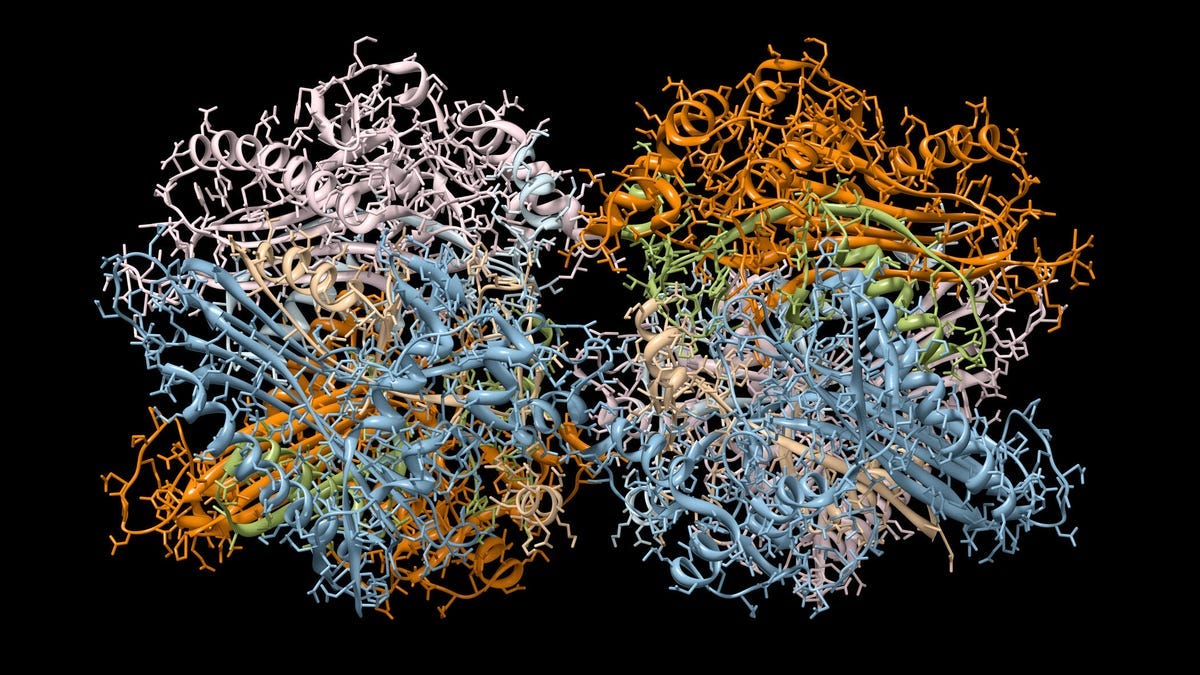
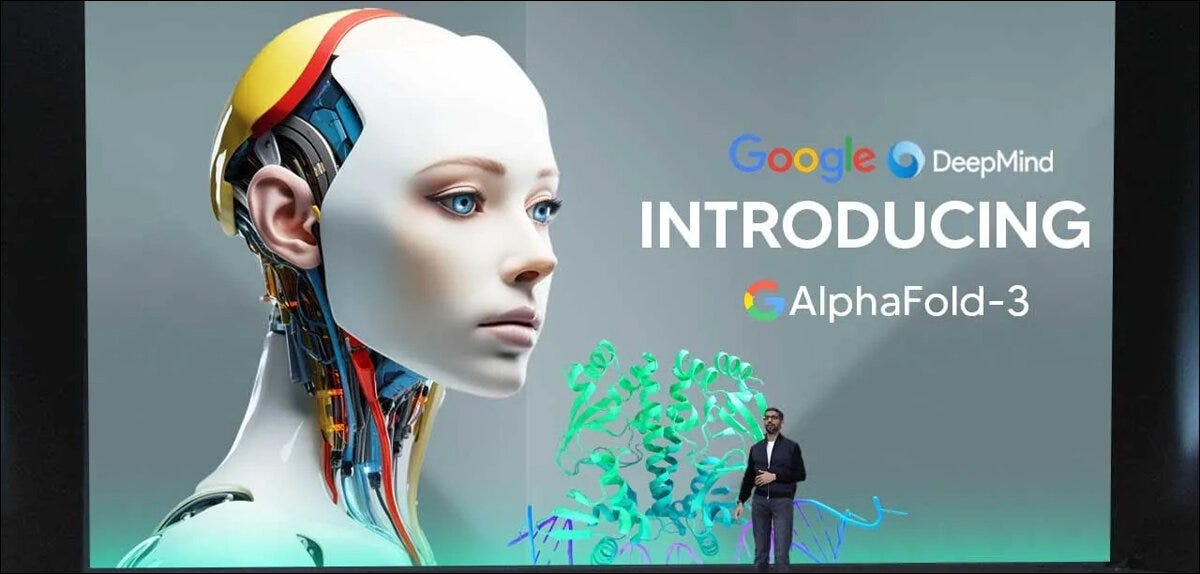
Demis Hassabis and John Jumper won the split 2024 Nobel prize in chemistry for their breakthrough advancements “for protein structure prediction.”10 This is just the beginning and with the release of AlphaFold3, a model that is significantly more efficient than AlphaFold2, the team at Isomorphic Labs is hoping to revolutionize medicine and drug development.
“The modelling capacity are getting significantly more sophisticated with every release. The size and complexity of the run is greater and takes less time. With AlphaFold2 it took me about 13 hours to run 2 proteins with a combined total number of amino acids of around ~2000. I had to wake up at night to make sure my computer monitor didn’t turn off. Now in half an hour I can run around 10,000 amino acids in multi-protein complexes. The Pharma Fox - Highly recommend checking out his account!
It is important to note that as great as AlphaFold is, at the end of the day, it is just a model, not real experimental data. The difference is like a photograph i.e., a real experimental structure, and a drawing i.e., AlphaFold’s prediction. It’s a model based on information predicted about an object, and not a photo of the object itself. Often they are pretty close or spot on - but there’s a limit to how much a biologist would trust it. Think no matter how accurate a painting of a jungle is, it’s not as accurate as a photo of someone in the jungle.
What Does Isomorphic Labs Do?
“Make me a drug for X disease, off it goes, here’s the molecule… Do you think that’s possible?” “It’s possible…Everything is pointing in that direction.” Max Jaderberg, President of Isomorphic Labs
Notably, AlphaFold2 wasn’t developed by Isomorphic Labs rather by its sister company Google DeepMind. DeepMind chose to release its code and model to the public, something that allows science to develop and advance.11 It also helped established DeepMind as one of the world leaders in AI.
While AlphaFold2 - and subsequent models - aren’t unique to Isomorphic Labs, Isomorphic Labs is using that technology to build their proprietary models. Because they are currently in the first stages of development in a field that is extremely regulated, they currently have not treated anyone or even gotten to the trial stage yet. That being said, the first trial runs are supposed to be in late 2026. Medical trial tests are often pushed back, and the first human trials were originally set for the end of 2025 before being pushed back.12
The end goal, will be to use AI to make drug research more efficient. This can come in many different forms including figuring out how drugs will react with proteins in the human body, discovering new therapeutics that were previously thought impossible to target and speeding up the current decade long trial and error process into a few years or even months.
Partnerships:
And today, Isomorphic Labs is partnering with some of the biggest names in the pharmaceutical industry. They initially partnered with Novartis - a Swiss pharmaceutical company worth $250 billion - in January of 2024 focusing on the “discovery of small molecule therapeutics against three particularly challenging targets.” After a year, both sides decided to expand the partnership in February of 2025.13
“Over the past year, we have witnessed the exploration of new chemical spaces that would be unavailable to probe through traditional methods.” Fiona Marshall, President of Biomedical research at Novartis.
They have also collaborated with Eli Lilly (the American pharmaceutical giant that just passed a $1 trillion market cap) and Johnson & Johnson. These partnerships help Isomorphic Labs in multiple different ways that are crucial to a young company.
These pharmaceutical giants give Isomorphic Labs access to additional resources and decades of data that they wouldn’t be able to access otherwise. This data can then be used by Isomorphic Labs in order to validate that their work is truly groundbreaking.
These partnerships also give them significant capital with which to work with, something that for a startup with no revenue is vital.
Partnering with other companies also allows them to broaden the scope of their research, allowing them to deploy their technology to a wider variety of therapeutic areas than they would be able to pursue alone.
These partnerships usually involve upfront payments with bonuses that are contingent on hitting milestones. The partnership with Lilly included $45 million in cash upfront and future payments that reach up to $1.7 billion. The Novartis deal was also huge, with $37.5 million upfront and another up to $1.2 billion dependent on results.14 While the J&J deal was confidential, we can assume that the deal also included a large sum, with the deal likely ranging from hundreds of millions to billions of dollars.15
Possibly one of the strongest forms of validation that Isomorphic has is that these companies are customers, rather than investors. These massive pharmaceutical giants view these as partnerships, rather than venture capital investments. For those who believe in Isomorphic Labs, the big pharma stamp of approval is a hugely positive sign. Investment requires a belief in an idea, customers require a product that provides value.
The Demis Factor:
One of the most important parts about early startup companies is the leadership. And with Demis Hassabis leading Isomorphic Labs you can be sure that the leadership is capable and innovative.
That being said, Demis Hassabis, as capable as he is and despite winning the Nobel prize in chemistry, is not a chemist by trade.

Demis was born in 1976 and quickly became a chess prodigy. By 13 years old, he was a chess master, at his peak ranked second in the world for his age gap ranked only behind Judit Polgar, who later went on to become the greatest female chess player ever. He then went on to become a video game and AI programmer before studying computer science at Cambridge. After almost a decade of work in neuroscience, he got his PhD in neuroscience before co-founding DeepMind. His work with DeepMind revolutionized many fields, and with the release of AlphaFold and its subsequent models, he fundamentally altered chemistry research. While all incredibly impressive, none of these are inherently chemistry achievements.
Which leads to the next point, there can also be a downside when it comes to having a “celebrity” name as the founder of a company. Namely, the valuation outpacing the actual products of the company. Demis carries a weight behind his name that likely has helped Isomorphic Labs raise $2.7 billion in funding.
The Big Question:
The biggest question mark with Isomorphic Labs is whether or not their technology will work. Artificial Intelligence is fundamentally changing the way many fields operate, but it is not fully clear that AI will fundamentally change drug production.
Chess was for a long time considered one of the peaks of human intellect and for a long time it was unclear whether artificial intelligence would even be able to beat humans. Then, in 1997, the AI model Deep Blue beat Garry Kasparov, at the time, the number one chess player in the world. And since then, artificial intelligence has significantly improved to the point where today, any AI model can easily beat the best player in the world.
But biotechnology might be fundamentally different than chess. While chess has a finite amount of pieces, with biotech and drug production, there are always unknown factors when it comes to protein binding. Drug design could be compared to chess, but chess in which there is a random mystery piece whose behavior you don’t know.
It is therefore unclear whether AI will learn at a pace that will shoot past humans in terms of their ability to develop drugs.
And that is one of the reasons why it’s not clear that Isomorphic Labs will work. Despite raising $2.7 billion, Isomorphic Labs has not dosed a single patient.
And in the meantime, the human trials that were supposed to have begun in 2025 have been pushed back.16 Currently, human trials are supposed to begin towards the end of 2026 although it is very possible these get pushed back as well.17 For Isomorphic Labs, so much hinges on this one question. Until an AI company is able to actually dose a human with their product, the potential revolution will always remain just a promising theory draining capital.
“There is a lot of doubt in the traditional academic & biotech research community that the answers to fundamental biological questions can simply be brute-forced given enough compute. Our understanding of seemingly simple concepts such as protein structure nevermind function is actually extremely limited and shaped by just a few decades of gradual progress.
The concern is that biology is being over-simplified and treated as a pure data analysis problem.
At the end of the day working in Biotech requires facing a harsh reality that can't be circumvented nearly as easily as in Computer Science: things either work or they don't. In the case of Isomorphic, their core thesis is that they can accelerate the speed of drug discovery and development using AI. As long as they do not have at least one drug candidate in clinical trials (and they're late on their initial targets), that thesis remains quite uncertain.” An unnamed executive of a biotech company.
Investments From Other Companies:
One of the most exciting things behind Isomorphic Labs is the amount of money backing it. In a field that often requires massive amounts of capital, having backing from a trillion dollar company and multiple sovereign wealth funds could be the difference between failure and success.
As mentioned previously, Alphabet (the parent company of Google) has a massive investment in Isomorphic Labs. While the amount isn’t public, Google likely has between hundreds of millions of dollars to a billion + invested in the company.
And they aren’t the only ones who are heavily invested in the company. Recently, in May of 2026, Isomorphic Labs announced that they held funding round that raised $2.1 billion. The funding round was led by Thrive Capital, who is famous for its high conviction bets. Thrive has famously invested in a huge number of winners, including Instagram at a $500 million valuation and Spotify at a $3 billion valuation.18 More recently they have invested heavily into SpaceX at a $38 billion valuation, Stripe at a $3.5 billion valuation and OpenAI at a $29 billion valuation.1920 Having Thrive as a backer is huge bet from a firm that has had numerous successful ones in the past few years and is a huge stamp of approval from a major player in the private industry.
And in that round, two sovereign funds and a foreign investment fund have also decided to invest. The UK Sovereign AI Fund, Temasek, Singapore’s state owned investment firm and MGX, an investment fund based in the UAE, decided to invest in Isomorphic Labs most recent funding round.
No company is too big to fail, but these additional investments from sovereign funds and MGX prove that Isomorphic Labs isn’t just one of Alphabet’s fun side projects. And Alphabet actually has a history of being able to turn futuristic technology into businesses worth billions. In November 2022, famous billionaire investor Chris Hohn said this about Waymo: “Waymo has not justified its excessive investment and its losses should be reduced dramatically”. Today, a few years later, Waymo is now worth $126 billion, roughly four times what it was worth in late 2022.21
Total Addressable Market (TAM) and Competition:
Looking forward, the biotech/AI industry is one that will almost certainly expand. And therefore, they will be excellently positioned to continue growing as more investment continues pouring in. Furthermore, in a potential winner take all field, Isomorphic Labs is ahead of their competition in funding with an extremely capable staff and a huge war chest behind them.
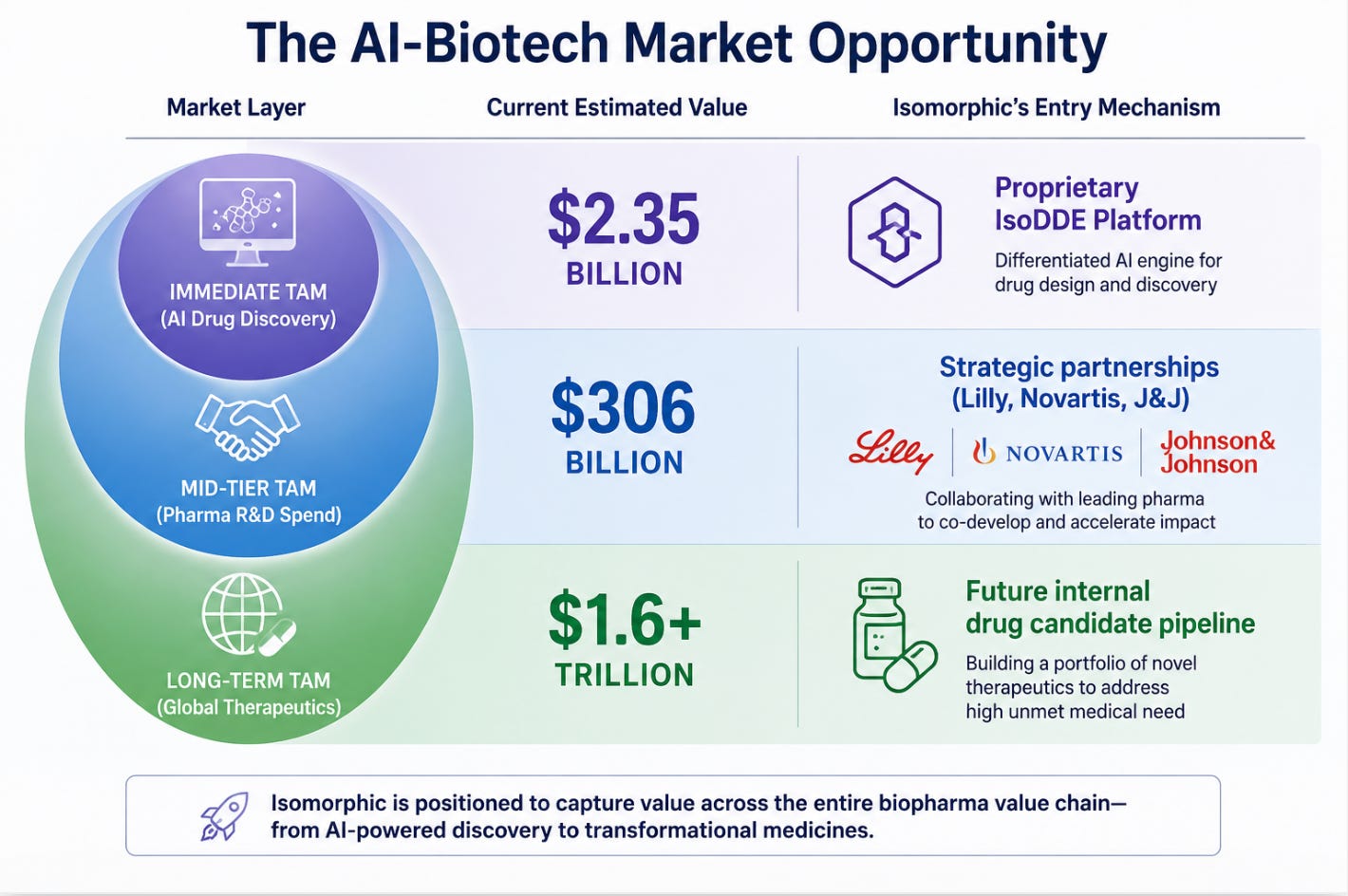
Isomorphic Labs immediate TAM is in the AI drug discovery market, valued at $2.35 billion by Grand View Research.22 However, it is a market that is projected to grow quickly, to $13.77 billion in 2033, a 24.8% CAGR. Isomorphic Labs, through its proprietary IsoDDE (Isomorphic Labs Drug Design Engine) is positioned as one of the key players in this field going forward. With the massive deals mentioned previously, they are no longer a fully speculative play.
But there is a larger potential TAM that Isomorphic Labs could transition into. Namely, Pharma R&D. Currently, there are over 23,000 drugs in development being developed by over 7000 companies.23 Global pharmaceutical spend on R&D reached $306 billion in 2024.24 In 2025, Johnson & Johnson alone spent $14.7 billion on R&D.25
Roughly one third of this spend is on the pre-clinical discovery phase. And AI has already proven to help speed up this process.26
“AI has demonstrably improved preclinical success rates. It has not yet cracked late-stage efficacy.”
With their deals with Novartis and Lilly, Isomorphic Labs has already managed to break into this market. Notably, while there is an upfront payment included, the vast majority of the total $3 billion deal is tied to milestone achievements, potentially showing uncertainty among big pharma and confidence among the Isomorphic Labs teams.
And this is an area that desperately needs something new to make it more efficient. Despite massive progression in technology and the tools available, today, fewer drugs are being approved per dollar than in the 1960’s, even adjusted for inflation. This is often called Eroom’s law in the pharmaceutical world.
The number of new drugs approved per billion dollars of R&D spending has halved approximately every nine years since 1950…. This dynamic is why AI is not optional. When a single Phase 3 failure can erase $500 million in sunk cost, any tool that improves early-stage prediction of clinical failure has compounding value.
This means that pharmaceutical companies will be looking closely at AI to see if it can speed up the process or increase efficiency in any way. And Isomorphic Labs leads this field.
The last possible TAM that isomorphic could target is the largest of all, the entire global therapeutics market valued at over $1.6 trillion in 2025.27 If Isomorphic Labs could hypothetically develop, market and sell their own drugs, (with possible partnerships with big Pharma), they could address a much larger market. While this is the largest potential market, it is also the furthest away. That being said, Isomorphic Labs bull case does not rely only on this market, rather any of the potential three TAM cases working out.
In the meantime, Isomorphic Labs is not the only company in the AI/Biotech world. Insilico Medicine is already public with a $22 billion market cap, with a goal to “extend healthy, productive longevity for everyone by using generative AI to transform drug discovery and development”.28 They aren’t alone, Schrödinger, Recursion Pharmaceuticals, and Exscientia are all using AI to try and advance pharmaceutical research.
What Isomorphic Labs has that differentiates itself from competition is a unique ability to use AlphaFold. When DeepMind released AlphaFold to the public, they also enacted strict non-commercial terms. As a sister company to DeepMind, Isomorphic Labs is the only AI Biotech company that can use AlphaFold’s technology to commercially. Competitors are trying to reverse engineer alternatives as quickly as possible, but AlphaFold truly is revolutionary.
That doesn't guarantee success above all competition. While a lot of the numbers mentioned in this section seem super promising, again it is important to remember that none of these numbers matter if Isomorphic Labs is unable to produce successful clinical drugs. In the meantime, their competitors are rushing ahead. Insilico Medicine has already dosed dozens of volunteer patients.29
Ethical Questions:
Surely with a company developing drugs to cure people there are no ethical questions… right? Not exactly.
With any new technology, ethical questions are bound to arise. With Isomorphic Labs it is no different. While the general goal of the company is extremely noble - solve all disease - that doesn’t inherently mean that every company in the field is noble.
“Even if all the actors are good in that environment, let alone if you have some bad actors, that can drag everyone to rush too quickly, to cut corners.” - Demis Hassabis
If biotechnological advancement come into the hands of the wrong actors, it could cause immense destruction. With generative AI, someone could hypothetically design toxins that commercial screening would not notice. Unfortunately, this is no longer a hypothetical as in October of 2025, the “Paraphrase Project” confirmed that screening is only 97% accurate.30 With something as potentially harmful as biochemical toxins, having a generative AI that could create toxins or even biochemical weapons, is leading us towards a dangerous and scary world. And the risk is real, even if 99% of the world is moral, even a few bad actors could cause immense and irreversible damage.
Future Revenue and Valuation:
After their most recent $2.1 billion funding round, estimates for the valuation of Isomorphic Labs ranges between $10-12 billion to $15-20 billion.3132 In either case, they have passed the $10 billion threshold and are no longer a small cap company. Perhaps more importantly, they are by far the largest AI-biotech company. If this is an industry that will prove to be successful and grow long term, Isomorphic Labs will be primed to grow rapidly as investment pours in.
If Isomorphic Labs is able to scale and pass the human trials stage, they will have a few main streams of revenue.
Usually, with pharmaceutical research companies, the primary cash influx comes in the form of selling the drug or treatment they built to big pharma. The company then gives pharmaceutical companies the bulk of the profits, while they generate a small royalty commission on each sale. This gives them a one time influx of capital which research companies rely on after a capital draining trial process and a long term stream of income. However, because Isomorphic Labs is backed by the massive war chest that is Google, they don’t necessarily need the massive immediate payment. They could therefore hypothetically only sell part of their ownership for strategic reasons and maintain a larger percent of the ownership.
The benefit with partnering with big pharma goes beyond just the one time payment and royalty fees. By partnering, Isomorphic Labs use the massive resources available to big pharma companies in order to push their products out to market. This allows Isomorphic Labs to focus on production rather than distribution.
Another way of generating revenue would be researching, developing and producing their own drug. As mentioned previously in the TAM section, this is the hardest but highest-reward play. By doing this, they transition from a AI biotech research company to a full fledged competitor to big pharma.
The IPO date.
Often, biotech companies will go public due to the immense costs associated with developing drugs. However because of Isomorphic Labs unique position with backing from both Google as well as multiple sovereign funds, they don’t need to go public anything soon. Therefore, for those interested in investing in them privately, this will be a very long term hold where your capital will likely be illiquid.
This doesn't imply that Isomorphic Labs is a bad bet. A few years ago, someone investing in Anthropic was investing in an AI company burning through cash in an unproven field. Today, that same investment is likely worth magnitudes more than it originally was. That doesn’t mean that investing into every AI “startup” is advised, investing should always be treated with caution, especially in the private market where fees are usually higher and illiquidity is often the case.
For retail investors without the ability to invest in private companies, the best way to invest into them likely remains investing in their parent company, Alphabet. While Google is so massive that Isomorphic Labs is only a tiny sliver of the companies overall valuation (probably around 0.1%), this is the only direct way to invest in them. If Isomorphic Labs does turn into a trillion dollar company, the value of Google’s stake in them will grow exponentially.
“Isomorphic is not a buyout target, it is the engine everyone else wants to rent. Lilly, Novartis, and Johnson & Johnson are all paying upfront plus billions in milestones just for access to the platform. With Alphabet holding the majority stake and roughly 2.6 billion dollars raised across two Thrive-led rounds, this looks far more like a future landmark IPO than an acquisition. The catalyst to circle is the first human trial, expected in late 2026. The day an AI-designed molecule gets dosed in a person, the whole category re-rates.” The M&A Hunter
Final Thoughts:
Google clearly has a huge conviction in Isomorphic Labs, which is why they have invested hundreds of millions or more in the company. Through partnerships with some of the biggest pharmaceutical companies, Isomorphic Labs could potentially rerate and the valuation could shoot up, proving another successful spin off by Google.
Isomorphic Labs has a lot of confidence in the statements that they have made. But the idea of “solving all disease” is currently still decades away,
However, there is another possibility, that the AI biotech space is now disconnected from the actual reality. That a company with zero dosed patients shouldn’t have billions of funding poured into it because of a hope. If so, we are likely watching capital dump into a company destined to fail. Modeling protein structures is one thing, solving all disease is another.
I don’t have a position in Isomorphic Labs, but for the sake of humanity I hope the company succeeds. Demis Hassabis released AlphaFold to the rest of the world instead of keeping the technology proprietary because that was what would do the most good for society. If Isomorphic Labs really can even partially succeed in their main goals, the world will become a better place, and for that reason, I hope they do.
“One day I hope we will be able to reduce drug discovery down from taking like ten years on average to go from understanding a target to having a drug in the clinic to maybe a matter of months or even weeks.” Demis Hassabis.
https://www.isomorphiclabs.com
https://deepmind.google
https://medicine.iu.edu/blogs/research-updates/the-protein-folding-problem-the-day-ai-unlocked-a-secret-of-life
https://pmc.ncbi.nlm.nih.gov/articles/PMC9293739/
https://pmc.ncbi.nlm.nih.gov/articles/PMC5837046/
https://www.yahoo.com/news/articles/scientists-may-closer-ever-reversing-230700013.html
https://www.frontiersin.org/journals/bioinformatics/articles/10.3389/fbinf.2023.1120370/full
https://www.nature.com/articles/s41586-021-03819-2
https://pmc.ncbi.nlm.nih.gov/articles/PMC5980623/
The Nobel Prize was also split with David Baker “for computational protein design”, for those interested in reading more: https://www.nobelprize.org/prizes/chemistry/2024/summary/
While AlphaFold2 had commercial restrictions initially, it was eventually released to the public. Currently AlphaFold3 is not for external commercial use, part of the bull case for Isomorphic Labs.
https://finance.yahoo.com/news/google-backed-ai-drug-discovery-195423147.html
https://www.isomorphiclabs.com/partnerships
https://www.fiercebiotech.com/biotech/alphabets-isomorphic-stacks-two-new-deals-lilly-novartis-worth-nearly-3b-ahead-buzzy-jpm
https://firstwordpharma.com/story/7072716
https://firsttechwc.co.za/ai-designed-drugs-by-a-deepmind-spinoff-are-headed-to-human-trials/
https://www.reuters.com/business/healthcare-pharmaceuticals/google-backed-ai-drug-discovery-startup-isomorphic-labs-delays-clinical-trial-2026-01-20/
https://www.businessinsider.com/josh-kushner-thrive-capital-and-instagram-2012-4
https://www.gunder.com/en/news-insights/client-news/thrive-capital-invests-in-stripes-6-5b-series-i-financing
https://finance.yahoo.com/news/thrive-raises-10b-lps-anticipate-184635996.html
https://sacra.com/c/waymo/
https://www.grandviewresearch.com/industry-analysis/artificial-intelligence-drug-discovery-market
https://www.statista.com/topics/6755/pharmaceutical-research-and-development-randd/#topicOverview
I looked for an agreed upon number for 2025 and couldn’t find. I used instead the 2024 amount of $306 billion, 2025 spending was probably closer to $330 billion if I had to estimate. Source for 2024 R&D spend below.
https://www.healthcare150.com/p/trends-and-finance-of-r-d-in-pharmaceutical-industry
https://www.qualtrim.com/app/insights/JNJ?quarterOrAnnual=annual
A fantastic in depth article about how AI will inevitably break into the biotech world and how that will look. Highly recommend this article specifically. https://www.drugpatentwatch.com/blog/how-ai-is-already-changing-drug-development/
https://pmc.ncbi.nlm.nih.gov/articles/PMC8119231/
https://insilico.com
https://insilico.com/phase1
https://biosecurityhandbook.com/ai-biosecurity/ai-pathogen-design.html
https://intuitionlabs.ai/pdfs/isomorphic-labs-2-1b-series-b-ai-drug-design-analysis.pdf
Excellent post; the research here is top quality. Having worked directly with life science and pharmaceutical companies, I agree that this represents a massive market opportunity. Isomorphic Labs seems built to succeed and capitalize on a highly lucrative demand. That said, I am reserving final judgment until clinical testing begins. Until then, the thesis remains largely hypothetical. Still, this is an area where AI holds immense promise, and it could be genuinely life changing if human trials go well.