
The Breakdown: Polymarket
Inside Polymarket: The ethics and valuation behind the largest prediction market in the world.


Editor’s Note: This piece was co-written by The Private Ledger and Learning.Investing.Thriving. While Joseph focuses on deep dives into private company fundamentals, Marc draws on his long history as a hedge fund veteran to teach the next generation of investors. If you enjoy this breakdown, please consider subscribing to both publications to support our work. Enjoy the piece!
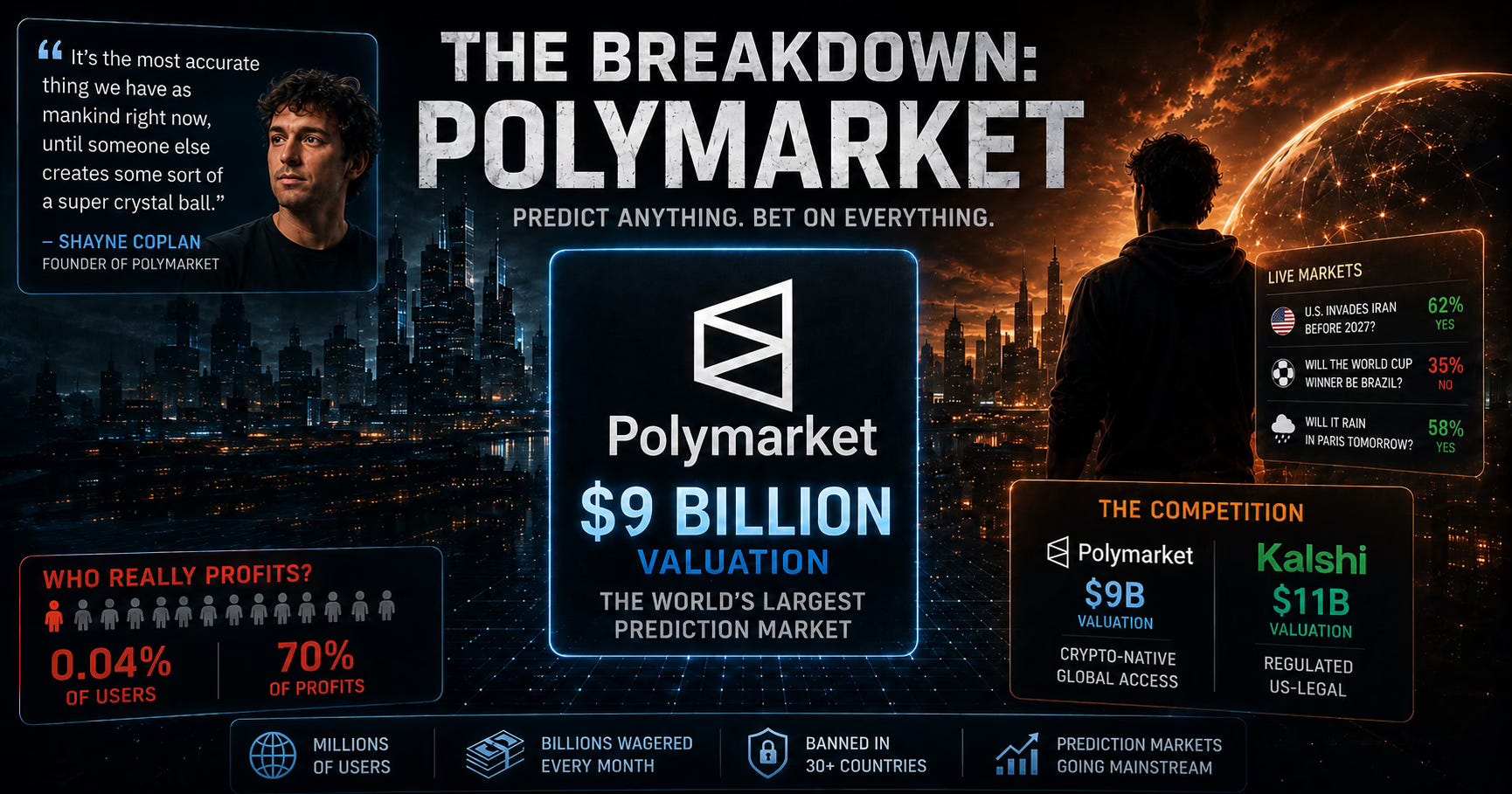
Polymarket is a website in which 70% of profits go to the top 0.04% of users. And yet, it continues growing rapidly. Even an FBI raid on Polymarket’s founder, couldn't slow down the growing momentum.
The ability to put your money on any bet, and a new way to wager money on everyday life is becoming more and more popular. Despite resistance from governments around the world, a former niche for crypto bros has become mainstream. This is the story of Polymarket.
It is almost impossible to watch a YouTube video today without some sort of sponsored advertisement from Polymarket, Kalshi or another betting platform. “Prediction markets,” as they are called, have become mainstream, even partnering with major sports leagues, including the MLB, NHL, Serie A and La Liga. 12
The fundamental question with prediction markets is whether they provide actual value or whether they are simply a tax on the ignorant, or worse.
Polymarket is leading the charge as the largest prediction market in the world. They have experienced explosive growth, jumping from only a $350 million valuation in 2024 to a targeted $15 billion in 20263.
By way of a roadmap, this piece will begin by explaining what is a prediction market, go through the history behind Polymarket and explain what they do right. We will then focus the bulk of the piece on the ethical questions and debate whether they produce significant value. From there, we will examine their TAM and the competition they face, and from there present a valuation framework. I purposely will focus the majority of the piece on the ethical questions as I think they are by far the most important part of this article.
As with all of my pieces, this piece will be relatively lengthy and go in-depth on the business. If you only have time to read one section, please read the section on ethics. It is by far the most important in my opinion.
This article isn’t impartial and I want to make that clear from the beginning. Polymarket is in my opinion a damaging product that provides minimal value in exchange for the damage it causes. That being said, I will uphold professional standards and look at their valuation as objectively as possible. I reached out to Polymarket for comment, but did not get a response.
The Birth of Polymarket:
Polymarket wasn’t the first prediction market. In fact as early as the late 1800s people were betting on presidential elections. At its peak around the turn of the 20th century, so much money was being wagered on political elections that some historians estimate that it rivaled the amount of money in the stock market4. However, largely due to regulations put in place and sports betting moved to traditional sportsbooks, prediction markets were rolled back over the next few decades.
In the 1980s and 1990s, prediction markets began experiencing signs of revival. Researchers began to take interest in the potential value that prediction markets offer and the University of Iowa offered a prediction market on the presidential election of 1988. This is the oldest market that is still running today, notably with a $500 cap.
Polymarket was founded in 2020 by Shayne Coplan, with the desire of finding a better way to aggregate knowledge than pollsters and pundits who had their own biases.
The 2016 presidential election was heavy in people’s mind where pundits and pollsters predicted sweeping Clinton victories incorrectly. And so, the 2020 election was the breakout moment for Polymarket. Millions of dollars were wagered on the election. On the eve of the election, Biden was slightly ahead, polling at roughly 60% chances of winning. In 2024, four years later, pundits were calling the Trump-Harris election “too close to call”. Meanwhile, Trump was polling on Polymarket at a 59% chance on election eve.
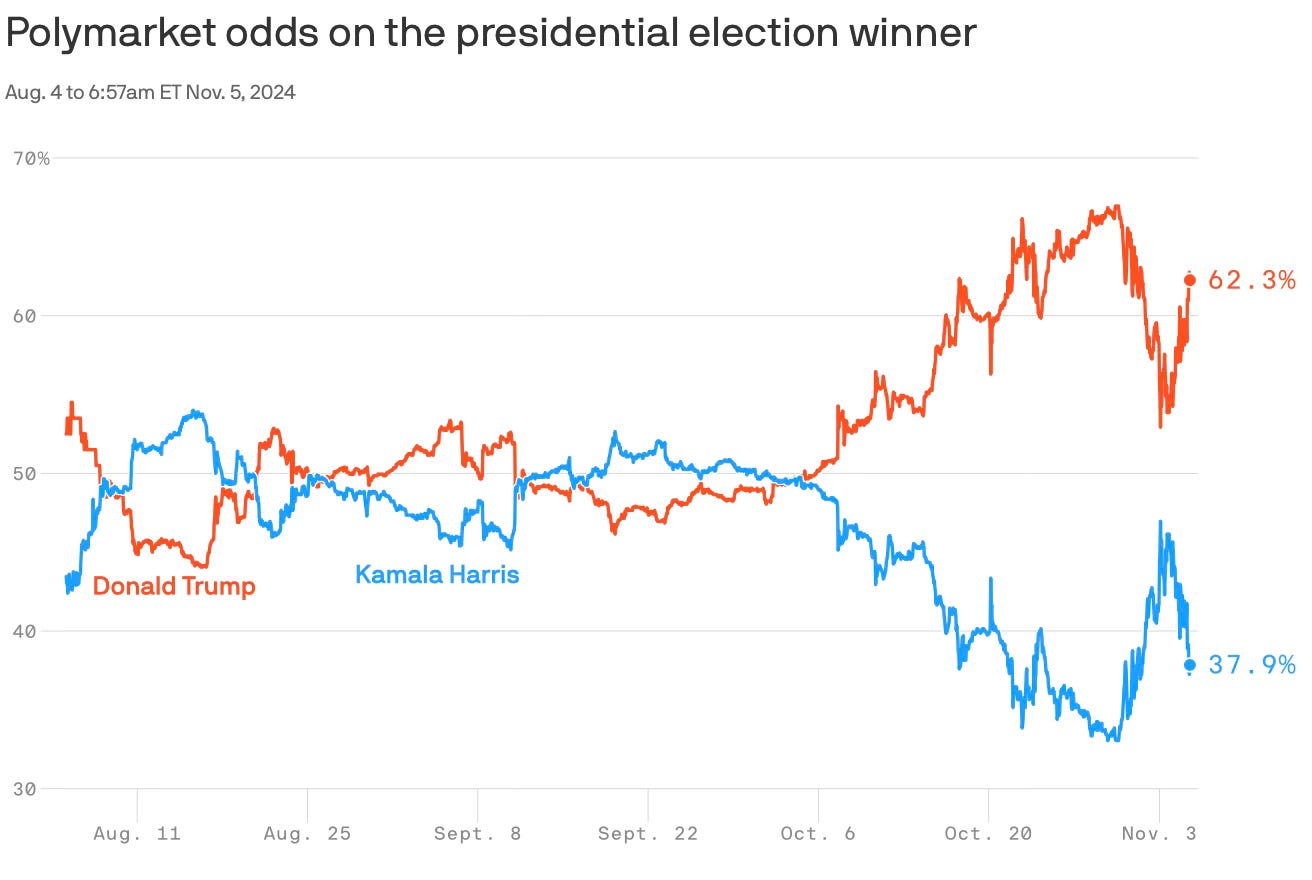
The 2024 election was a turning point for Polymarket. It stopped being a niche crypto website and began being a mainstream product. Over $3.6 billion were wagered on one event. Monthly active traders rocketed up from tens of thousands to 450,000.5 People felt that prediction markets were one of the only true forms of journalism left. Pollsters and pundits could make whatever statements they wanted and risk nothing, meanwhile on prediction markets, people were correctly predicting outcomes using their hard earned money.
And then, a week after the election, Shayne Coplan, the 26-year-old founder was woken up at 6:00am by the FBI over allegations over insider trading. This raid ended up backfiring on those hoping Polymarket would be shut down. Instead, millions who felt that the raid was driven by a partisian nature rallied in defense of Polymarket. Under the Trump administration, federal prosecutors shut down investigations that had been launched during the Biden administration. One election cycle. From battering ram to billionaire.

Today, Polymarket has millions of dollars bet daily and is the largest prediction market in the world. Despite the controversy surrounding it and Polymarket being banned in dozens of countries, Polymarket and general prediction markets continue to spread rapidly.
What does Polymarket do?
Polymarket doesn’t produce a physical product. Instead, they offer their users an ability to trade (or make predictions) on different markets. Users can bet on anything from sports to politics, from the weather to whether a pandemic will break out. If you are wondering about any topics, Polymarket usually has a prediction market for it.
Polymarket’s system allows users to bet on different markets against other users. The user buys a share in the outcome and has the ability to sell at any time or hold until that outcome is resolved. The payout is dependent on how much you wager and the odds at which you bought. As users constantly buy and sell, the odds change daily with every piece of news that comes out.
As an example, a user may believe that the Democrats will win the midterm elections. The user can then go to that market, and place a bet on it. As new information comes out and the odds go up or down, the user is able to sell at a profit or a loss at any point.
Polymarket advertises themselves as the ultimate prediction market. Where you can find actual data on real time events that matter. Critics of the website respond by saying that they are a glorified gambling platform that preys on the ignorant and lets insiders make millions.
It's the most accurate thing we have as mankind right now, until someone else creates some sort of a super crystal ball." - Shayne Coplan, Polymarket Founder
What Polymarket Gets Right:
Before entering into the ethical questions, it is important to state that Polymarket does have unique advantages and insights that separate itself from traditional journalism. There is a reason why usage on the site has grown rapidly and the most trustworthy news source nowadays seems to be prediction markets. Polymarket is better at forecasting certain things than traditional polls.
In 2024, most pundits called the election “too close to call”.6 And this wasn’t due to lack of polls . In fact, only 24 hours before the election, quotes like this were posted:
We’ve had months of campaigning and hundreds of polls. Yet, there are still few conclusive takeaways other than the dissatisfying catchphrase of election analysts the world over this year: “it’s too close to call”.
And yet, on Polymarket Trump had a clear lead. Trump passed Harris in early October and never looked back. The accuracy data is meaningful on high-liquidity markets. The Keyrock and Dune Analytics joint report from data scientist Alex McCullough puts accuracy around 90% one month out and 94% in the final four hours on well-traded markets.7 That doesn’t mean they are perfect, in the example of the Trump-Harris election. In the three months leading up to the election, there were at least 11 distinct crossover events.
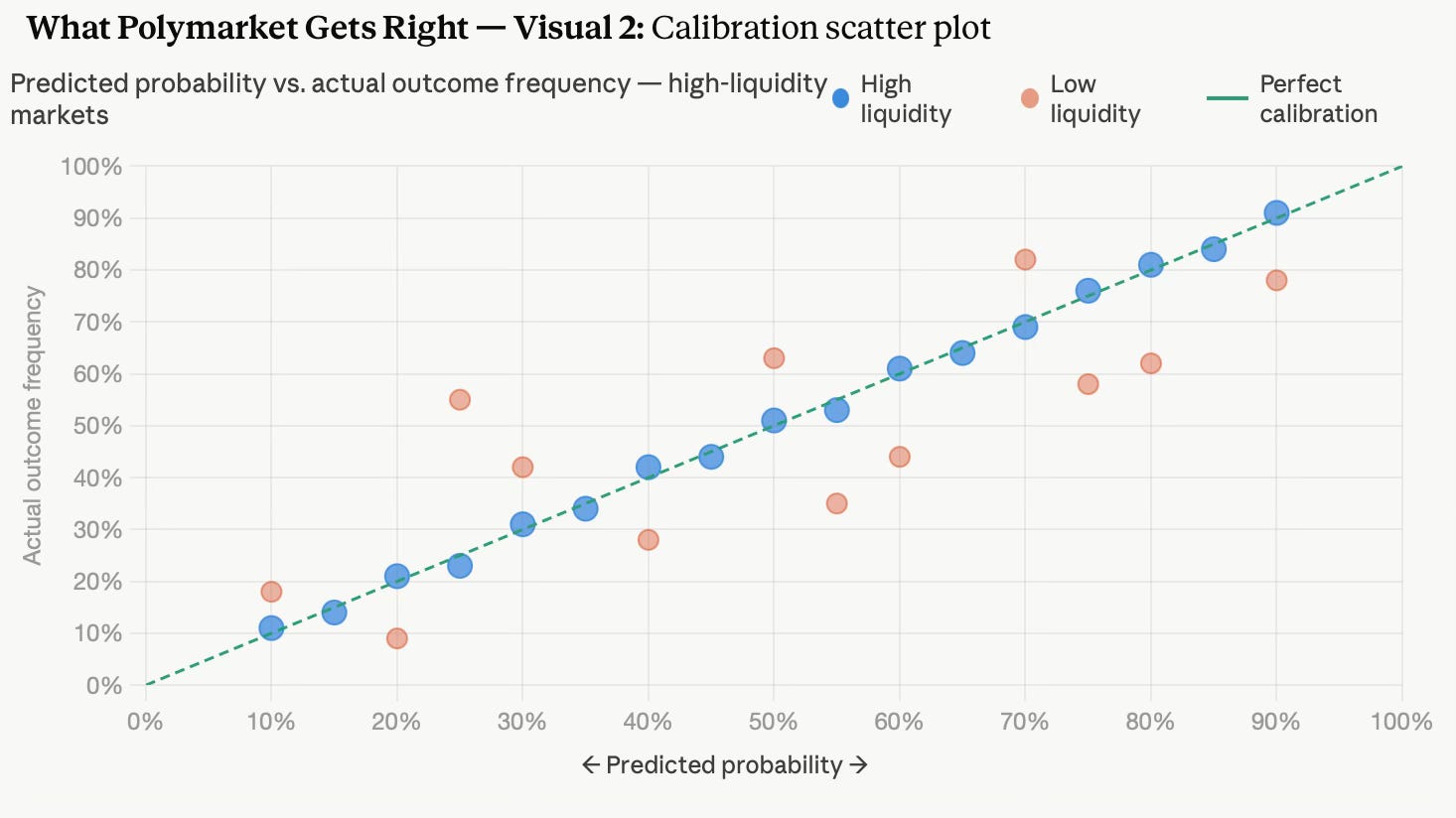
That being said, Polymarket is a useful tool that can be used as a supplement to traditional forecasting. In 2021, Polymarket polls were insistent that inflation was a long term issue rather than “transitory” as the fed chair Jerome Powell kept telling the public.8 A few months later, Powell famously retired the word “transitory”.9 Polymarket was forecasting that for months.
Bloomberg terminal’s integration of Polymarket lends the website institutional validation. When Bloomberg puts something on the terminal it has officially crossed from novelty to data layer.
One potential downside when it comes to Polymarket’s data is that the site isn’t a perfectly even distribution of the population. For example, 65% of users are between 18-35. In addition, over 70% of users hold a degree that is a bachelors or higher.10 Finally, between 73-78% of users are male.11 When a certain subset of the population makes up the majority of users, markets will inevitably be swung by their opinions.
But the benefits that Polymarket offers don’t protect those who are hurt in the process.
Ethical Questions:
As mentioned in the introduction, this section is by far the most valuable. Before evaluating and certainly before investing in any company, it is imperative to look at the ethical aspect of a business. After all, when investing in a company, you are becoming a part owner of the business.
Some companies have ethical question marks that investors should address before investing. The best example, in my opinion, being Meta. They provide a number of extremely valuable services, most notably allowing billions to connect globally for free. At the same time, their products, specifically Instagram and Facebook, have been proven to raise depression and anxiety rates, especially among teens.12
Meta accidentally created a mental health crisis while trying to connect users across the world. Polymarket’s damaging nature isn’t a byproduct of its design; it is the financial goal of their product.
In the case of Polymarket, I believe that it is a vastly more damaging product per user with an upside that is significantly more limited.
Polymarket often markets themselves as the ultimate place to know what is in store for the future. But does it actually work? Is the wisdom of the masses truly the most insightful tool we have today?
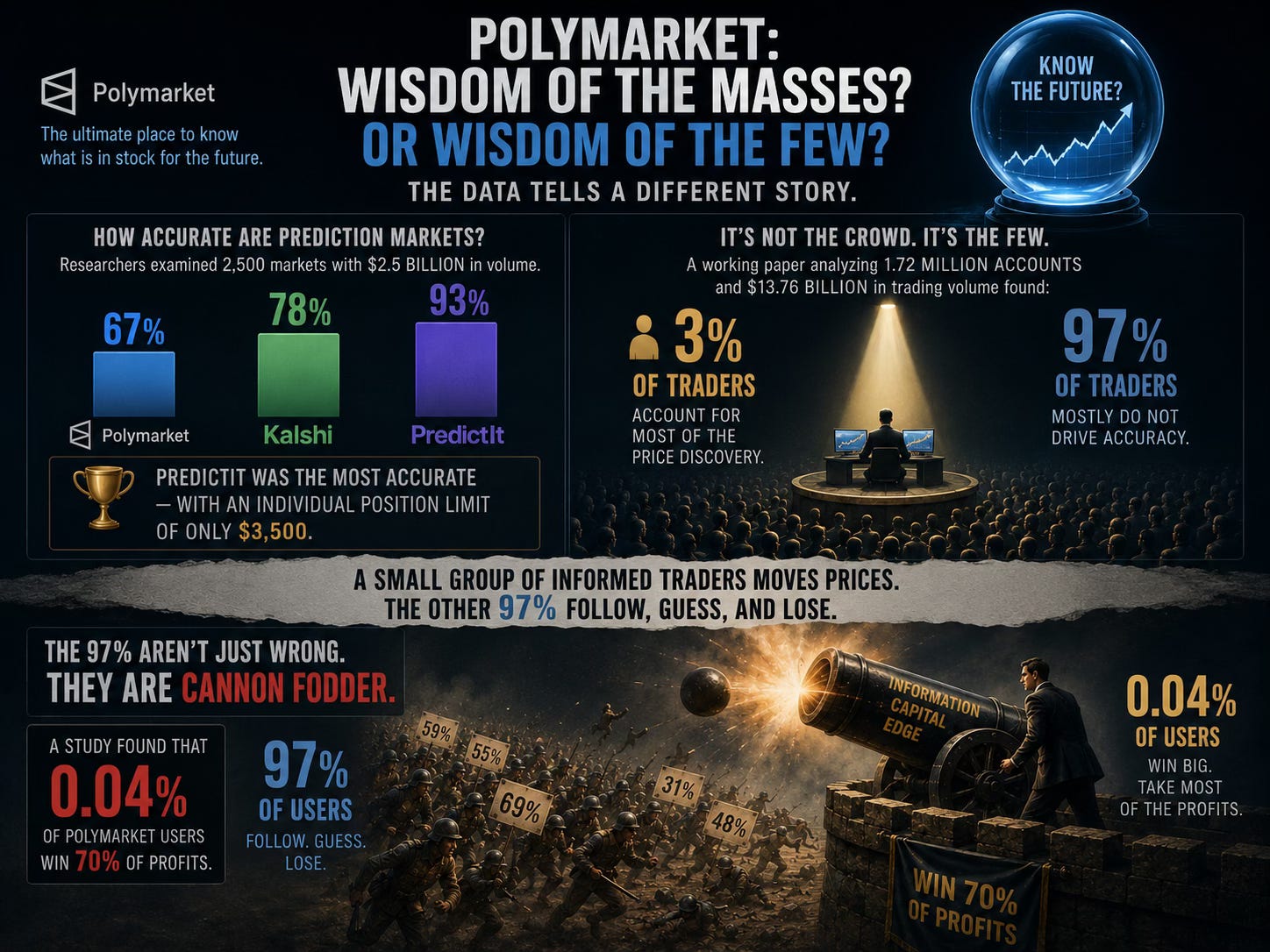
Researchers who examined 2,500 markets with $2.5 billion in volume found that Polymarket got only 67% of markets right, while Kalshi got 78% and PredictIt did 93%. Interestingly enough, PredictIt has an individual position limit of $3,50013.
It should be noted that a limit actually seems to make the platform more accurate rather than less. A cap naturally enforces diversity, as a few viewers with deep pockets can’t sway the market by themselves.
Next, a recent finding showed an incredibly compelling piece of evidence. A working paper analyzing 1.72 million accounts and $13.76 billion in trading volume found that just 3% of traders account for most of the price discovery.14 It is not the wisdom of the crowd driving accuracy, rather a small group of informed traders moving prices toward the correct outcome while the other 97% mostly do not.15
And these 97% who aren’t driving accuracy are not just moving the needle. They are cannon fodder in every sense of the word. A study found that 0.04% of Polymarket users win 70% of profits.16
The overwhelming amount of young males on the platform leads to an inevitably bias. And those market discrepancies aren’t being left outstanding, they are being found and taken advantage of by professional traders who reap the profits.
Let me say this in the bluntest way possible. Polymarket is not an aggregate of collective human wisdom. It is a wealth transfer from hard working men and women who are essentially donating their money to insiders and quant traders who prey on their misconceptions and desperate situations.
And the ethical questions don’t end there. Polymarket has seen a huge amount of insider trading happening. Examples range from rigged sports betting to insiders betting on the U.S. invading Iran.
One famous example of this, was the 38 year old special forces operative who bet thousands of dollars on the capturing of Nicolas Maduro.17 This operative, who bet a total of $33,034 in order to win $409,881 put his life, as well as the lives of his entire team at stake when he placed a bet days before the raid took place.
And that’s not the only place that potential top secret U.S. war plans were potentially given away. Six brand new accounts wagered bets with a potential payout of $1.2 million on bets that the U.S. would attack Iran days before the actual attacks took place.18 When the bombs landed, the users walked away with huge returns.
In both of these cases, not only did people with clear insider information give away state secrets, they also risked the lives of their crew members and they profited off innocent people who did not have access to the same insider information.
Next comes the question of do these “prediction markets” actually provide value or are they just gambling platforms? While Polymarket often likes to market themselves as a platform that provides value, what value is provided in betting on whether or not Rihanna will have a boy or a girl, a market which had $87,348 wagered on it.
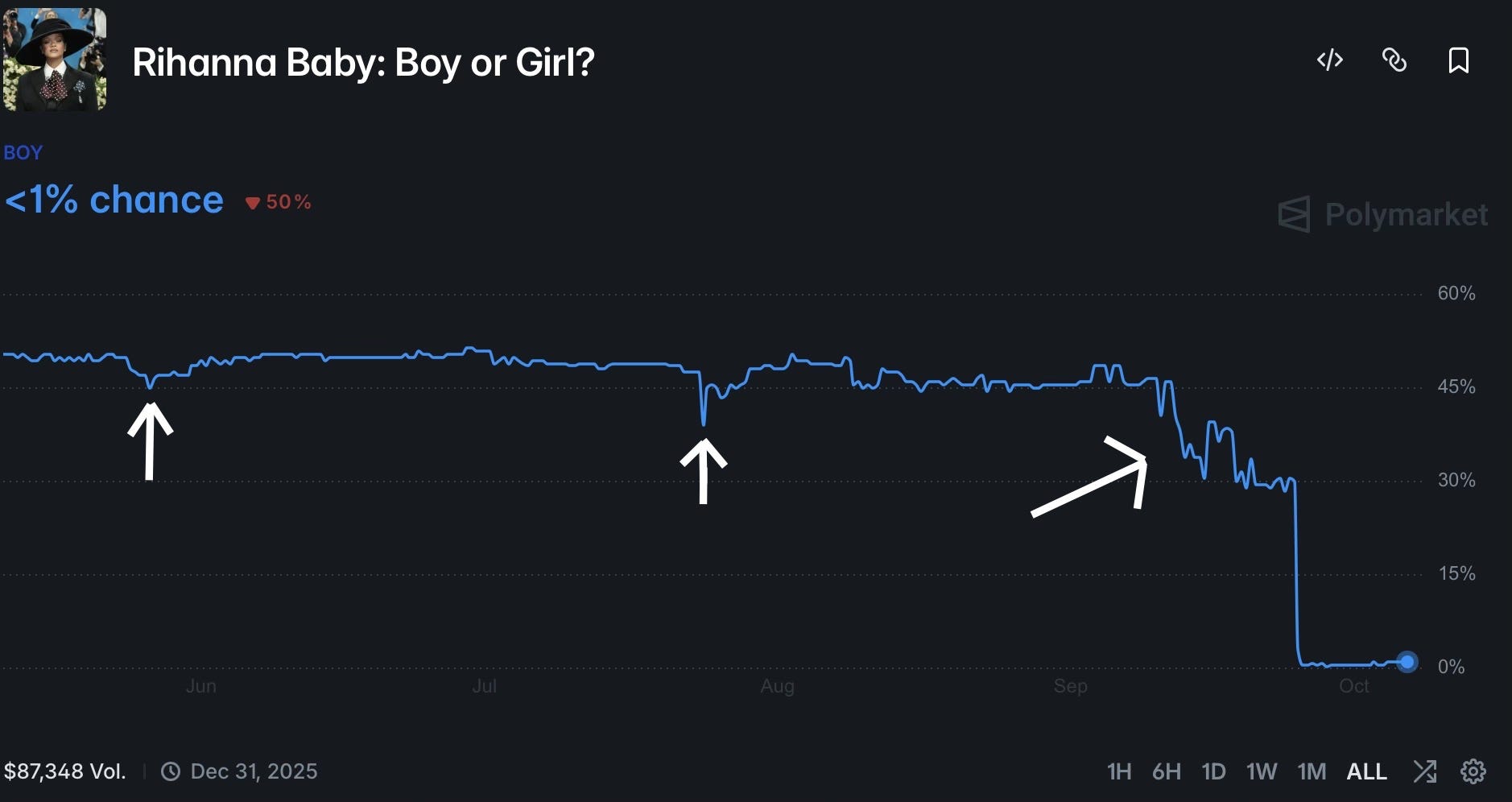
In fact, if we take this market as an example of potential insider trading, note how there are two clear potential instances of insider trading. Looking from the left side, the first two arrows have clear drops indicating people betting on girls. Within a few hours or days, after no official announcement, the market moved back to around 50/50 odds. Why would someone feel that betting on Rihanna’s kid being a girl at 61% odds is a smart bet? The only logical answer to me is that perhaps they had an inside source.
This is one reason why insider trading is virtually impossible to stop. It is impossible to even conceptually describe who is an insider. In the case of the market on Rihanna’s baby, Rihanna herself is obviously an insider, but why should she be stopped from betting on her own market? And if Rihanna tells her friends that she is having a girl, do those friends also turn into insiders? What if those friends tell other friends? How is Polymarket supposed to keep track of who has been told about the gender of a celebrity’s baby. The vast majority of the time, insider trading is both impossible to track and impossible to prosecute. It is perhaps for this reason, that only three individuals have ever been charged with insider trading, including only one in the US.
If we look at the potential value that Polymarket says that they offer, it is hard to understand how this is true when they offer hundreds of markets on meaningless markets. Anything from “what will the weather be in Paris” to “how many tweets will Elon Musk put out this week” is available to be bet on in Polymarket. I fail to understand how any of these are furthering us towards a better society. What I do see is enormous potential for exploitation and insider trading, something that runs rampant, even in weather markets.19
In addition, are Polymarket and Kalshi really financial tools like they want us to believe they are or just betting markets with better branding?
On Polymarket, sports betting amounts for 39% of Polymarket volume. Politics accounts for 34%, while crypto accounts for 18%. Other markets make up the remaining 9%. Given that politics spikes around elections, on a day to day basis Sports is easily more than half of all bets placed on the platform.20
Kalshi is no different: sports betting accounts for over 75% of its total volume, dominated by NFL, NBA, and college football. In mid December 2025, a study found that 91% of total volume bet that week was on sports.21 Hardly a financial tool.
The rigged nature of Polymarket and other prediction markets have caused some senators and lawmakers to actively campaign against them. Senator Chris Murphy has been a particularly vocal opponent of betting markets attempting to pass the “BETS OFF Act”. Of course, it doesn't help that the people he is trying to pass the bill with are the same ones often profiting from insider knowledge. It further doesn't help that Donald Trump Jr has invested tens of millions through his venture capital fund into Polymarket and sits on their advisory board as an “unpaid” member and a paid strategic advisor on the Kalshi team.
“All of the bets on government action, are rigged. Because someone in government knows the outcome. - Senator Chris Murphy
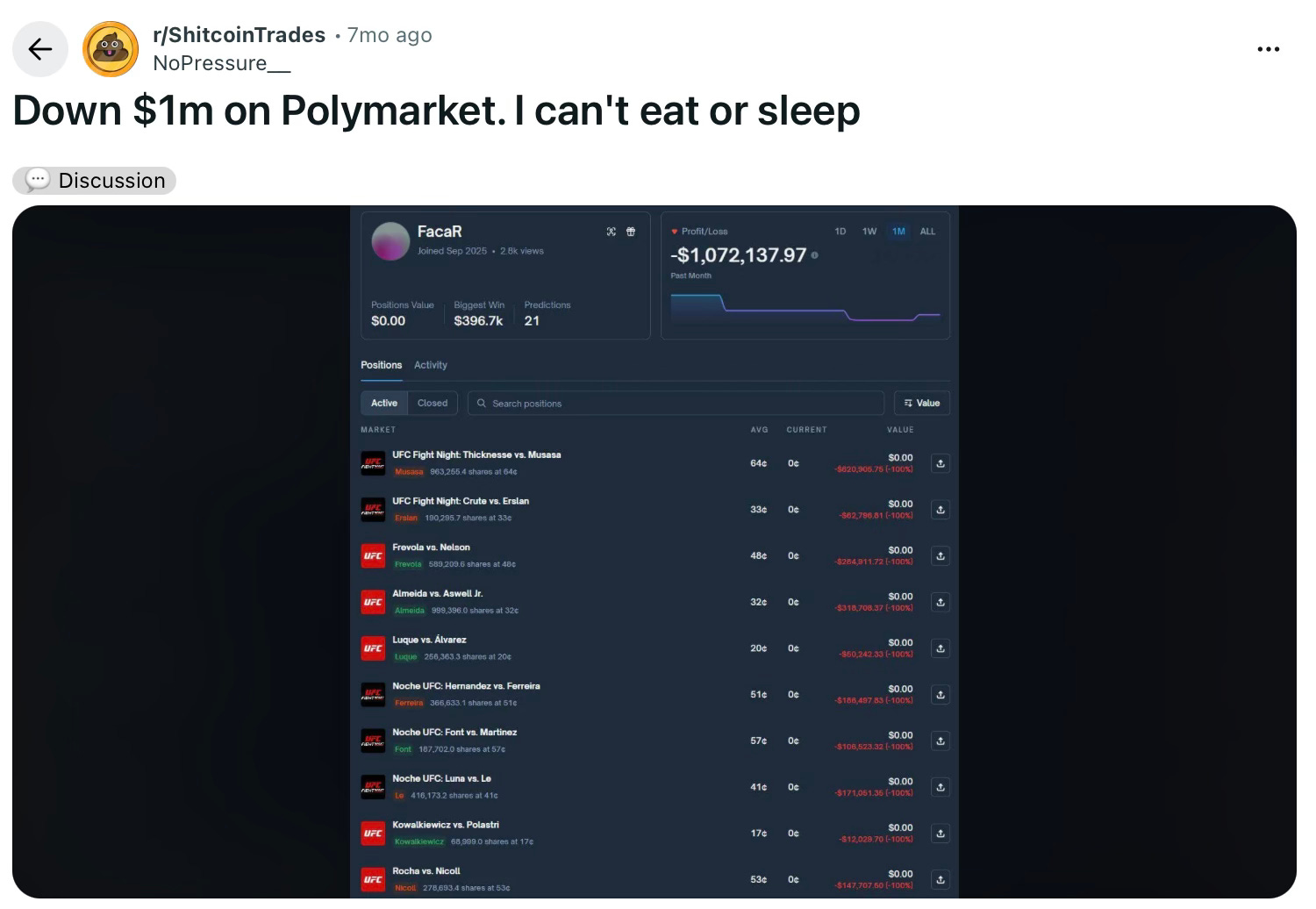
And sadly, despite the data proving that the average person will lose money on Polymarket, millions of people are losing substantial amounts of money on Polymarket. The user below posted this on reddit after losing over a million dollars on MMA fights.
Senators are not the only ones trying to fight against prediction markets. Joseph Carlson, a financial educator and YouTuber with over 500,000 subscribers and videos that generate millions of views has long been trying to stop the tsunami of prediction markets from infiltrating our society. Unfortunately, despite his best efforts, prediction markets have continued expanding and growing rapidly.
“Gambling is one of the surest, most predictable quickest ways to lose your wealth… It is a tax on the ignorant…. This is becoming a bigger problem as we have now changed the definition of gambling to incorporate prediction markets.… The underlying mechanics (between prediction markets and gambling) are the same, you are giving speculative outcomes on future predictions of which you are going to lose the majority of.” - Joseph Carlson
If the ethical questions weren’t enough for you to stay away, watch this ad made by Kalshi which highlights the desire to turn everything, including the rebirth of Jesus, into a prediction market. There are no moral guardrails anymore. Prediction markets goal is to turn everything, tragic, sacred or joyful into an opportunity to gamble.
TAM and Competition:
I went ahead and included the valuation section deliberately. Polymarket is an important company getting serious institutional backing from ICE and the New York Stock Exchange, it is generating significant press, and it is clearly going to play a meaningful role in financial markets whether I endorse it or not. Ignoring the business side would make the piece less useful, not more principled.
Polymarket’s total addressable market (TAM) is massive. In the first eleven months of 2025, $22 billion of volume was wagered on Polymarket, exceeding all of 2024 volume by 57%.22 Polymarket TAM could easily reach into the hundreds of billions of dollars of trading volume in the next few years if prediction markets become more mainstream and legalized in additional countries. A reminder for how quickly these prediction markets can become, as mentioned previously, in the early 1900s the volume bet on the election rivaled the volume in the stock market.
Despite this, in 2025, Sacra estimated that Polymarket made $0 in revenue.23 Polymarket’s goal was expanding as quickly as possible and capturing maximum market share. This made them an unusual business, worth billions with $0 in revenue. Not profit, revenue.
In 2026, they began introducing fees for certain crypto markets followed by fees in certain sports markets. Polymarket has already announced that future expansion will include other categories like weather, politics, economics and more.24
As Polymarket continues its expansion, it has aggressively partnered with both websites and different creators. Substack’s partnership with Polymarket now lets you embed Polymarket prediction’s in your article as previously shown. X has also added a similar feature naming Polymarket “its official prediction market partner.” Polymarket has also aggressively targeted content creators, with an emphasis on YouTube.

This gigantic marketing campaign has multiple different purposes.
It expands the branch of a previously niche topic. Polymarket has been most successful in the sports world, today, it is hard to find a sports fan who hasn’t heard about prediction markets.
It normalizes putting massive amounts of money on every day events. By operating as prediction platform that provides valuable information instead of gambling, creators, often with a young fan base, feel more willing to promote their product.
It makes prediction markets news sources that are considered serious. Today, those giving news will often say “Polymarket has a X percent chance of this happening.” With Polymarket becoming integrated in the news world, it is furthering its perceived legitimacy as a real news platform and not a gambling website.
As prediction markets become more mainstream, tens of billions of dollars will pour into this space. And Polymarket aren’t the only ones trying to get a piece of the pie.
Kalshi is Polymarket’s biggest competitor. Kalshi operates in a totally different way. Kalshi works from within the system, they were approved by the CFTC (think financial prediction market police) prior to their launch and never had FBI raids on their founders house25. While Polymarket is crypto native, Kalshi works with regular bank transfers and brokerage interfaces.
While Polymarket has had more all time nominal volume bet on the platform, Kalshi is currently valued higher with a valuation of $22 billion - compared to Polymarket’s $9 billion valuation. Notably, Polymarket had their funding round done in October of 2025. Kalshi did theirs in May of 2026. Polymarket is now in talks for a new funding round that would place them at a valuation close to $15 billion. These are without a doubt the 1a and 1b in the prediction market platform. Two companies. Same idea. One took the outlaw route and nearly got destroyed. The other filed the paperwork.
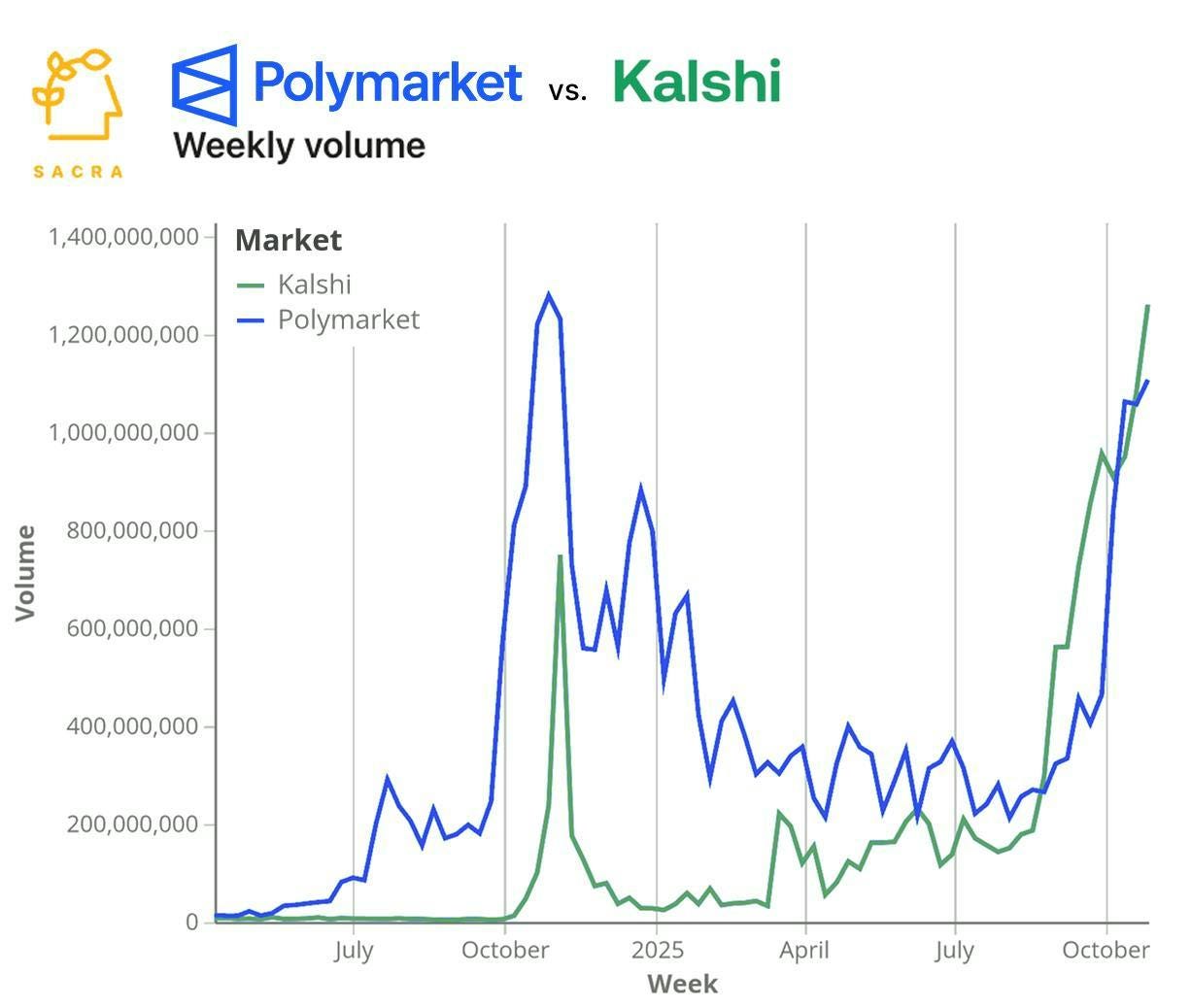
One other difference between them, is that Kalshi is more accurate. According to a study in which researchers examined 2,500 markets with $2.5 billion in volume, Polymarket got only 67% of markets right, compared to Kalshi at 78%.26
Valuation:
Assuming that no major regulation change takes place, I expect that Polymarket will continue its rapid expansion. Assuming a 35% growth rate in total volume over the next five years, a significant slow down from its current growth rate of over 60% in 2025, I believe that by 2030, Polymarket will surpass $100 billion in total amount wagered. I think this is a conservative estimate and will likely happen sooner. The World Cup and the 2028 elections will be important events to watch, likely each having tens of billions wagered.
If Polymarket continues growing at this 35% rate, by 2036, a decade from now they will have reached $500 billion in volume traded. In 2025, Polymarket made $0 in revenue, but with their 0.5-1.5% fees introduced in 2026, we can expect that number to grow, and quickly.27 In ten years, if they do reach $500 billion in volume traded, a 1% fee on each trade would amount to $5 billion in revenue.
$5 billion in revenue is similar to the sports betting platform DraftKings, who generated $4.77 billion in revenue in 2024. Draftkings generated this revenue on roughly $49 billion in handle an implied take rate of around 9.5%. That is 9x what Polymarket is projecting at 1%. FanDuel is comparable. Both DraftKings and FanDuel only reached sustained positive EBITDA in 2025 despite $4+ billion in annual revenue. The path from volume to profit takes longer than the headlines suggest.
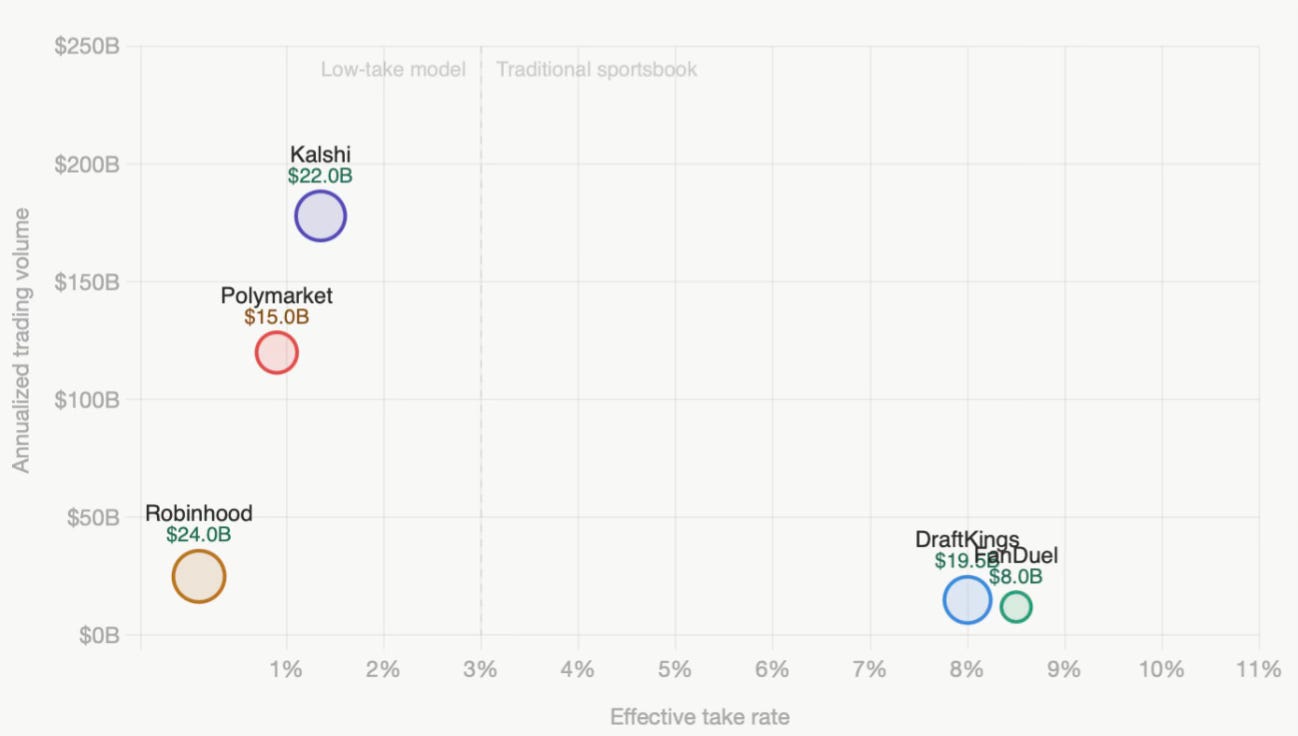
Polymarket is therefore taking a vastly different approach than a traditional sportsbook. While they have 7-10% take rates, Polymarket is targeting only 0.5-1.5%.
This is a similar path to the one Robinhood has taken. A zero-fee-to-low-fee trading platform that scaled volume before revenue. Q4 2025 revenues hit a record $1.28 billion, and revenue has consistently increased by 36% CAGR in the past five years. The model works, but the ramp takes time and capital. Robinhood has managed to scale revenue and turn the business profitable in 2024, eleven years after being founded. One key difference between the two sites, is that Robinhood promotes investing, which has a positive expected value for most people. Polymarket on the other hand, promotes gambling, which has a negative expected value. This is difference that might have a detrimental affect to Polymarket long term.
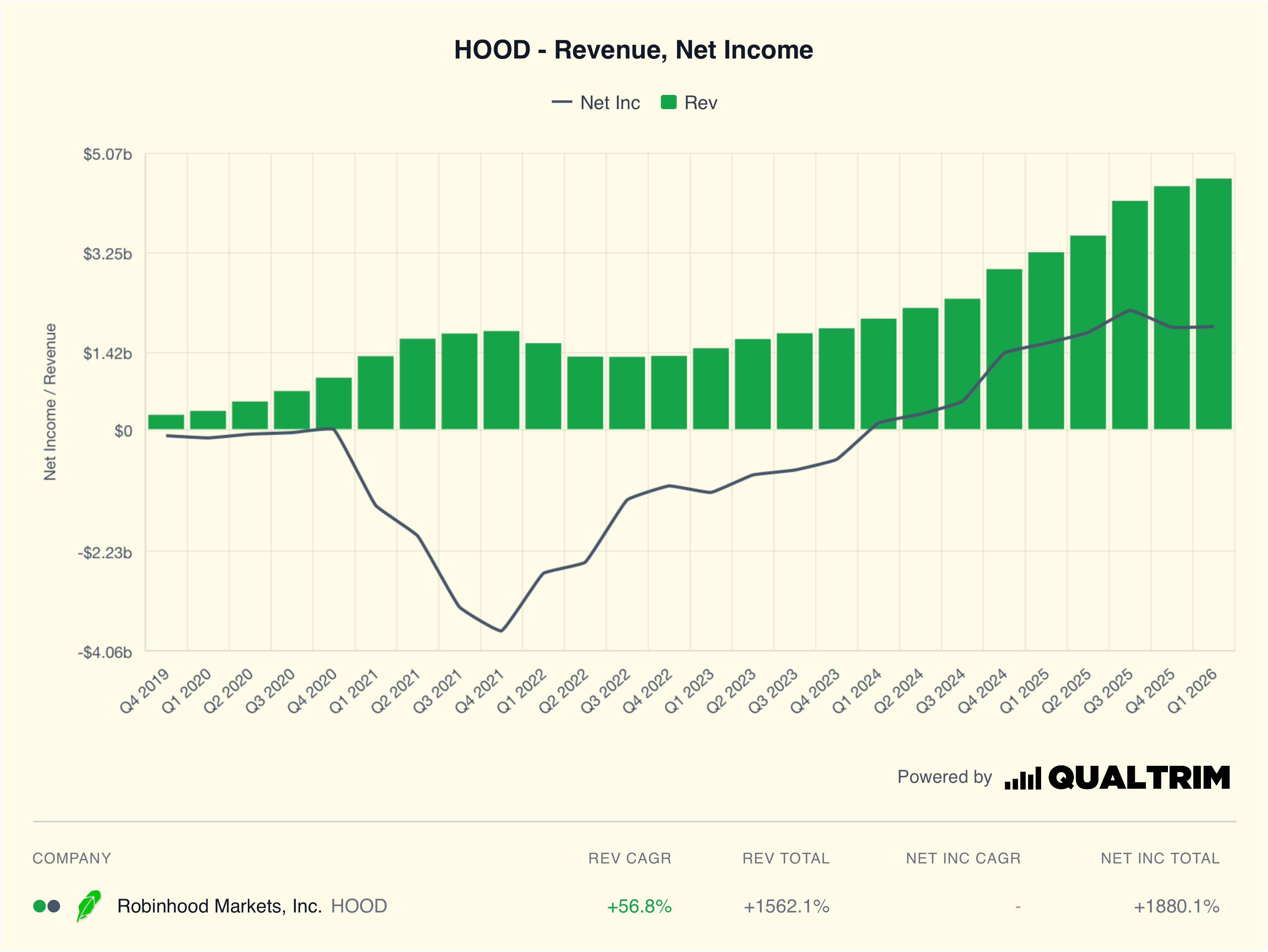
This differentiation between traditional high take rate (i.e. traditional sports book) and low take rate (the Robinhood strategy) will likely either prove to be Polymarket’s long term moat or a mistake that pushes profitability back by years. It is for investors to decide what their stance is on this matter.
There are also other forms of revenue Polymarket will likely target as their brand grows and gains public approval. Selling data to hedge fund in order for them to incorporate algorithmic trading (read hedge funds taking advantage of the masses) could also become a revenue stream. In the future, Polymarket will also likely get paid by companies and people to promote their products. For companies, having their name on a Polymarket bet will mean that thousands will search up and research their product. Another example, would be licensing their intellectual property with different news sites like Forbes or CNN.
While Polymarket reportedly generated $0 in revenue in 2025 according to Sacra, they will likely cross the tens of billions of dollars in revenue within a few years.
Under their current business model, a study from Binance Square found that Polymarket retains 47% of the revenue they currently generate from fees.28 Looking forward, we can take this as a base rate when looking at their profit generation. Some forms of revenue will likely be higher margin - such as licensing intellectual property which is free for Polymarket but to be on the conservative side we can take a 47% profit margin.
A decade from now, we could be looking at an extremely valuable fast growing company generating billions in net income whose operating margins are significantly higher than companies like Apple and Google. Polymarket is helped by the fact that they have no hardware costs, no need for colossal Capex projects and a relatively small team who is able to manage their website.
At a $9 billion valuation it is at today, Polymarket is likely undervalued. Currently, Polymarket is in talks to run a $400 million funding round which will likely push their valuation up to $15 billion. Even at $15 billion, for those interested in holding long term, this could easily turn into a company worth hundreds of billions.
Government Regulation:
Today, governments around the world are actively fighting against the spread of Polymarket. The Nevada Gaming Control Board filed a civil complaint against Polymarket in January 2026. Their position was simple: no state gaming license, no access. The case is actively ongoing with the courts recently ruling against Polymarket and Kalshi, effectively forcing them to go to court at the state level, something the prediction platforms wanted to avoid.
This leads into the big risk for Polymarket - government regulation. As mentioned at the beginning of this article, in the early 1900’s, gambling and specifically prediction markets were massive. What caused prediction markets to fade away from the public eye, was not a lack of appetite for gambling, it was rather government regulation.
Gambling will always be addictive and the main hurdle for gambling companies to overcome will always be government, not the human appetite for gambling.
Polymarket is currently banned in dozens of countries including the US, Australia, Germany, Italy and Russia.29 The global regulatory market tightened today even more, with Spain restricting access today to both Polymarket and Kalshi for operating without a gambling license.30 This follows recent bans made by Indonesia and Brazil. Of course, this doesn't mean that it is impossible for users to access the website, just that users need a VPN in order to do so.
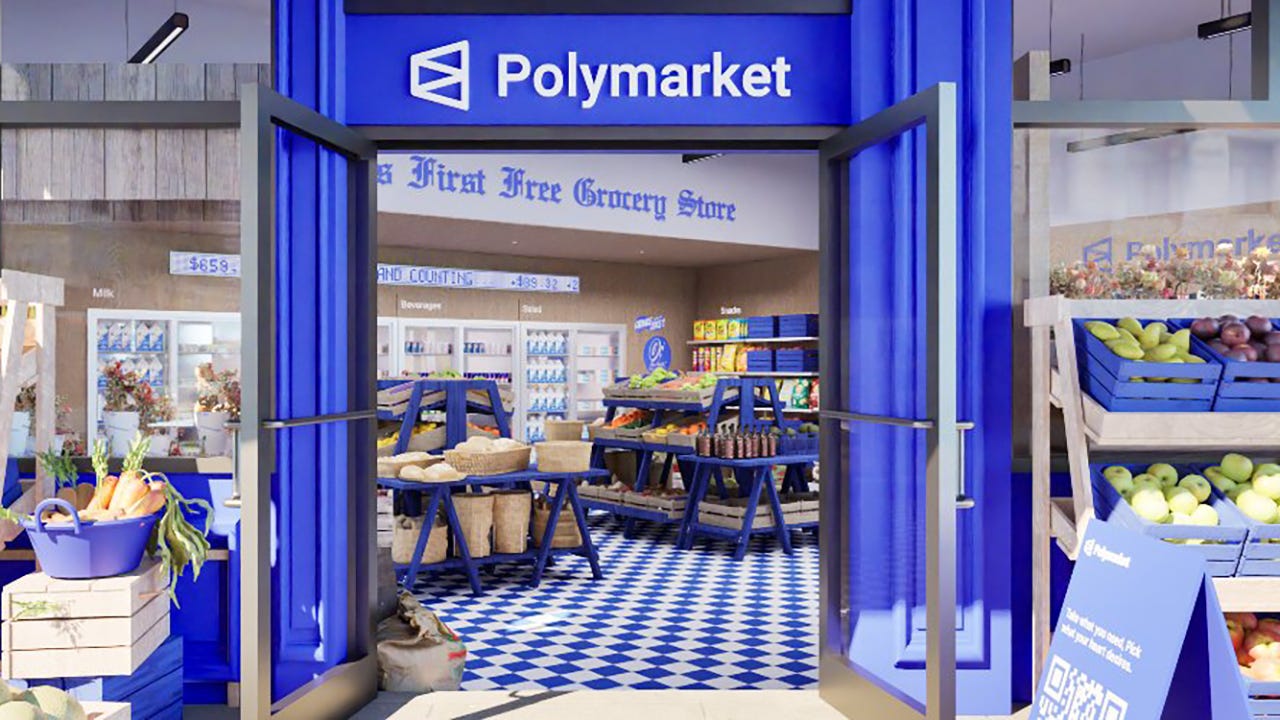
Polymarket is campaigning aggressively in both the U.S. and abroad to legalize the website. This campaigning has even included setting up a free grocery store in New York in order to improve public image.31 Polymarket has also allegedly attempted to crack down on insider trading, something that as mentioned previously will likely be virtually impossible.
In July of 2025, Polymarket completed a purchase of QCEX for $112 million, an existing CFTC-licensed derivative exchange.32 By doing this, Polymarket essentially inherited the previously existing federal licenses. Polymarket relaunched in December of 2025 with a user-compliant version with stricter guardrails. Users can no longer use anonymous crypto wallets to fund transactions and must now report their taxes.
It is unclear however, how many Polymarket users actually pay taxes, something that Polymarket itself does not help users with. A 2022 study found that only 0.53% of crypto users report taxes.33 In the US, that number is only slightly higher at 1.62%. In either case, less than two percent of users actually pay taxes on their crypto transactions. Whether Polymarket’s changes will actually lead to crypto users paying taxes remains to be seen, although it is hard to believe.
Less than 1% of crypto users globally report taxes.
Luckily, for the vast majority of users on Polymarket, taxes aren't relevant as they are losing money.
Final Thoughts:
I am aware of the contradiction in spending thousands of words arguing against a company and then valuing it. I did it anyway, because understanding how something is priced is different from endorsing what it does.
When investing or analyzing any company, before looking at the financials, I believe it is important to look at things that are more important, namely the ethics. In Polymarket, you have a product that is made to addict people and cause them to lose money. Unfortunately, not only is the product addictive, but it can also cause immense financial damages both to a person and their surrounding family or support system. Everyone knows someone who is addicted to gambling, and if you don’t think you do, you probably just don’t know.
In a few years, even if Polymarket turns into a company worth hundreds of billions, I will be happy to say that I not only stayed away but encouraged others to do the same. Ethics should come before money, and I feel in this case I am making the right call taking a stand against Polymarket.
Facar, the user highlighted previously is now at a $1.78 million loss, losing over $700,000 additional dollars since his reddit post. Facar joined in September of 2025. That is less than a year. As Polymarket continues growing, the list of users like him grows as well. That is something I don’t want to invest in and a decision I am sure I will be happy to look back on.
The goal of these deep dives is to strip away the corporate narratives and map out how these businesses actually operate. If you find value in these breakdowns, please consider upgrading to a paid subscription to support the publication. Thank you.
https://www.nhl.com/news/nhl-announces-landmark-multiyear-partnerships-with-kalshi-polymarket
https://frontofficesports.com/polymarkets-soccer-spree-continues-with-serie-a-deal/
https://www.kucoin.com/blog/en-polymarket-seeks-400-million-funding-as-valuation-hits-15-billion-is-an-ipo-next
https://www.predictsites.com/guides/history-of-prediction-markets/
https://www.mexc.com/news/973513
https://theconversation.com/the-us-presidential-election-is-too-close-to-call-dont-blame-the-polls-242763=
https://www.gamblinginsider.com/in-depth/110180/prediction-market-statistics
https://www.federalreserve.gov/newsevents/speech/powell20210827a.htm
https://finance.yahoo.com/news/fed-chairman-jerome-powell-retires-the-word-transitory-in-describing-inflation-162510896.html
https://businessmodelcanvastemplate.com/blogs/target-market/polymarket-target-market
https://www.bbc.com/news/articles/c93xv27kpwxo
https://time.com/4793331/instagram-social-media-mental-health/
This limit was previously $850 and has now been expanded to $3500, still only fractions of the largest bets placed on Polymarket.
https://www.globenewswire.com/news-release/2025/07/16/3116432/0/en/PredictIt-Announces-Regulatory-Agreement-Supporting-Broader-Public-Participation.html
https://www.coindesk.com/markets/2026/04/26/only-3-of-traders-drive-prediction-markets-accuracy-not-the-crowd-study-finds
https://medium.com/@monolith.vc/prediction-markets-2025-polymarket-kalshi-and-the-next-big-rotation-c00f1ba35d13
https://finance.yahoo.com/news/70-polymarket-traders-lost-money-192327162.html
https://www.forbes.com/sites/digital-assets/2026/04/24/burdensome-mix-unmasked-soldier-charged-in-first-polymarket-case/?utm_source=chatgpt.com
https://www.forbes.com/sites/boazsobrado/2026/03/02/fresh-wallets-made-12m-on-polymarket-hours-before-iran-airstrikes/?utm_source=chatgpt.com
https://www.euronews.com/business/2026/04/23/hair-dryer-trick-behind-25000-win-france-probes-potential-weather-data-scam-linked-to-poly
https://www.mexc.com/news/289299
https://www.linkedin.com/posts/charlielambropoulos_prediction-markets-just-hit-5-billion-in-activity-7419352195185311744-nDZ-
https://www.linkedin.com/posts/edberthsu_polymarket-predictionmarkets-marketstructure-activity-7420698011875598336-uRbF
https://sacra.com/c/polymarket/
https://help.polymarket.com/en/articles/13364478-trading-fees
Polymarket was regulated by the CFTC in November of 2025, adding another level of legitimacy to the business.
https://finance.yahoo.com/news/polymarket-kalshi-reliable-not-quite-201417879.html
For those interested in understanding more about the fees Polymakret is implementing and how that is affecting the website, click on this link.
https://www.binance.com/en/square/post/305664754956530
https://docs.polymarket.com/api-reference/geoblock
https://www.globalbankingandfinance.com/spain-blocks-prediction-markets-polymarket-kalshi-over-lack/
https://nyunews.com/culture/food/2026/02/18/polymarket-free-grocery-store/
https://www.gamblinginsider.com/in-depth/106291/is-polymarket-legal-in-the-us
https://divly.com/en/guides/global-crypto-tax-report
 | A guest post by
|
This is how ethics and rigorous valuation coexist. Well done, you two.
Fantastic article. I completely agree that they are gambling and wouldn’t touch them with a 10-foot pole.