
The Breakdown: ByteDance
"In the US, companies control the government. In China, the government controls companies."

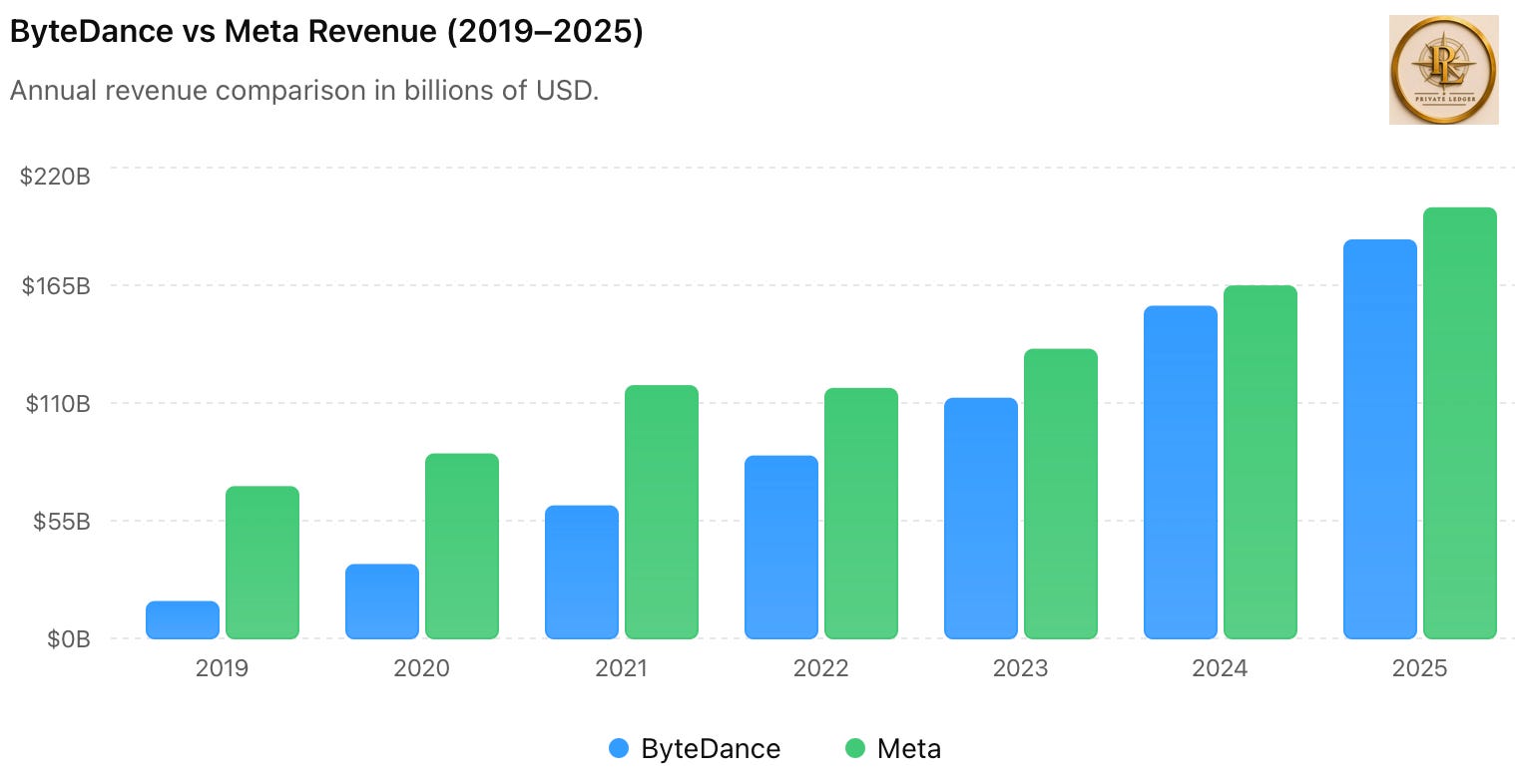
Chinese companies are often clouded in mystery. And ByteDance is no different. The company behind TikTok has been hit with thousands of lawsuits since inception, having to toe the line between the US government and their native Chinese government. But the lawsuits seem to have hardly slowed the company’s growth. ByteDance generated $186 billion in revenue in 2025, a 20% increase from 2024 and only slightly less than Meta’s $201 billion 2025 revenue.
TLDR Summary:
ByteDance isn’t one or two apps, it’s dozens of different apps that dominate both in mainland China and abroad. It is in every way a media empire the same way that Meta is.
ByteDance’s revenue growth is one of the fastest in the entire world at the scale they are at. They went from being less than a quarter of Meta’s revenue in 2019 to being almost equal only six years later. This is despite Meta’s 18.5% revenue CAGR over the past five years.
Operating in China isn’t like operating in the US. Both domestically and internationally, ByteDance has major complications that arise and they constantly have to toe the line between pleasing their own government and not offending international ones.
ByteDance’s valuation is affected just as much by external geopolitical factors as it is by the financial ones. It therefore has a current estimated valuation significantly lower than it would if it were operating out of Silicon Valley.
ByteDance is investing extremely heavily into AI and currently boasts China’s leading chatbot model: Doubao.
A poll is included at the end of the post to decide on next weeks breakdown! For all those on browser, please vote :)
Welcome to The Private Ledger - an independent, research publication that focuses on breaking down companies in the private market weekly.
📈 You’re reading my latest breakdown into a private company. As always, this breakdown took a long time and a lot of time and hard work. If you enjoy the research, make sure to like & subscribe to receive much more like this, weekly!
The Birth of ByteDance:
In 2012, Zhang Yiming and Liang Rubo founded ByteDance from their four bedroom apartment in Beijing. Zhang recognized that people in China were spending more and more time on mobile phones but that content discovery was still stuck in the 20th century of manual search. Zhang wanted to create an app that used machine learning to create an algorithm that brought short form easily digestible content tailored specifically to each user.
In August of 2012 ByteDance launched Toutiao, (Chinese for Today's Headlines,) an app that brought you daily news using an algorithm specific for each user. Within a year of inception, Toutiao had millions of users, validating Zhang’s theory that users wanted content tailored to them on phones.
Notably, the early 2010’s happened to also be the “rapid mobile adoption” phase in China. Phone usage went from only a few percent in 2010 to 65% in 2014.1 Additionally, China adopted 4G nationwide in December of 2013. More and more people in China were spending hours browsing on their phones, and ByteDance took advantage of this.
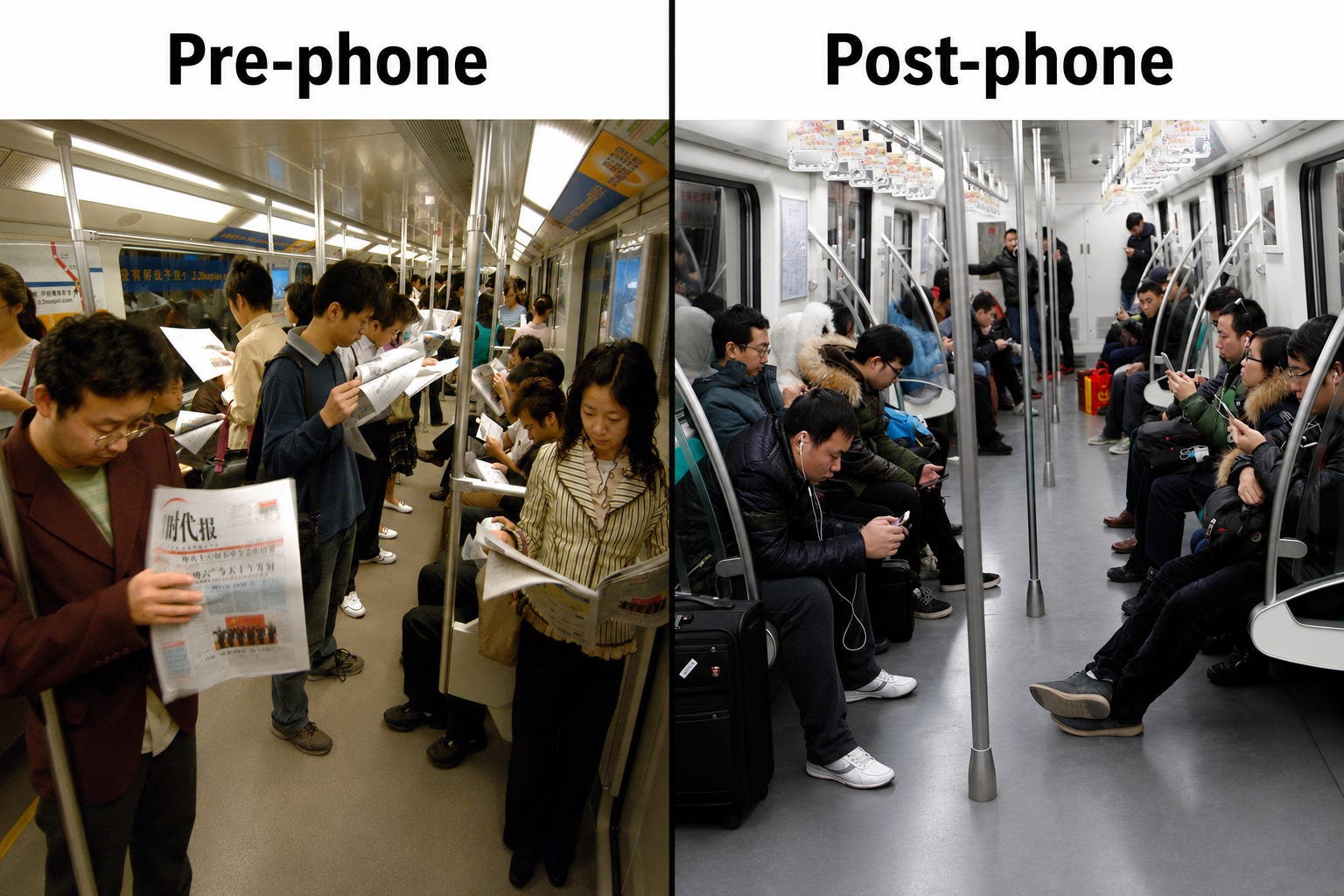
With the mass expansion of phones into everyday life, ByteDance became more and more relevant and its total addressable market continued to expand rapidly. In the same way Facebook and Instagram were expanding extremely quickly in the US, Toutiao was growing in China and by 2014, only two years after being founded, the app passed 100 million users.2
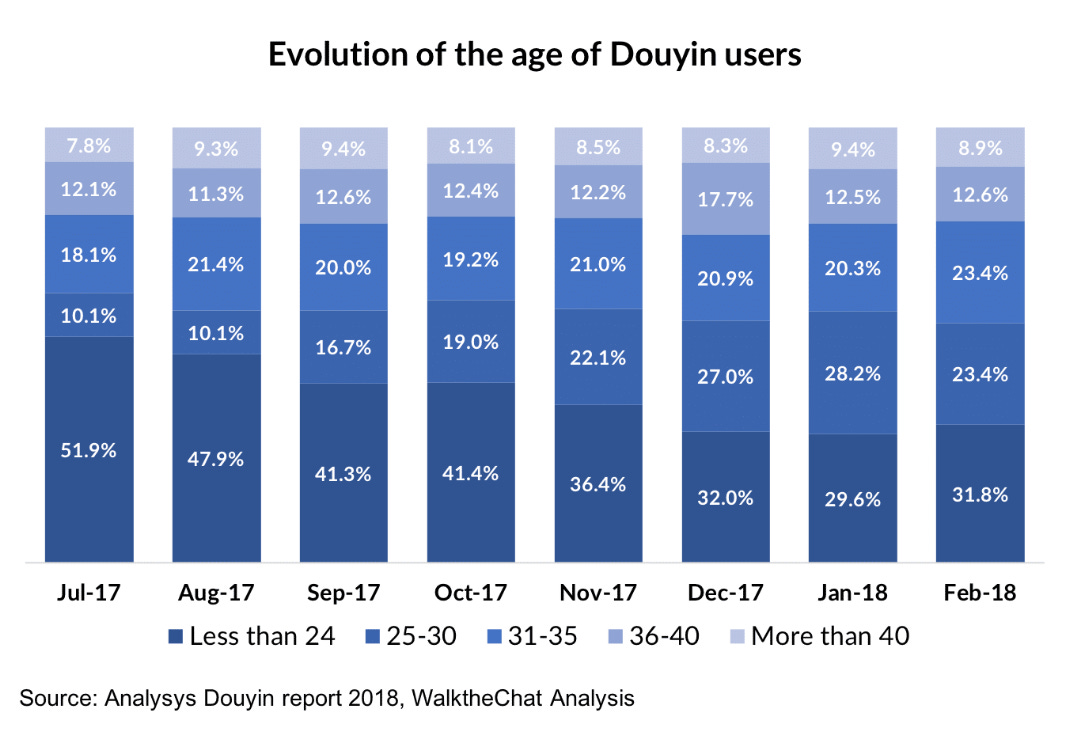
In 2016, ByteDance launched Douyin, which instantly became a success. Within a year, 30% of Chinese internet users were using the app and ByteDance set their eyes on international expansion.3 In 2017, ByteDance launched TikTok, an app extremely similar to Douyin but for an international audience.
Today, around a decade later, Douyin boasts over a billion monthly active users (MAU) while TikTok has 1.99 billion monthly users.45 In total, ByteDance has 4 billion monthly active users across all of their platforms.6
While the majority of their revenue comes from these two apps, ByteDance also has a number of other apps including the previously mentioned Toutiao released in 2012, Xigua Video in 2016, CapCut in 2019, Doubao released in 2023, and more. For those who view ByteDance simply as “the parent company of TikTok”, it’s not. ByteDance has created an online empire in the same way that Meta has.
Some General Context:
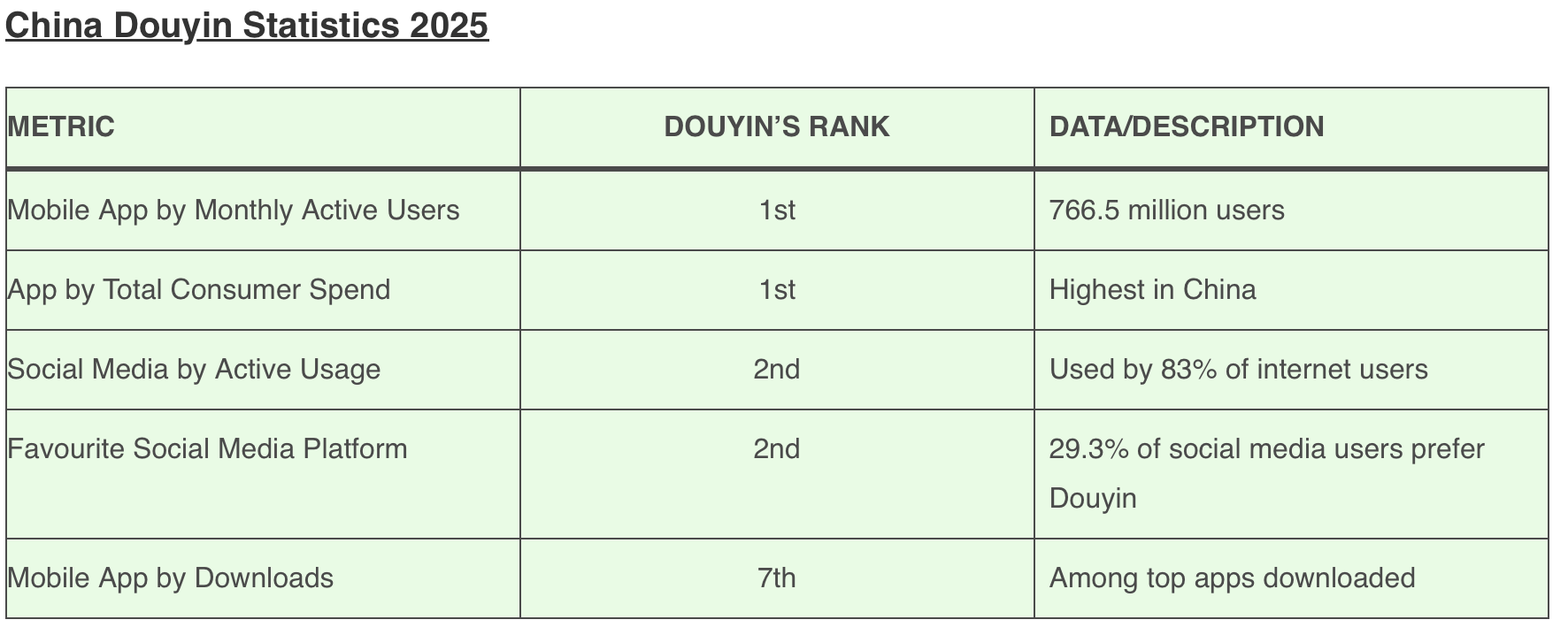
One of the reasons why ByteDance is so massive is because traditional news sites and Western apps are banned in China. For those who don’t understand the scope, Google, YouTube, Facebook, Instagram, WhatsApp, X, Netflix and pretty much every Western social media app are banned in China. This creates a massive vacuum for the 1.4+ billion people living in China. Stepping into this vacuum is ByteDance and their largest app Douyin. Douyin captures 83% of Chinese internet users and is the largest app by total consumer spend in China.7
It is also important to note that in China, unlike in the US, companies are not entities independent from the government. In 2018 Zhang actually had to publicly issue an apology and shut down their joke-sharing app due to it violating “core socialist values.” This is a topic we will dive into more depth later in the piece but is important to mention as well now.
“If the country needs it, I will hand over Alipay to the government at any moment.”
Jack Ma, Co-founder of Alibaba
What does ByteDance do?
As previously mentioned, ByteDance is the parent company of a number of social media apps. As ByteDance has dozens of apps, I won’t go into every one of them specifically but I will go over five of their biggest apps and explain what they do and some interesting information that is worth knowing about each one.
Douyin:
Douyin was created in 2016 and used the same sophisticated algorithm that ByteDance’s other apps use in order to maximize user retention. As users spend more time on the app, the app becomes more effective at giving users what they want. And Douyin was an instant success. Within a year, Douyin had 100 million users and a video posted on their platform reached one billion views.8 To put that into perspective, YouTube took seven years for the first video on its platform (Gangnam Style) to reach one billion views. Douyin quickly expanded their user base and in September 2017, only ten months after being created, the app ran its first ad campaign with AirBnB.
Douyin gained rapid popularity for a number of reasons. They allowed users to create videos within the app without having to edit using other apps. Any user could choose one of the available music themes or edits and immediately create a video and go viral. Douyin spread from its originally extremely young user base to the vast majority of the population in only nine months. Today, the platform is one of the largest social media apps in the world.
Douyin generates the bulk of its revenue through digital advertising and e-commerce commissions.9 They also generate revenue in other ways, including taking a percentage of user tips (an option that allows users to tip their favorite creators with Douyin coins), taking a commission for food delivery or hotel bookings and taking fees from brand sponsorships that they facilitate.
Douyin’s ads are particularly effective due to Douyin’s market being a closed-loop e-commerce model. What this means is that instead of seeing an advertisement on Instagram and having to leave the app in order to make an order, Douyin takes you directly to their shop where you can make purchases there making the whole process significantly smoother. Just imagine scrolling through reels/shorts on Amazon.
As ByteDance isn’t public about their specific revenue generation by segment, I am going to have to make a few assumptions in order to calculate Douyin’s rough revenue generation. 2025 was the first year that ByteDance generated more than 30% of its revenue outside of mainland China.10 In 2024, Douyin made up roughly 65% of overall revenue, but due to the fact that revenue growth outside of China rose by 50% year over year while Chinese growth rose only 20% year over year, we can assume that Douyin generated roughly $113.6 billion or 61% of ByteDance’s total revenue.11
TikTok:
In January of 2017, following the “death of Vine” - the six second video platform - another Chinese app filled the vacuum. Musical.ly was ironically created less than ten miles away from ByteDance headquarters and instead of focusing on the Chinese market they focused on International expansion. Two months after launching their own app, TikTok, Bytedance decided to purchase Musical.ly for $1 billion and combined it with TikTok. This purchase has a lot of similarities to Facebook’s purchase of Instagram. The TikTok Musical.ly merger proved to be a huge success and in just 5.1 years, TikTok became the fastest app ever to reach 1 billion users.12
While the majority of those reading are likely familiar with TikTok, just in case, TikTok is a social media app where users can post short form videos that are designed for quick entertainment and are easy to share.
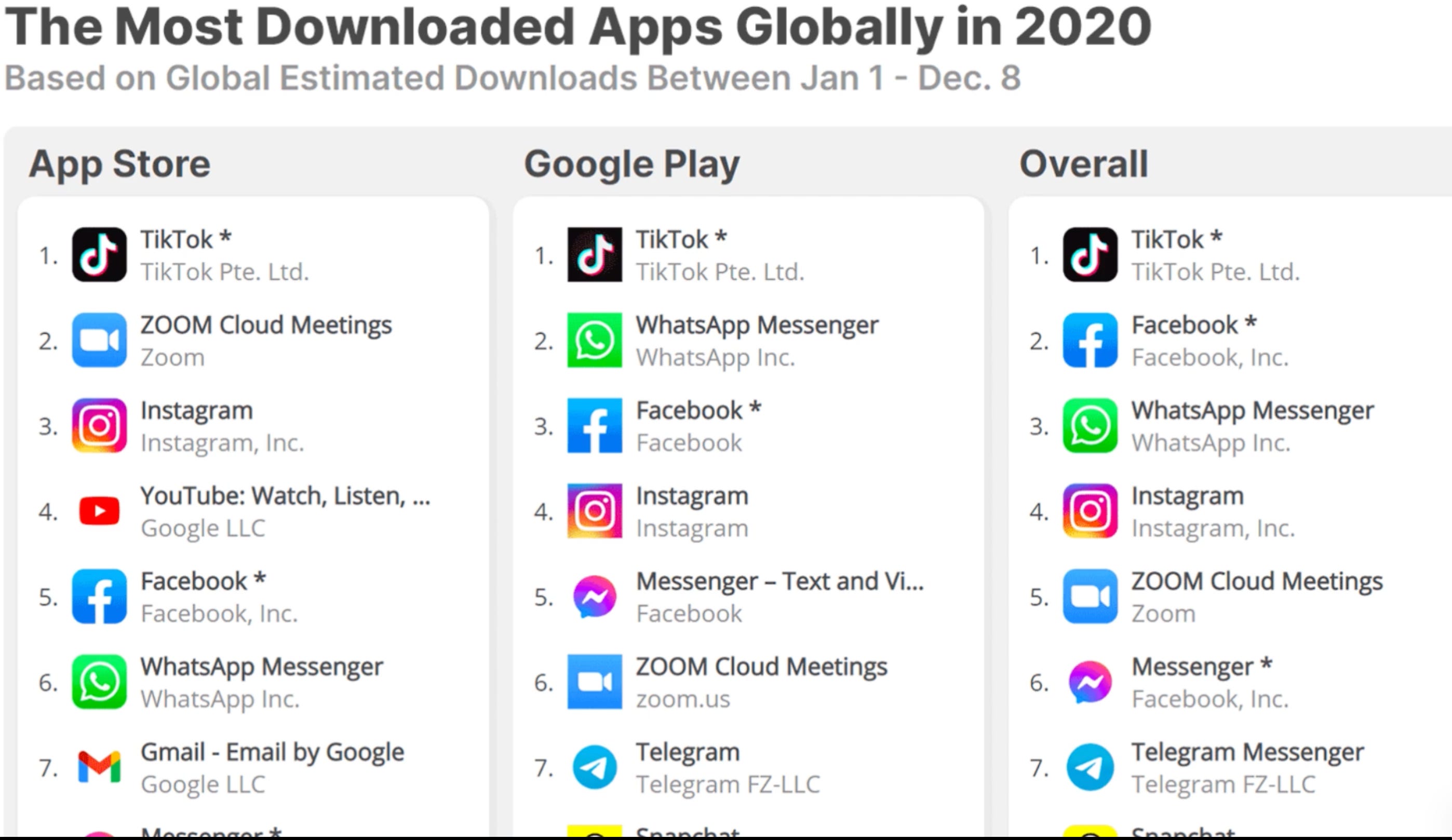
TikTok quickly became extremely popular and in 2020 it was dominating the social media and general app charts. It was so popular that both Instagram (reels) and YouTube (shorts) were forced to create competitors. Recently, even Netflix (clips) has produced their own alternative to TikTok. Originally seen as a fad that would likely pass, short form content quickly became extremely popular and is now clearly here to stay.
TikTok’s growth over the next few years was far from a fluke. TikTok made it extremely easy and efficient to create videos through their platform and then watermarked all of their content. And so even for those who didn’t use TikTok, they often saw videos shared with them with the TikTok logo. This created a massive amount of free advertising and in addition TikTok also spent an estimated $300 million on Google Ads alone to promote TikTok.13
And thus, TikTok continued to grow both in size and in revenue. TikTok saw a huge boost in usage during the Covid-19 pandemic that caused phone usage specifically among teenagers and young adults to spike.14 In 2020, however, TikTok was still in the infancy of generating revenue, something that they would focus on improving over the next few years.
Over the next five years, TikTok would scale up advertising and other forms of revenue and by 2025, TikTok was generating $33.6 billion. A huge catalyst in their growth was their September 2023 launch of TikTok Shop which has grown at an astronomical pace. In 2025, the TikTok Shop reported $15.8 billion in US sales, representing a 407% increase from their 2024 numbers.15 This revenue generation strategy is one that ByteDance has already mastered in China and is now working on bringing to the US and the rest of the world.
Toutiao:
Toutiao was the first app that ByteDance released. Using a complex algorithm that recommended to users the content that they read the most, Toutiao quickly became a huge sensation.
Toutiao, meaning “headline” in Mandarin is one of the main ways that people in China get news daily. Toutiao works as its own ecosystem, with a search function and different content formats which include posts and forums. Think of it as a hybrid between Apple News and Reddit. Users using Toutiao live mostly in “Tier 1 and 2” cities, i.e. cities with a higher GDP.16
Toutiao is also a popular place for both users and businesses to post articles and share content, allowing writers to generate money using either advertisements or a paid subscription model - like Substack. With their sophisticated algorithm, users are shown the exact ads that are most efficient in targeting them. Rather than obviously being ads, Toutiao advertisements often are shown as pieces of news, blending in with average news.
"Nobody reads advertising. People read what interests them, and sometimes it’s an ad." Howard Luck Gossage
Due to ByteDance being a private company and not reporting revenue by segment, there isn’t an agreed upon number for Toutiao’s revenue. ByteDance’s 2025 revenue was $186 billion and roughly 75% of that number or $147 billion was in China. With Douyin making up roughly 65% of Chinese revenue, Toutiao is likely competing with a number of other apps for the remaining revenue.17 Assuming that Toutiao is capturing roughly 3-7% of the total revenue generation for mainland China, a rough estimate would have them at around $5-10 billion. While this might not sound like a lot in comparison to ByteDance’s massive revenue generation, Reddit, which are valued at $35 billion, generated $2.2 billion in 2025 revenue. The New York Times for comparison, worth $12.5 billion, generated $2.82 billion in 2025.
Today in China Toutiao has over 600 million users including 150 million daily active users who open the app an average of nine times per day.18
XiguaVideo:
Originally launched as Toutiao Video in 2016, they renamed the platform in 2017 to Xigua Video meaning watermelon video, a play on the Chinese term “watermelon-eating crowd” or 吃瓜群众. Translated directly, it means “bystanders”, the term means those who enjoy eating watermelon and watching from the side.
XiguaVideo is one of the Chinese equivalents to Youtube with roughly 100 million MAU.19 Importantly, despite ByteDance’s support, XiguaVideo has actually lost market share in the last few years. In 2019, the platform had 169 million viewers meaning viewership has declined by around 40% in the last few years.20 This is likely due to a number of factors including increased competition and their lack of pivot towards a short form video option. In the latter regard, ByteDance has chosen to focus Douyin as not only their short form content machine, but also their medium length app now allowing users to post videos up to 30 minutes long. While technically keeping XiguaVideo mainly for long form videos, it is clear that ByteDance has chosen to prioritize Douyin ahead of XiguaVideo, causing the latter to lose market share.
XiguaVideo historically has produced around 3% of ByteDance’s revenue, now, with ByteDance’s other apps growing while Xigua is shrinking, Xigua likely produces closer to 1-2% of ByteDance’s revenue or $2-4 billion. For ByteDance standards, that is a small fraction of the pie. For most other companies, it is a huge amount.
CapCut:
Released in May of 2019, CapCut, known in China as JianYing, is a video editing platform that allows users to perform edits ranging from basic to sophisticated based on the users needs. CapCut’s real value lies in an easy to learn editing process which includes different templates and formats that people can use. For those who want a more premium experience, CapCut offers a paid tier which allows additional features and space with plans ranging between $7.99-9.99 a month.
CapCut has also succeeded in integrating AI into their app. CapCut is famous for offering automated captions which are highly accurate, the ability to remove the background with the click of a button and an ability to use AI voiceovers to narrate your videos.
Due to the low learning curve needed and ByteDance promoting their app, CapCut has grown extremely quickly and according to the WSJ in March of 2023 it was the second most downloaded app in America. By 2025, it had reached one billion downloads in the Google Play store alone.
Doubao and AI Spend:
North American hyper-scalers aren’t the only ones massively investing in AI. In fact, the number one most used chatbot in China is actually Doubao, ByteDance’s AI chatbot. Doubao currently holds a major lead ahead of all competitors with 345 million MAU or the cumulative sum of the numbers two, three and four domestic chatbots.21 Furthermore, Doubao is actually still growing at a rapid pace, doubling in the past 12 months and adding 900,000 users daily. Their competitive advantage is furthered by their app being used significantly more than competing models, with Doubao’s model being used 54.8 times on average per month vs only 41.7 DeepSeek and 19.8 for QianWen.22
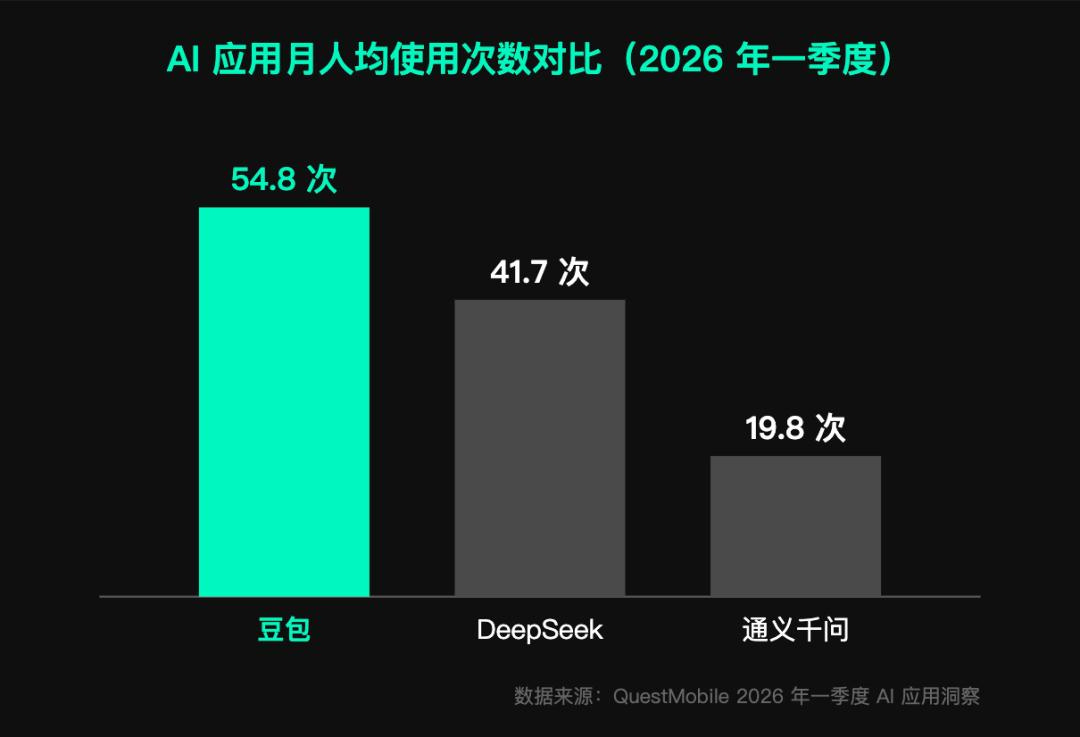
Doubao is an all in one AI chatbot with an option for search, image and video generation. Doubao is focused more on practical everyday applications of AI, like general chatting, specifically geared towards social media trends, like photoshopping yourself with a famous celebrity. In addition, when asking questions, Doubao will often give you a link to a video on Douyin. Think if Google seamlessly integrated Youtube shorts into their AI chatting.
ByteDance split Doubao into two versions, their web browser targeting white collar workers and their mobile app, targeting everyday users. Their web browser allows users to easily create slides and process office productivity tasks. Doubao’s mobile app is more fun and their avatars are extremely popular in China, creating an almost cult-like culture. Incredibly, the AI avatars are so effective that they are even sometimes able to outsell human creators.23
Doubao has a number of revenue streams that are still mostly in their infancy. Like all major AI models in the West, Doubao has also started offering subscription options. In addition, Doubao also offers products that they earn a commission on, although the conversion rate is relatively low at only 3%.24 In addition, Doubao also has an option for enterprise clients to pay based on token usage with fees dependent on the specific usage cases.25
For ByteDance, there are two main reasons to spend heavily on AI. First, ByteDance generates the majority of their revenue from ads and the more efficient their algorithm and the advertisements they offer are, the more ByteDance profits. The second is that ByteDance wants to dominate the chatbot world. AI is not just profitable in the US but in China as well and ByteDance’s goal, like Meta is likely to switch to more than just a media empire. In addition, ByteDance will likely be able to leverage their AI data into making their social media algorithm even more effective and efficient than it already is.
AI models are infamously very expensive to run and in 2025, ByteDance decided to slash profits by 70% in order to focus on AI spending.26 In 2026, ByteDance announced that they would be spending $23 billion in AI infrastructure including a purchase of 20,000 Nvidia H200 chips. ByteDance’s investment into AI brings up similar questions to the ones asked about the US hyper-scalers and their massive AI spends and only time will tell whether this spend will pay dividends down the line.
Below is an example of a picture that was uploaded along with a script to one of ByteDance’s AI models, bringing Albert Einstein back to life.
The China (PRC) Factor:
Life and the workforce in China is significantly different than the US. In the US, the feeling is often that the government is beholden to companies and that senators or lawmakers are often “bought out” by big corporations. In China, the relationship is fundamentally different. The government controls companies.
Nowhere was this more apparent than when Jack Ma, China’s richest man and the creator of Alibaba disappeared. Following a speech Ma made where he was critical of some of the practices of the Chinese government, Ma simply vanished and for three months, the world didn’t hear from him. He finally broke his silence by giving a virtually recorded speech in January of 2021 before truly coming back only in February of 2025, more than four years after his critical speech of the government.27
To better understand how the Chinese government affects life in day to day business, I contacted and spoke to a lawyer who worked in China for years before immigrating to the West. They generously agreed to speak to me off the record, and I’ll mention a few of my key takeaways below:
There is no such thing as saying no to the government. What the government wants is not negotiable.
Those who run businesses know that ultimately, the party always comes first and loyalty to the party and the country comes ahead of profits or anything else.
How the law applies depends entirely on how many connections you have, not on the law itself.
The written law by the government is one thing. Practically, what your locality decides is what really defines your day to day life. If the local government decides one thing and the written law says something else, the local government will often prevail.
In a country where the wealthiest man can disappear for a year and then come back with no announcements as to his whereabouts, it’s not far-fetched at all to think that the government plays an integral part in the companies operations. In fact, it would be far-fetched to think the opposite.
The get in line approach has become paramount among all Chinese run businesses. Loyalty is #1, something many of the CEO’s of the largest Chinese companies have made very clear with their statements.
Tencent is a product of the times. We succeeded because we were riding a wave of national development, and our duty now is to serve that progress."
Pony Ma (Ma Huateng), Co-founder and CEO of Tencent
Ironically, in order to comply with the Chinese internet regulations, ByteDance actually had to block TikTok in China. The fact that ByteDance, a Chinese app has had to block their own app, is ironic to say the least, but serves as a powerful reminder about how powerful the word of the government is in China. Instead, Douyin is promoted in China and TikTok outside of China.
The Data “Leaks”:
The unfortunate logical continuation of the Chinese governments powerful position has to be asked, is if ByteDance is ultimately subject to the desires of the Chinese government, how can users be sure that their data is safe?
And in short, they can’t.
ByteDance has been accused multiple times of “leaking” its users data across multiple platforms. These leaks have happened on many of their platforms and several of them have been confirmed, shifting the conversation from “What if ByteDance misuses our data?” to “ByteDance has misused our data, what is to stop them from doing it again.”
The most damning leak, happened in 2022, when ByteDance admitted that a number of their employees had used IP tracking to check if any ByteDance employees acting as confidential informants were near journalists.28 This internal spying on their own users was not a leak rather a conscious misuse of power. While the employees were subsequently fired, who knows if this was ordered from ByteDance management - or even the Chinese government itself - and those employees were just used as the sacrifice needed to save the PR image.
In 2022, another major controversy arose when a leaked recording from an internal TikTok meeting suggested that Chinese engineers had repeatedly accessed non-public confidential data of its U.S. users. ByteDance responded by launching “Project Texas”, an initiative with the goal to store U.S. data locally rather than abroad in China.29
In 2023, TikTok was fined £345 million by the Irish Data Protection Commission for failing to protect the data of its users under 18. Two years later in 2025, the same commission fined TikTok an additional £530 million for failing to protect European data from the ability to be accessed from China and the lack of transparency behind regarding how data could be accessed.30
Additionally in 2023, CapCut was accused by many of their users of illegally profiting off of its users data. In September of last year, the judge presiding over the case excluded the majority of the case from going forward over insufficient proof although a minority of the case did go forward.
These are only a few of the many examples of ByteDance leaking or misusing its users data. Overall, there have been a multitude of accusations against ByteDance, and its apps about their questionable data usage and while not all of them have been proven to be true, overall they hurt the apps public image. Unlike Meta, who have also been accused of collecting the data of their users, here there is an additional fear there the data is being sent back to China, rather than just being used for each companies questionable intents.31
The Geopolitical Factor:
Most governments are aware of the dynamic that Chinese companies have with their government and therefore are often uncomfortable with Chinese companies. ByteDance therefore, have to try and placate governments across the world at the same time that they are subject to the desires of the Chinese governments.
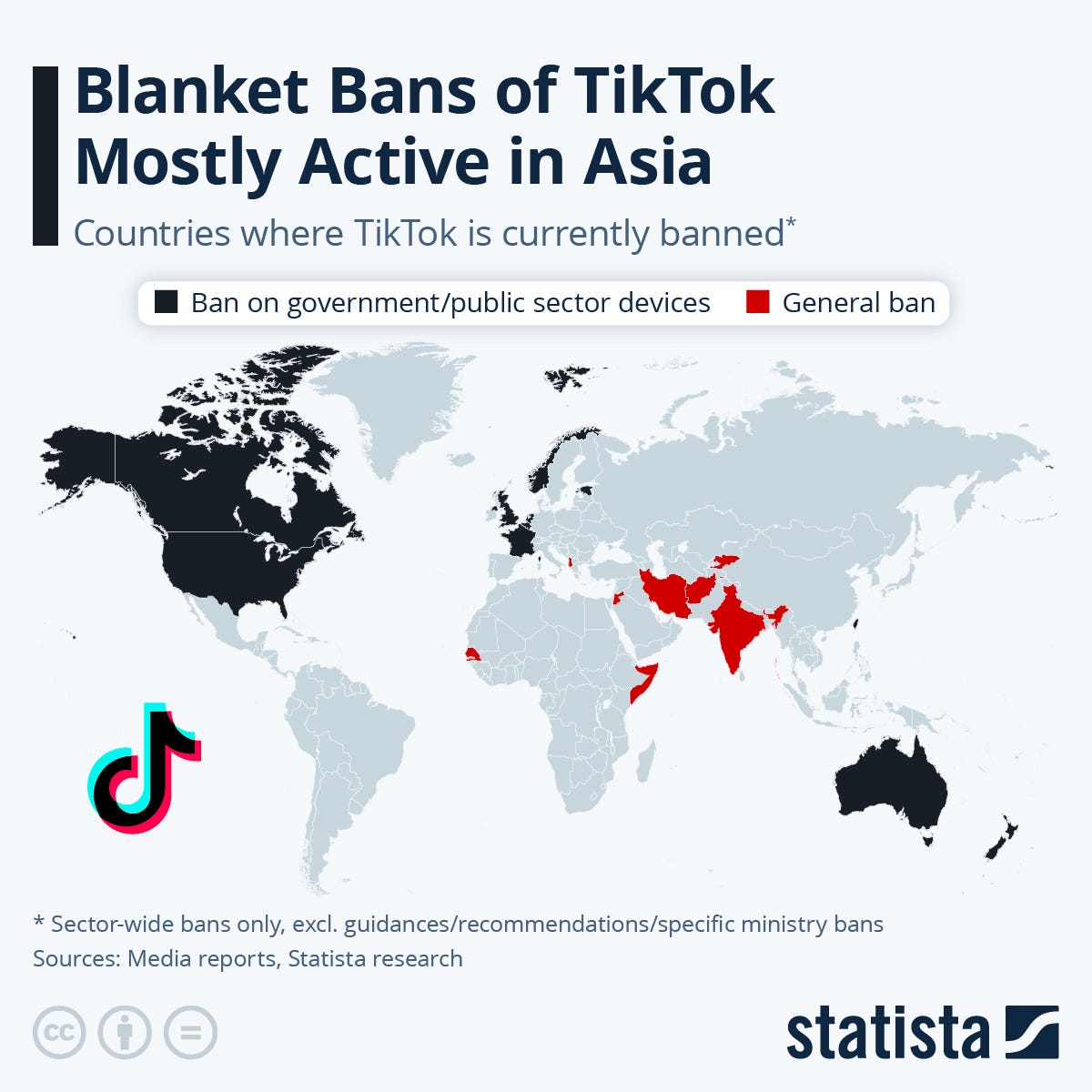
In 2024, Congress (under Joe Biden) passed the “Protecting Americans from Foreign Adversary Controlled Applications Act,” an act that forced ByteDance to either sell TikTok to an American company or have it banned. The act was challenged in the U.S. Supreme Court but in early 2025, the court decided to uphold the ban.32 TikTok was then briefly banned for about 12 hours in January of 2025. The Trump administration entering office announced that they are going to push off the ban assuming ByteDance agrees to a deal to move privacy and data storage to the U.S. ByteDance agreed and today data is being stored in the U.S. with ByteDance owning a >20% minority stake in U.S. ventures.33 Interestingly, while this deal was extremely closely followed in the U.S, in China, the deal was hardly mentioned, likely on purpose.
“While the TikTok deal has dominated Western media headlines, it has barely been mentioned in Chinese state or financial media. Some say that silence is deliberate. Beijing is trying to reassure domestic entrepreneurs and investors that it will not weaponise private companies for geopolitical gain.”34
This is far from the end of ByteDance’s complicated geopolitical standing. India for example, which has had a number of disagreements over the past few years with China, decided to fully ban TikTok (among other Chinese apps) in 2020 following border skirmishes with China.35 This ban has lasted for six years in which time ByteDance has missed out on a 1.4 billion person market.
Today, ByteDance has found its apps currently banned in six different countries and restricted in another 19.36
TAM and Competition:
It is for this reason, that the total addressable market (TAM) of ByteDance isn’t exactly the entire world’s population. TikTok for example is entirely banned among two billion people, the majority of whom are in India and China. Overall, roughly 1.7 billion people are fully banned from using TikTok worldwide.
That being said, the majority of the world can use the apps offered by ByteDance and billions do. If we compare their TAM to Meta’s, despite being banned by India along with other countries, they dominate the Chinese market with their apps.
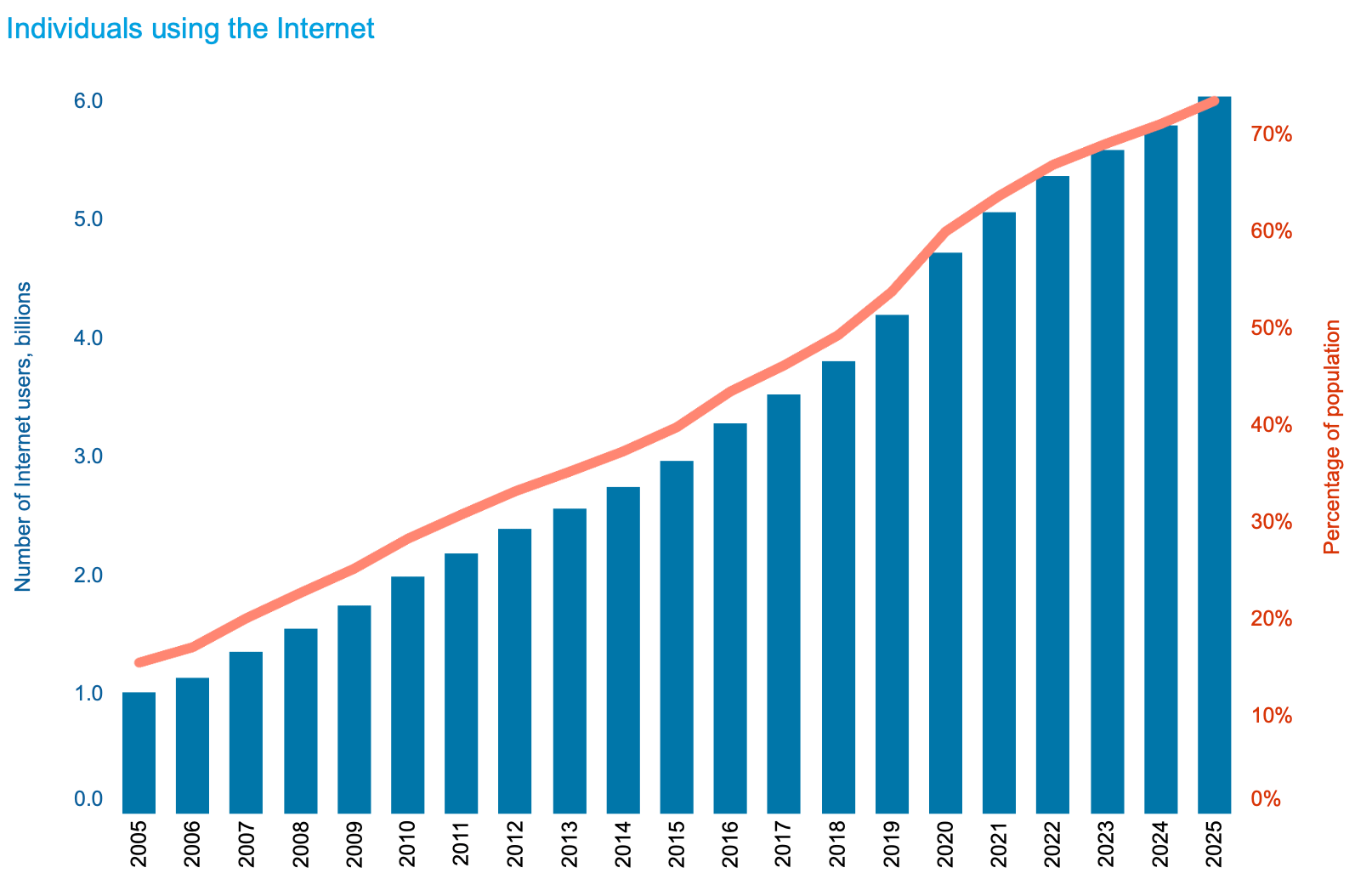
Excluding countries ByteDance is banned in, ByteDance has a total addressable market of around 6.5 billion users which is currently mid saturation. Importantly for ByteDance, the number of people without internet access, is shrinking daily with 74% of people having internet access today, compared to only 40% a decade ago.37 Anecdotally, last year when I travelled in some of the poorest places in Laos and Vietnam, cellphones and scrolling were still very prevalent, something that wasn’t the case when I was traveling a decade ago.
Still, competition for phone time is fierce. Today, there are dozens of apps and social medias vying for user retention. Outside of China, TikTok competes with a number of the biggest apps in the world including Meta platforms, Youtube, Netflix, Snapchat and more. Meta, TikTok’s most direct competitor boasts over 3.5 billion daily active users, a number that has grown by 5% per year in the past five years.38 Youtube also has a huge user base with 2.7 billion people watching videos every month.39 And these aren’t the only ones competing for your attention, indirect competition exists through thousands of apps. Anything that takes your eyes away from TikTok be it Duolingo, Substack or any other app is competition for ByteDance.
In China, ByteDance’s main competitor is Tencent’s WeChat, China’s most popular “everything” app which has over 1.4 billion MAU. Other competitors include Kuaishou which focuses on rural “tier 3-5 cities” with 710 million MAUs and Xiaohongshu which focuses on “tier 1 and 2” cities with 200-250 MAU.40 On the e-Commerce side, Douyin’s marketplace competes primarily with AliBaba, a powerhouse valued at roughly $300 billion. Alibaba also includes Taobao, which has over two billions items for sale and uses a complex algorithm to retain shoppers.
Valuation:
ByteDance’s current valuation is pretty fascinating and I am uncharacteristically not going to share it until the end of this section, hopefully allowing you to form your own opinion.
The first thing to look at when valuing any company is the money. ByteDance has fully transitioned into a revenue generating machine reporting $186 billion in revenue in 2025 up from only $17 billion in 2018, a 994% increase in eight years.
ByteDance has even managed to hugely narrow the gap with Meta, who has experienced 18.5% revenue CAGR over the past five years. And yet, ByteDance has been narrowing the gap between revenue rapidly spurred by a massive 41% CAGR in the past five year. In fact, when you look at their revenue side by side, you can truly see how quickly ByteDance is growing.
Before investing in AI heavily in 2025 and 2026, ByteDance reported a healthy 21% net profit margin compared to 37.9% from Meta. It’s also noteworthy that in 2023, Meta reported net profit margins of 21.5% and its huge jump to 37.9% was due “the rapid advancement of AI technology.”41 ByteDance will likely see their profits temporarily compress in the coming years before likely expanding due to AI making their products more efficient, an AI they notably own.
In addition, according to financial documents viewed by the Australian Financial Review, ByteDance is also sitting on a cash pile that is second only to Berkshire Hathaway.
“ByteDance had a cash balance of around $US180 billion, further supporting the company’s valuation.”42
All these seem like positive signs towards a massive trillion dollar valuation but as mentioned previously, there is a fundamental difference between ByteDance and a company like Meta. Location. If ByteDance were a public company in the US, they would likely command a significantly higher valuation. As it stands currently, they are not. The risk of the U.S. and other Western countries potentially banning the company is one that isn’t a paper tiger, it’s a legitimate bear case that could be worth billions of dollars.
Which leads to the hardest question of all, how do you value a company with billions of daily active users, a revenue growth that’s almost twice as fast as Meta’s over the past few years, the leading chatbot in China and a cash pile that is second only to Berkshire Hathaway?
If your answer was, “I don’t know but it’s getting more and more valuable.” You’re not alone.
According to Sacra, ByteDance’s valuation went from $75 billion in October of 2018, to $180 billion in December of 2020, to $268 billion in December of 2023, to $330 billion in August of 2025 and finally to $550 billion in February of 2026.43
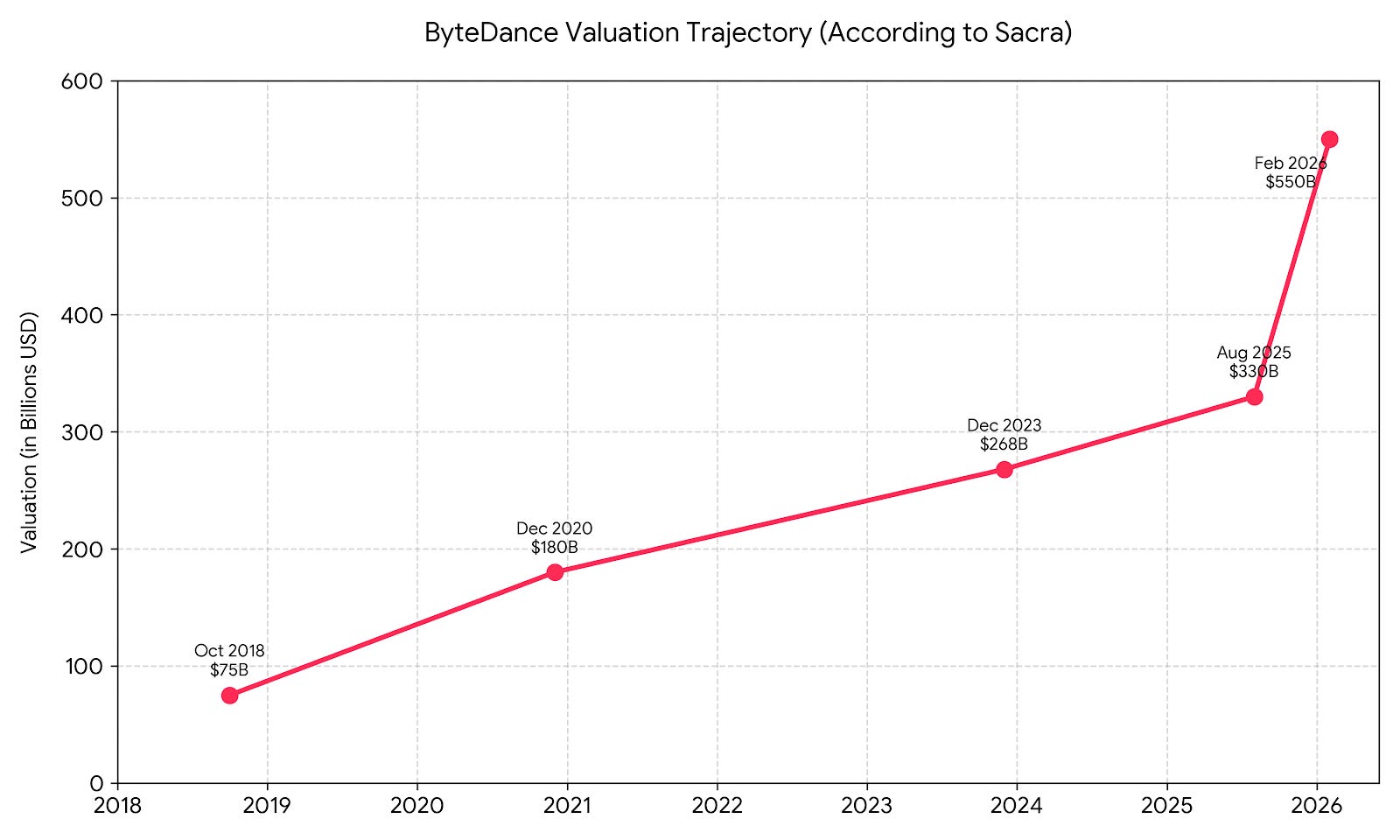
It’s unclear what ByteDance’s valuation would be if they were a publicly listed stock in the U.S. My guess would be around the $1 trillion range. That doesn’t mean that’s what they are worth today, geopolitical factors are real, if you don’t believe me, ask Gazprom, the Russian energy corporation that dropped from $323 to $238 almost overnight because of the Russian invasion of Ukraine and was then pulled off of Western stock markets due to sanctions on Russian companies. Over four years later, the stock still is not traded in the West.
Public Listing (or not):
ByteDance originally was planning to go public around 2020, with plans to potentially split its businesses into multiple different listings. Then, in April of 2021, ByteDance announced that they had no imminent plans to IPO due to not being ready to go public. A few months later in July of 2021 ByteDance announced that they are putting all plans to go public on hold after Chinese regulators “Warned About Data Security.”44
Then, a month later in August 2021, reports surfaced that ByteDance was considering going public on the Hong Kong stock exchange by early 2022, plans that clearly did not come to fruition.45
Currently, ByteDance has no imminent plans to IPO. Last November, a Chinese investment firm won a bidding war to buy shares of ByteDance at a $480 billion valuation, a sign that there is still strong investor interest in the company and perhaps even a sign that an IPO might be happening at some point down the line.46
For those still interested, it is also important to note, that as someone likely reading this from a Western country, investing in a company whose relationship with your country is not clear. Russians investing in the U.S. learned this the hard way, with billions in assets being frozen after Russia invaded Ukraine in 2022.47 When investing especially in the private market where liquidity is almost certainly lower, adding an additional factor of a foreign (adversarial) government who can lock up your wealth is something that should be greatly considered before investing in ByteDance.
Ethical Questions and Final Thoughts:
There is another factor that is more important than any valuation framework or revenue generation. And that is the ethics.
When investing in a Chinese company, it’s important to ask the question, do I want to be investing in a company whose government is unethical in numerous ways. I don’t want to turn this whole piece into a China ethics piece, but I do believe that it is important to note China is by no means an ethical country and their government routinely doesn’t follow basic moral standards that we take for granted in the West. Some examples include but are not limited to:
China’s systematic crimes against Tibetans, Uyghur and Turkic Muslims.48
Suppressing freedom in Hong Kong including dismantling Hong Kong’s independent legal system and brutally shutting down the pro-independence peace rallies.49
Forcing “prisoners” to take tablets and blood samples that the government would later use for biomedical research and data harvesting in order to create facial recognition software for minorities.50
Overall mistreatment of workers by not permitting unions, freedom of expression and running a totalitarian government that doesn't allow dissent.51
This is hardly all there is to it. China’s ethical problems deserve a piece of their own. If you want a full breakdown, I highly recommend reading this lengthy report.52
Now, while someone might say that it is unfair to criticize a company for the actions of their government - a somewhat fair point, - it is important to note that as mentioned previously, in China, there is no true separation between company and state. But don’t take it from me, take it from Zhang Yiming, the founder of ByteDance.
“All along, we have placed excessive emphasis on the role of technology, and we have not acknowledged that technology must be led by the socialist core value system.”
Zhang Yiming, founder of ByteDance.
There are more ethical questions, data leakage, users manipulation and addiction and potential censorship problems. That being said, I don’t think that these are relevant. I think the ethical questions end with the Chinese government, not necessarily the fault of ByteDance, but largely because they have no other choice unfortunately. Dictators are not kind and often rule with an iron fist. In this case, that iron fist ultimately has control over the company we are speaking about.
While most of the eyes in the private market are focused on SpaceX, Anthropic and OpenAI, ByteDance has a good case for being the most important private market company in the world. They run one of largest social media empire in the world, the largest chatbot in China and are one of the leading AI companies outside of the U.S. Despite all that, as interesting as it is, and even if I did think it was undervalued, I would not invest in this company over ethical concerns.
https://sacra-pdfs.s3.us-east-2.amazonaws.com/bytedance.pdf
https://businessmodelcanvastemplate.com/blogs/brief-history/bytedance-brief-history
https://www.linkedin.com/pulse/rise-douyin-chinas-tiktok-how-did-other-players-trakroo-frm-clgjc
https://nanjingmarketinggroup.com/blog/douyin-user-demographics
https://www.demandsage.com/tiktok-user-statistics/
https://www.bloomberg.com/news/articles/2025-05-16/bytedance-aims-to-match-meta-sales-in-2025-as-tiktok-gains-steam
In the chart below, the statistic likely is focused on non messaging social media platforms. https://www.theglobalstatistics.com/china-douyin-users-statistics/
https://walkthechat.com/douyin-became-chinas-top-short-video-app-500-days/
https://digitalinasia.com/how-douyin-advertising-actually-works-a-guide-for-non-chinese-speakers/
https://www.scmp.com/tech/article/3350720/bytedance-profit-plunges-ai-push-tiktok-shop-powers-overseas-growth-reports
https://www.businessofapps.com/data/tiktok-app-report/
This record held until last week, when ChatGPT broke the record. https://www.telemediamagazine.com/tiktok-hits-1bn-users-milestone-and-did-it-a-record-5-1-years/
https://sacra.com/c/bytedance/
https://www.sciencedirect.com/science/article/pii/S2590291126001233
https://www.charleagency.com/articles/tiktok-statistics/
https://multimedia.scmp.com/2016/cities/
https://digitalinasia.com/how-douyin-advertising-actually-works-a-guide-for-non-chinese-speakers/
https://www.vertwebsolutions.com/china-b2b-digital-marketing-agency/toutiao-news-aggregator/
https://www.statista.com/statistics/1364841/china-monthly-active-users-xigua-video/?srsltid=AfmBOopgpZpLFT7yrkJ8A6ZEzBiwTxSr1BNkYIkxi0QNGgiih_KWMg4D
https://chinafilminsider.com/cbi-video-streaming-part-two/
https://www.binance.com/en/square/post/323300490689729
https://finance.biggo.com/news/vk2htp0BrdTHlKtC9wsf
https://www.cnbc.com/2025/06/19/ai-humans-in-china-just-proved-they-are-better-influencers.html
https://www.binance.com/en/square/post/323300490689729
https://www.chinadaily.com.cn/a/202605/06/WS69fa79bea310d6866eb46f3e.html
https://sacra.com/c/bytedance/
https://www.bbc.com/news/articles/c5yvyl710jpo
https://edition.cnn.com/2022/12/22/tech/tiktok-bytedance-journalist-data
https://docs.house.gov/meetings/IF/IF00/20230323/115519/HHRG-118-IF00-20230323-SD030.pdf
https://www.dataprotection.ie/en/news-media/press-releases/DPC-announces-345-million-euro-fine-of-TikTok
https://www.cnn.com/2024/02/29/tech/meta-data-processing-europe-gdpr
https://www.cbc.ca/news/world/supreme-court-tiktok-ban-1.7434082
https://www.bbc.com/news/articles/clyng762q4eo
https://www.afr.com/world/asia/tiktok-deal-lifts-bytedance-private-shares-to-539b-20251009-p5n1f6
https://www.theguardian.com/world/2020/jun/29/india-bans-tiktok-after-himalayan-border-clash-with-chinese-troops
https://www.statista.com/chart/29654/countries-currently-banning-tiktok
https://www.itu.int/itu-d/reports/statistics/2025/10/15/ff25-internet-use/
https://www.qualtrim.com/app/insights/META
https://www.globalmediainsight.com/blog/youtube-users-statistics/
https://www.statista.com/statistics/1327421/china-xiaohongshu-monthly-active-users

https://www.afr.com/world/asia/tiktok-deal-lifts-bytedance-private-shares-to-539b-20251009-p5n1f6
https://sacra.com/c/bytedance/
https://www.wsj.com/tech/bytedance-shelvedipo-intentions-after-chinese-regulators-warned-about-data-security-11626078000
https://www.reuters.com/technology/tiktok-owner-bytedance-aims-hong-kong-ipo-by-early-2022-ft-2021-08-08/
https://www.bloomberg.com/news/articles/2025-11-20/bytedance-s-valuation-soars-to-480-billion-in-share-auction
https://home.treasury.gov/news/press-releases/jy0608
https://www.hrw.org/world-report/2025/country-chapters/china
https://www.amnesty.org/en/location/asia-and-the-pacific/east-asia/china/report-china/
https://www.nature.com/articles/d41586-024-00170-0
https://2017-2021.state.gov/chinas-disregard-for-human-rights/
https://www.state.gov/reports/2023-country-reports-on-human-rights-practices/china
The fact that ByteDance is pulling $186B in revenue while basically operating with one hand tied behind its back is wild. Makes you wonder what the actual ceiling is if they ever get unfettered access to Western markets... or if the constraints are actually what's kept them lean and efficient.
I was guessing a valuation of 700-800 Billion if listed in China and 1.5 Trillion if US. That level of activity and user growth is completely mind boggling. 994% user growth is unheard of and the fact that they have so many apps used by so many is incredible. Thanks Joseph for this write up!