
The Breakdown: Saronic
Inside Saronic: The SpaceX of the Sea.

On June 8th, Iran shot down a U.S. Apache helicopter over the Strait of Hormuz. Within two hours, the pilots were rescued.
The rescue mission was hugely significant both strategically and technologically as it marked the first ever time an Uncrewed Surface Vessel (USV) was used in a rescue mission.
The company behind the mission was Saronic, a company founded less than four years ago. Founded by a former Navy SEAL with eleven years of experience and eight combat deployments, Saronic is quickly making waves in the defense tech sector.
Welcome to The Private Ledger - an independent, research publication that focuses on breaking down private companies and macro trends surrounding IPOs.
📈 You’re reading my latest breakdown into a private company. If you enjoy the research, make sure to like & subscribe to receive much more like this, weekly!
I want to disclose that although the article is extremely bullish, I do not own any stake in Saronic and was not paid to write this article. I genuinely was impressed with the company and my writing is reflective of that.
The Shrinkage of the U.S. Navy:
Saronic was created in large part due to the shrinkage of the U.S. military, especially in relation to competition in China.
In 1945 at the end of World War II, the U.S. Navy had 6,768 ships being manned by 3.4 million soldiers. Today, more than eighty years later, the Navy has shrunk to 287 ships manned by roughly 335,000 soldiers.1 In other words, the Navy is only 4% as large and being manned by less than 10% of what it was 80 years ago.
At the same time, China’s Navy in 1945 consisted of fewer than 100 ships, and no aircraft carriers. Today, China has more than 370 battle-force ships, 60 submarines and 3 aircraft carriers.
China now has the largest Navy in the world and over 5000 commercially flagged vessels. The U.S. has less than 100.2
More importantly, China’s shipbuilding capacity today is now more than 200 times greater than the U.S. according to U.S. Navy Intelligence.3 In the words of Saronic’s founder Dino Mavrookas:
China went from 5% of the world’s global shipbuilding capacity. Today they have 50%….What do you think happens to all that commercial capacity when the first shot is fired?”
While currently, those capabilities are being used to build commercial ships, in the case of a potential conflict with the U.S, that capability can quickly shift to building ships for the Chinese military.
In World War II, one of the largest advantages the U.S. had was its ability to produce more than any other country. More ships, more weapons and better technology. Today, that advantage - at least at sea, not only no longer exists, but is a major disadvantage in a potential conflict with China.
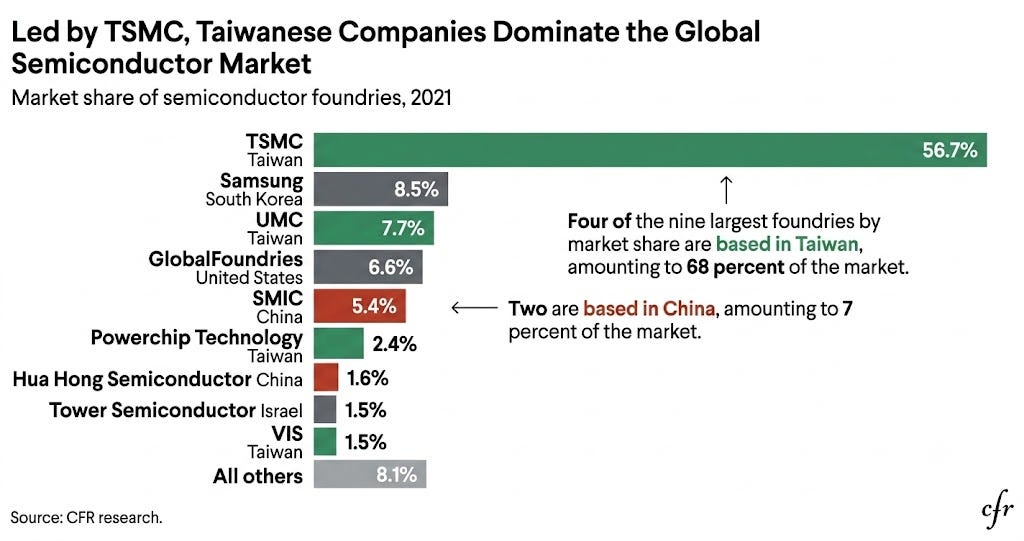
And today, a potential war in the East might be started over a 36,193 square kilometer island in the Pacific Ocean off the coast of China. Taiwan, half the size of the U.S. state of Maine, produces roughly 65-70% of semiconductors and 90% of the most advanced microchips in the world.4
If China took over Taiwan, they would be able to blockade the rest of the world from accessing chips and semiconductors leading to a huge shortage in vital technology needed for everything from cars to phones.
The Birth of the Company:
The idea for the name Saronic comes from the Greek battle of Salamis 2500 years ago. Salamis doesn’t exactly roll off the tongue, so instead Dino’s wife Georgia suggested Saronic, the name of the surrounding gulf.
With a mission “to redefine maritime superiority and revolutionize the future of naval and maritime operations,” Saronic set out to shift the balance of power back in favor of the U.S.5
“Other things were moving forward, and boats weren’t…. Without autonomous boats, the surface fleet of the Navy does not have what it needs to actually maintain naval superiority.”
Dino Mavrookas
The problem, as identified by Saronic’s founder, was that after decades of fighting against terrorist groups rather than another “proper” military, America’s view on war fundamentally shifted.6
“Our attention as a nation was on counter-insurgency, was on the global war on terror. It wasn’t on how do we have the most powerful navy in the world to deter the Chinese.”
Dino Mavrookas
When founding the company, Dino didn’t want to just build a small defense startup. He was looking for a gap in the market that he could enter and fix a major problem. When he thought of Saronic and autonomous vessels, he asked himself a fundamental question:
“Does anybody care that this company doesn’t exist?… Can you build a real generational company? Is the Navy actually going to buy thousands of autonomous systems? Or not. And if the answer is no, that’s okay I just don’t want to start this company.”
He decided he wanted to try, and founded the company in late 2022. Since then, Saronic has quickly become one of the fastest growing defense tech startups and is now worth almost $10 billion.

Dino Mavrookas, the founder, CEO, and the man behind the idea, recruited three members who went on to become the founding team at Saronic.
Doug Lambert was a maritime hardware and engineering specialist who was working at the time on autonomous submarines when he met Dino in 2022. Doug today serves as the COO at Saronic.
Rob Lehman was a retired Lieutenant Colonel in the U.S. Marines who had been working in the defense sector consulting. After meeting Dino on a pheasant hunting trip, Rob began helping Dino for the next few months until he decided to join full-time. Today, Rob serves as the CCO at Saronic.
Finally, Vibhav Altekar was recruited from Anduril where he served as a machine learning engineer. Vibhav today serves as the CTO at Saronic.
Saronic continued building and expanding the team pulling top talent from other great companies. Dino has attributed part of Saronic’s rapid growth in large part to the team they have recruited.
“How fast we move is completely remarkable… We’ve attracted a world-class team, A+ team from across industries, from top companies SpaceX, Google, Tesla, Anduril, military.”
Dino Mavrookas
What does the company do?
Saronic builds autonomous boats and ships whose goal is to automate and modernize America’s Navy.
While until now Saronic was producing only smaller ships, its brand-new flagship model is 180 feet. More importantly, the construction of Port Alpha expected to be completed by 2028, will allow Saronic to increase the speed of its production and allow the company to grow even faster than it already is.
It seems that at this point, Saronic is actually ahead of schedule, something that is extremely rare in the defense industry. In fact, Dino Mavrookas said in a June 2025 interview that Saronic is looking to expand its product lineup and build bigger ships.
“What we’re building next? We’re building 40-foot, 60-foot and 150-foot autonomous ships.
Only a year later, Saronic’s flagship model Marauder was testing open waters. And it wasn’t 40 or 60 feet, it was 180. This model transitions Saronic from a company building small USVs to a company building large heavy-duty autonomous ships.
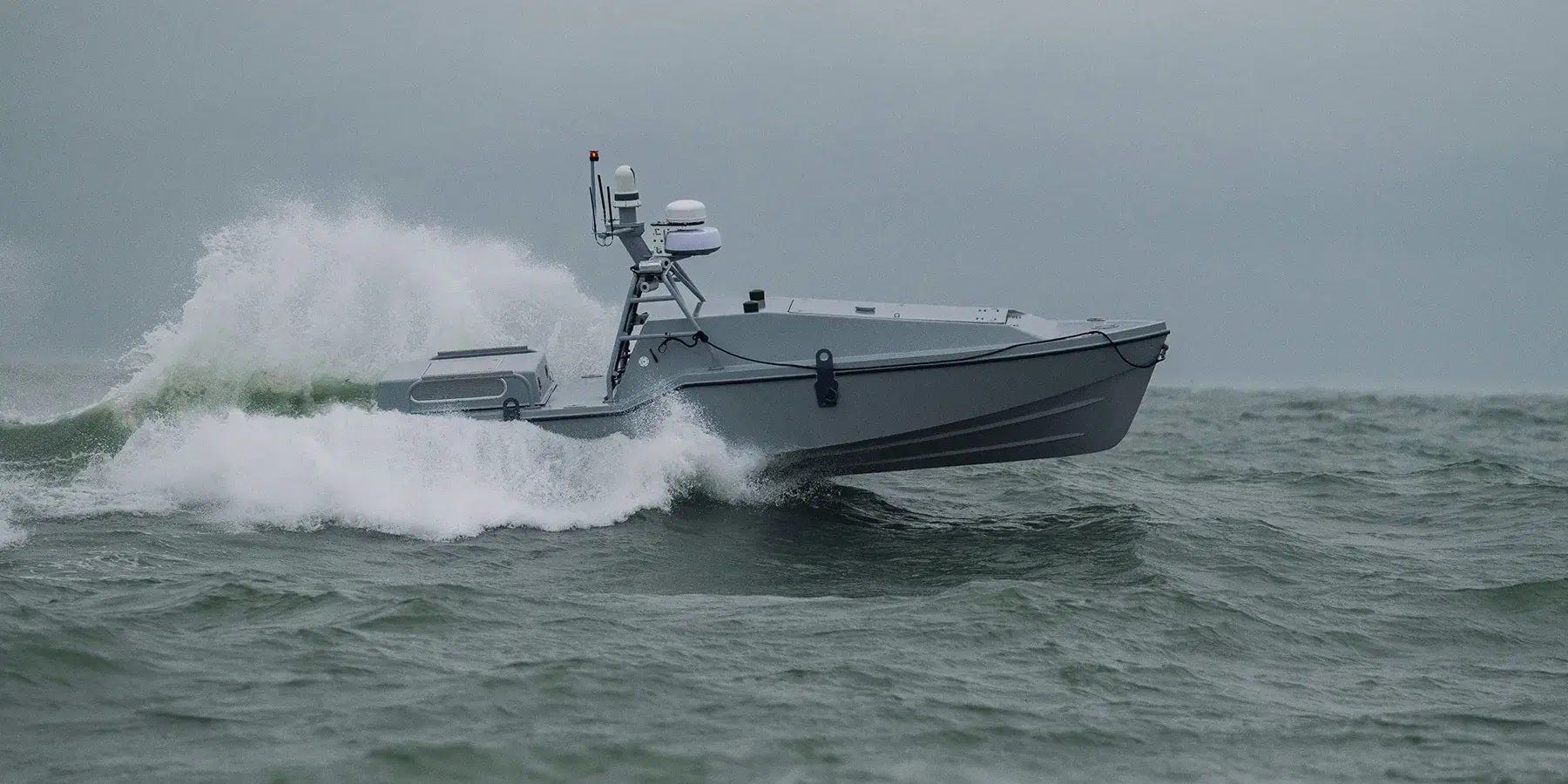
Currently, Saronic has three smaller autonomous vehicles. The smallest Spyglass is only 6 feet long and is used mostly for intelligence and surveillance. Next, they have Cutlass which is slightly larger at 14 feet and can transport payloads. Lastly, they have Corsair which is a 24-foot-long boat that can carry large payloads, conduct long-range operations and can navigate autonomously.
Corsair was the model that conducted and executed the successful rescue of the U.S. Army helicopter pilots. The mission was completed fully autonomously, without putting human lives at risk.
In order to truly understand the value Saronic offers, you have to compare that rescue mission to the daring rescue operation that the U.S. executed in Iran. That rescue mission involved hundreds of U.S. troops and dozens of aircraft. During the rescue operation, two helicopters were hit, injuring the crew aboard.7 While there were no fatal casualties, the heroic rescue could have ended significantly differently.
One is a quiet rescue mission that doesn’t put human lives at risk. The other, daring and heroic but putting hundreds of soldiers at risk.
Rob Lehman spoke about the feeling he had when he was notified about Saronic’s participation in the rescue operation:8
“There’s no business milestone, there’s no metric of performance or success that comes anywhere close to the satisfaction and gratification you get from knowing two families didn’t have to get the worst phone calls of their lives and instead they got one of the best.”
It’s rare to get a proof point that tangible that what you are doing matters...”
When comparing the two missions, it is clear to me that the U.S. Navy will want to pivot to more autonomous options when available.
Saronic’s boats are powered by its in-house software Echelon. This software is built to power a fleet of autonomous vehicles that a controller is able to control from miles away. Saronic splits up the software deployment into three parts:
Set mission objectives, routes, and roles with coordinated precision.9
Run mission scenarios to validate performance before real deployment.
Command and monitor vessels live with full operational control.
This three-step software program serves as the nervous system for Saronic’s boats and is the sea equivalent to Anduril’s Lattice. By producing all the software in-house, Saronic doesn’t need to be reliant on any other company in order to build and deploy its boats.
Within a few years, Saronic’s goal is to fully integrate its fleet into the Navy. At the rate they are going, it might just happen.
Our vision is having very smart robotic systems that can have a lot of persistence in the maritime domain and deliver complete domain awareness through advanced sensors and the most advanced software in the world.”
Dino Mavrookas
The Dino Factor:
Dino Mavrookas was born in New Jersey around 1985 and worked in a Greek diner as part of his family business.10 Like many college students from New Jersey, 9/11 was a formative experience in his life and it was when he decided he wanted to participate in the war against terror. He showed up to an FBI meeting wanting to be a tactical operator without any prior military experience and was instead sent to a Navy recruiter who put him to the test the next day.
The next morning at 7am, he met up with a former Navy SEAL for a run on the beach. A few hours later Dino was wrapped in a blanket with hypothermia after swimming in the freezing cold Atlantic Ocean.
Dino did not come from a military family and he said that until he joined the military, he had never known someone who was in the military. Despite that, Dino ended up spending 11 years in the Navy SEALs which included eight combat deployments and a period with SEAL Team 6, arguably the best unit in the world most well known for taking down Osama bin Laden.
After the army, he went back to college to get his master’s degree at The Wharton School of the University of Pennsylvania, one of the most prestigious schools in America and the alma mater of Peter Lynch, Sundar Pichai and many more.
Dino then worked at the private equity firm H.I.G. Capital for a year before moving to Vista Equity Partners for a few years.
After more than a decade of service as a SEAL and five years working at different private equity firms, he went on to found Saronic.
From what I have seen from Dino, he is a great mix of humble and hard-working and seems like the ideal CEO to lead a company. In a four-hour interview linked below, he constantly gave credit to those around him and attributed the success of his company to his wife, the team around him and to everyone imaginable except himself.
Although he is extremely humble in his own accomplishments, he is confident in his belief that Saronic will succeed and grow into one of the most important companies in the world. The mix of humility in himself and confidence in his company is one that particularly stood out to me when researching the company and listening to Dino speak.
TAM and Port Alpha:
While Saronic is primarily focused on defense and military, its technology is fully compatible with commercial uses as well. In fact, in a 2025 interview, Dino Mavrookas actually compared the sea to space as a potential area that is underdeveloped. He compared Saronic specifically to SpaceX.
“This is SpaceX. The space industry was dead. The large primes aren’t getting it done. And we’ve seen this play out in the space industry. And you’re going to see the same thing play out in the shipbuilding industry.
I know it sounds crazy that a two and a half year company is the company that is going to invest billions of dollars and recreate the shipbuilding industry and build this shipyard from the ground up and build thousands of autonomous boats and hundreds of autonomous ships. It sounds crazy because it is crazy. But it doesn’t mean it’s not true.״
While initially this claim seems outlandish, if you told someone 25 years ago that the largest IPO in history would be centered around a company focused on outer space, they would likely scoff at you.
Now while I don’t think that Saronic will pivot to data centers underwater, its potential TAM could be massive both in the military and commercial world.
It is important to note two factors when it comes to the TAM and competition.
A successful company doesn’t just dominate the existing TAM, they expand it and grow it to a level that didn’t exist previously. In 2006, the year before the first iPhone was released, the global spend on mobile phones was $109 billion.11 Today, that number is well over $500 billion. Apple’s iPhone revenue alone was over $200 billion. Apple didn’t just dominate the smartphone market, but helped expand and grow it.
Competition follows cash. When SpaceX was founded in the early 2000s, Space was considered a dead industry that had seen its spending reduced every year. Today, after SpaceX’s $1.75 trillion IPO, competition seems to be coming from every direction. More importantly, the investments in Space companies that allow fuel growth are coming in at a rate that has never been seen before.
In the military and specifically the Navy, Saronic could dominate production for small to medium boats short term and expand soon into building hundreds of large ships capable of operating fully autonomously.
Beyond its naval aspirations, Saronic has its sights set on being the largest shipbuilder in the U.S. Saronic’s new shipyard, Port Alpha, is going to be the largest shipyard in the Western Hemisphere by far. Currently, the largest shipyard is 550 acres. Port Alpha is going to be initially 835 acres with potential future plans to expand it to nearly 4,400 acres which would make it the largest shipyard in the world by far - more than double the second largest.
With the construction of Port Alpha, Saronic is following the SpaceX playbook: design your own product, control manufacturing, build at scale, increase speed and cut costs where possible.
The $3 billion construction of Port Alpha transitions Saronic from a minor player building futuristic technology into one of the major players long term for shipbuilding.
With Port Alpha expected to open production by 2028, here are some possible areas that Saronic can expand into in the future:
Military Shipbuilding
This is the most obvious one. The U.S. Navy allocated roughly $47-50 billion to Navy shipbuilding, “substantially higher” than the $39 billion that they spent in 2025.12 Notably, this 18% increase comes without any real conflict with China which could be a catalyst that would jump naval spending. This number can likely grow to an excess of $100 billion in the next decade, especially if tensions increase in the Pacific.
Currently, Saronic is still a relatively small company producing USVs. With Port Alpha it is clear that Saronic’s intentions are on larger shipbuilding in general. This opens up tens of billions (and soon to be hundreds of billions) in potential TAM both in the U.S. and among their allies.
Echelon:
In the future, Saronic’s software Echelon might also become the leading model in naval technology. With its software running in hundreds and eventually thousands of USVs, the software automatically learns and creates a huge amount of proprietary data that it can use and sell down the line. As more boats become autonomous, Saronic can potentially use its software to create new revenue streams both in the Navy and in commercial settings.
Offshore Energy:
There are trillions of dollars worth of infrastructure at sea around oil and gas. And those rigs need to be maintained every year. In 2025, the oil and gas testing, inspection, and certification market alone reached USD 24.36 billion. This number is expected to grow to over $30 billion by 2030.13
Saronic could potentially produce ships that could inspect rigs, transport equipment and perform surveillance, opening up billions of dollars in potential revenue.
Logistics:
The U.S. military spends billions of dollars moving supplies from point A to point B. Each truck driver is someone who needs to be paid, fed and housed, not to mention that they potentially put their lives at risk. Down the line, it might be both cheaper, more effective and safer to use autonomous boats to transport cargo. This is something that Saronic clearly has thought of, its new Marauder ship can carry up to 150 metric tons or four 40-foot ISO containers.
As the ships they build get larger, they can carry more and potentially generate revenue through logistics routes.
This logistics revenue isn’t limited to military or navy spending alone. Saronic could potentially move to commercial shipping as well, an industry which generates hundreds of billions of dollars in revenue annually.14 With shipping also being the most “green” form of transportation, this is a potential space that could generate billions in revenue for Saronic long term.
The SpaceX of the Sea:
Many of the above examples are likely years or decades away, but if you think of Saronic as a potential “SpaceX in the sea”, these are the potential huge revenue streams that Saronic can move into long term.
This is clearly how Dino Mavrookas and management view the company. A small company building USVs today, and a game changer in the waters in the future. The SpaceX playbook.
Competition:
Of course, Saronic isn’t the only one trying to take advantage of this space. With maritime budgets likely to expand, competition both from the legacy primes and from new companies is likely to increase.
Legacy Primes:
The most obvious and direct competition are the legacy prime companies. While currently Saronic is ahead of them in terms of USVs, the more money pours into Saronic, the more the legacy prime companies will want to move into the space that Saronic is currently leading.
Huntington Ingalls Industries (HII):
Arguably the largest threat to Saronic. HII is the U.S.’s go to naval builder building everything from Aircraft Carriers to Nuclear Submarines. While its main focus isn’t focused on USVs, they have already invested into autonomous systems and have experimented with MUSVs. If the U.S. Navy decides that they want to move further into that space, HII already has the shipyards, the builders, engineers and the connections with the U.S. government. Just to understand the size difference, HII generated over $12 billion in 2025 revenue, more than 50x more than Saronic.15
The other primes are also competing fiercely. General Dynamics has huge R&D budgets, teams working on cutting-edge technology and prior expertise in underwater warfare through its various submarines. RTX currently is the leader in maritime payloads. They might not compete with Saronic on the ships themselves but instead on the weapons around them and systems as a whole. Northrop Grumman has so far focused on autonomous aircraft but that same technology could likely be used for submarines and other maritime vessels as well.
Another potential competitor is Anduril who currently mostly focuses on autonomous aircraft and drones. Anduril has proven that they can quickly and effectively move into a space and dominate it. If Saronic was able to go from nothing to almost a $10 billion valuation in under four years all from scratch, Anduril could make significant progress very quickly if they chose to move into maritime defense. Although Anduril has not prioritized maritime products yet, Anduril has already produced a submarine called the Dive-LD. Again, innovation and competition will likely follow the money. Anduril generated $2.2 billion in 2025 revenue, 11x what Saronic did. If Saronic starts to attract contracts worth hundreds of millions or more, Anduril will likely move into the space.
The real question here is the revenue. Competition follows the money. For most of the large primes, it might not be worth it to produce small vessels that sell for hundreds of thousands of dollars. If Saronic starts generating billions of dollars in revenue, you will likely see some of the primes move into the space more seriously. Likely, Saronic will end up partnering with some of these companies providing the autonomous boats and ships while the other companies provide weapons that they use.
The Ethical Questions
Many of the questions involved with autonomous weapons are questions we also covered in our piece on Anduril. For those interested in autonomous weapons, I highly recommend checking out that piece below.

When it comes to autonomous weapons, the obvious question that arises is whether it is morally okay to invest in a company that creates weapons that can (or are even designed) to kill people. Of course Saronic’s technology can also be used for other reasons such as to save the downed pilots or to transport logistics, but one of Saronic’s primary uses is to cause damage or kill, autonomously.
Dino Mavrookas takes a similar approach to Palmer Luckey. In an interview with Shawn Ryan, he addressed the potential ethical questions with autonomous weapons:
“Am I putting a smart weapon system or a dumb weapon system? Am I sending a torpedo that I can’t call back, or an autonomous boat that I can call back.”
Dino’s point is that as technology progresses, weapons shouldn't be made not only more effective but more ethical. “Weapon sophistication can hypothetically be used to properly differentiate between civilians and militants, something that is often incredibly hard to do for humans.”16 In addition, Dino focused on the (American) lives that can potentially be saved if the U.S. moves over to USVs.
“Let’s keep those 5000 people safe. Let’s keep them out of the weapons engagement zone. Let’s have them controlling thousands of autonomous boats and ships that are patrolling the waters and overwhelming our adversaries.
However, there are larger potential ethical questions at stake here. Autonomous weapons can also introduce the possibility of lethal decisions being made without human supervision. This can be a recipe for disaster, as with time eventual mistakes will happen.
When they do, who is to be held accountable? The military officer who deployed the weapon? The engineering team who designed and built it at home? The CEO of the company whose idea it was to found the company? Or perhaps the government who authorized its use?
Likely no one can be held accountable which is what makes it so frightening.
Proponents say that autonomous weapons, like self-driving cars, can be more accurate at identifying potential targets and can be therefore more ethical. In this scenario, despite not being perfect autonomous weapons would hypothetically be the better and more ethical choice.
The difference between self-driving cars autonomous weapons is that the latter are made to kill. It also opens up a potentially dangerous scenario where a government goes rogue and can then use autonomous weapons to control or kill their own population or the population of a different country. Imagine a potential rogue government with an autonomous fleet of drones or USVs to do its bidding.
These ethical questions are questions that are worth asking and should be thought about. I bring them up not to give an answer but to provoke you to think beyond the compelling story and the next section, the valuation.
Valuation:
Saronic was founded only in late 2022 and its valuation and funding has increased quickly every year.
In 2023, Saronic had its first funding round and raised $55 million at an undisclosed valuation. The next year in July of 2024, Saronic raised an additional $175 million at a $1 billion valuation. Eight months later, they raised $600 million at a $4 billion valuation. Only one year later, they raised $1.75 billion at a $9.25 billion valuation.
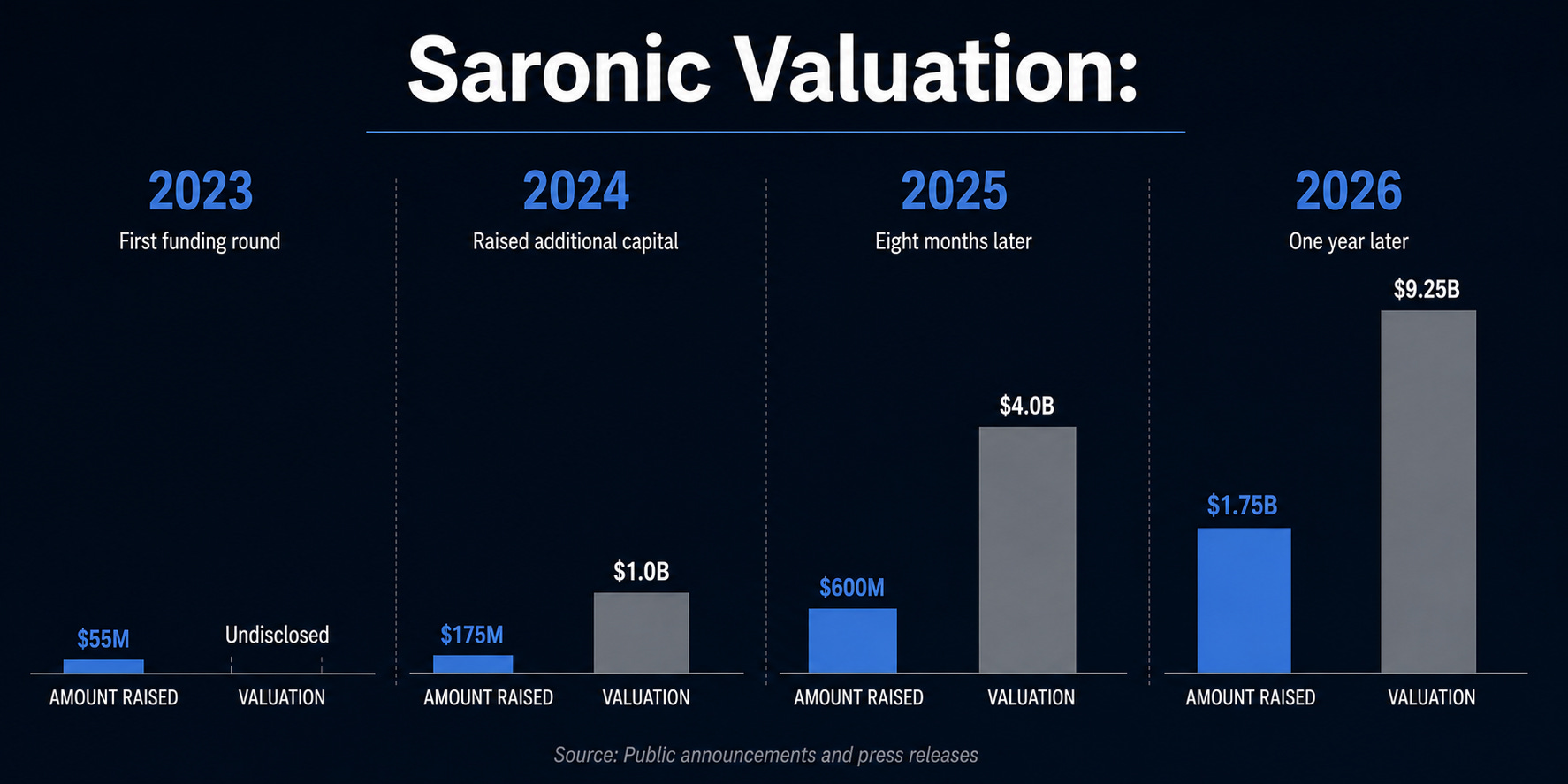
Saronic is backed by some of the biggest VC names in the industry. Its Series B funding round was led by Andreessen Horowitz. The Series C was led by Elad Gil and had a number of big names participating in it including 8VC, General Catalyst and Lightspeed Venture Partners. The Series D funding round was led by Kleiner Perkins, and included new investors like Advent International and Bessemer Venture Partners.17
Saronic has gotten major stamps of approval from the “smart money”. But does that mean they aren’t overvalued?
Sacra estimated that in 2024 Saronic generated $12.5 million in revenue. In 2025, that revenue rose to $200 million, a 1500% increase although well short of the $400 million the company guided for in January of 2025. On the one hand, explosive growth in its first full calendar year, on the other hand well short of its goal.
If we take its funding round from March 2026 which valued them at approximately $9.25 billion and compare that with its full 2025 revenue we get a valuation to revenue multiple of 46.25x. For those who aren’t familiar with the finance world, that means that at its current revenue Saronic would need 46 years of current revenue (not profits) just to match its February 2026 valuation - which has already grown.18
The big caveat is that its revenue is growing extremely rapidly as they are an extremely young company. If Saronic doubles its 2025 revenue, that multiple goes down to 23x, still high but much more reasonable. Additionally, with the construction of Port Alpha expected to finish in 2028, you can expect Saronic’s revenue to grow significantly in the coming years.
It is therefore very hard to properly evaluate Saronic and whether or not they are a good buy today. What we do know is that they are currently trading at a 46.25x valuation to revenue and are backed by some of the biggest names in the VC world. We also know its TAM is massive and the management is competent and hard-working.
This is a speculative bet that can turn into a huge company if things go right.
The bear case is relatively simple: a valuation that doesn’t match its revenue and legacy primes that block them from entering the market. While they have grown revenue from zero to 200 million in only a few years, a $3.2 billion investment into Port Alpha will need to return billions in profits in an industry that has relatively low profit margins.
For context, while Saronic’s profit margins aren’t public, the aforementioned HII which is the industry leader in shipbuilding have a gross margin of 12.7%. It is hard to know whether autonomous vessels will be significantly more profitable than regular vessels. Anduril in comparison, has gross margins that are estimated to be somewhere between 35-45%.19 If we estimate that Saronic is more similar to Anduril rather than traditional shipbuilding, that still means that they would need almost $10 billion in revenue just to pay back Port Alpha - or 50x what they made in 2025, generated solely from Port Alpha.
The IPO:
Currently, Saronic has no plans to IPO, at least none stated publicly. The investments that are currently pouring into Saronic likely don’t create a sense of urgency in Saronic to go public. Its most recent funding round closed in March with $1.75 billion raised and overall they have raised over $2.5 billion in funding in its short history.
Perhaps the only hint at Saronic going public is a LinkedIn post in which Dino Mavrookas stated that “We are the only company that comes into the market as a technology company that delivers capabilities through boats.”20
But this is more hopeful thinking than an accurate read. When billions of dollars are being poured into the company, the need for immediate capital is less likely to be urgent and therefore there is less of a point in going public immediately.
That being said, if you combine how ambitious the company is with public investors that have a strong desire to invest in Saronic, it is hard to imagine that they don’t go public when the time is right… The only caveat is that it could be in 10-15 years.
A Public Company to Watch:
For those who are interested in investing in Saronic, unfortunately unless you are an accredited investor, you can’t directly invest in Saronic. Unfortunately, no direct proxies that hold major stakes in Saronic exist like SKM for Anthropic.21
As such, those who are interested in investing in Saronic have to look at other companies that will benefit from Saronic’s expansion. Below is a possible example of a company that might benefit from Saronic’s growth.22
Huntington Ingalls - HII:
Listed above as one of Saronic’s competitors, in this case “a rising tide lifts all boats”. As the largest U.S. shipbuilder that is already deeply embedded within the Navy, it is possible that as Saronic brings additional investments into maritime companies, HII gets larger contracts from the government. This, alongside more potential investors looking at maritime companies in general leads to additional investments.
This is a reality that is already happening. In his 2025 State of the Union address, President Trump announced that:23
“We are also going to resurrect the American shipbuilding industry, including commercial shipbuilding and military shipbuilding.”
Perhaps this is part of what spurred an incredible run with HII growing over 170% in a twelve-month period. Today, HII is down over 35% from its all-time highs which presents a possible attractive time to buy, although additional research is of course needed besides the TAM expansion and a drop in the price.
If Saronic does grow significantly, HII’s growth could be analogous to the growth Rocket Lab has experienced in the buildup to SpaceX’s IPO going from roughly $25 a share to a peak of $150 in 12 months. Investing in other companies during a hype phase in order to gain access to a different company can be lucrative, but it can also be dangerous. Rocket Lab is now down 50% from its all-time high.
That being said, with HII actually being the leader and Saronic the disruptor, it is a much less speculative bet than Rocket Lab which was trading at a market cap of almost $100 billion with less than $1 billion in revenue.
Notably, for those who are interested in investing in HII, it is important to realize that you are investing not in a Saronic proxy, but in a competitor who might benefit from additional investments into its sector.
Final Thoughts:
The bear case for Saronic is that the company is valued at a level that doesn’t yet match its current revenue, its investment into Port Alpha is extremely expensive and that the U.S. government is not always the easiest customer to work with. Governments often experience delays in contracts and changing administrations can choose to prioritize one company or sector over another. Saronic’s reliance on the U.S. government as by far its biggest customer is both a strength and a potential weakness.
On the other hand, Saronic is a company with an ambitious goal to redefine maritime warfare. With its recent rescue mission, the company has moved into one that can and has produced tangible returns that save lives. With a revenue growth rate of 1500% in 2025 and the construction of the largest shipyard in the Western Hemisphere still ahead, Saronic has the potential to grow into one of the largest defense companies in the world.
What stood out most to me when researching the company is the impressive leadership and rate at which they have been able to successfully grow the company in less than four years. For those considering investing, there will almost certainly be volatility along the way, but this is without a doubt one of the most exciting companies in the defense sector and one that should be on every investor’s radar.
Disclaimer: The information shared in this publication is for educational and informational purposes only and should not be considered financial, investment, legal, or tax advice. Nothing published here constitutes a recommendation to buy, sell, or hold any security. While I strive to provide accurate and well-researched information, I cannot guarantee its completeness or accuracy. Always conduct your own due diligence and consult a qualified professional before making any investment decisions. Finally, I don’t hold any position in Saronic and was not commissioned to put out this piece.
https://www.heritage.org/sites/default/files/2026-03/2026_IndexOfUSMilitaryStrength_ASSESSMENT_POWER_NAVY.pdf
Noteworthy, this doesn’t mean the U.S. Navy is less powerful than it was in 1945, which it isn’t.
https://www.csis.org/analysis/unpacking-chinas-naval-buildup
https://www.congress.gov/crs-product/RL33153
https://www.cfr.org/articles/why-taiwan-important-united-states
https://www.linkedin.com/posts/saronic-technologies_celebrating-three-years-of-pushing-the-boundaries-activity-7373716189799333889-8zHv
The majority of this information comes from a four hour podcast with Shawn Ryan which I highly recommend listening to. In it, Dino goes over everything from why he started Saronic to his military experience. Dino is extremely humble and stresses that he was not part of the team that got Bin Laden, something I feel I should include here as well as he wanted to make that part extremely clear. The podcast is linked here.
https://www.bbc.com/news/articles/cx2vpz1kwreo
From the podcast CTRL+ALT DEFENSE: July 6th episode, Saronic Technology — Rob Lehman: Reflections on the Saronic-Powered Rescue Mission in the Strait of Hormuz
https://www.saronic.com/echelon
Saronic and Dino are still very much under the radar, Dino doesn’t even have a wikipedia page. I assumed that if he was a college freshman during 9/11, he was born roughly in 1985 although I could be wrong by a year or two.
https://www.nbcnews.com/id/wbna10805870
N.b. this spending is not the entire U.S. Navy spending budget but rather just their budget for shipbuilding.
https://www.congress.gov/crs-product/RL32665
https://www.mordorintelligence.com/industry-reports/oil-and-gas-testing-inspection-and-certification-market
https://www.atlantacustomsbrokers.com/international-commercial-shipping/
https://www.qualtrim.com/app/insights/HII?quarterOrAnnual=annual
From my Anduril article linked here.
https://sacra.com/c/saronic/
It is important to note, as a private company, Saronic doesn’t publicly disclose its revenue. I am therefore using Sacra’s estimate alongside my own calculations.
https://acquinox.capital/insights/space-and-defense-tech/anduril-industries-investor-insights-rewriting-the-defence-industrial-base-at-a-30-5-billion-valuation
https://www.linkedin.com/posts/saronic-technologies_robot-ship-startup-raises-55m-sets-sights-activity-7117581712397635585-QQq_
I do want to publicly disclose that I have a small amount of money invested in SKM.
I do not hold positions in HII nor do I recommend buying or selling any of them - do your own research.
https://www.navytimes.com/news/pentagon-congress/2025/03/05/trump-to-launch-new-white-house-office-focused-on-shipbuilding/
Great article! Two sells and three buys:
Sells:
1. China’s shipbuilding capacity advantage is overblown. What looks like a capacity advantage now quickly becomes targetable liability in armed conflict, especially when you consider that all industrial manufacturing sites have fixed GPS coordinates and elevation that become legitimate military targets in war.
2. Comparing an unmanned rescue mission in contested sea space to an overland rescue mission in hostile, mountainous terrain is questionable, though the utility in 7th Fleet AOR is certainly legitimate.
Buys:
3. I love the leadership team, their experience, their mindset, and their vision. Great companies almost always have great leadership teams, and Saronic appears to be on track for greatness.
4. Automation is the future, and the Navy is no exception. The biggest challenge the modern Navy faces is recruitment and retention of talented sailors, especially when you consider resourcing and operational tempo. Automation of the force would provide the Navy with the luxury of personnel flexibility it has not had in years.
5. The commercial applications and TAM growth are very intriguing, and I see this trend developing nicely for commercial shipping and logistics. With Saronic positioned to meet production demands, they may be able to capture a significant portion of that pie.
My biggest question mark is the moral and ethical constraints that can be engineered into the weapons systems. As you mentioned, accountability is a difficult conversation that must be addressed in advance. Operationally, I would prefer semi-autonomous weapons systems to allow for human judgment, but I understand that is not always viable when executing distributed maritime operations.
Based on your article, I would absolutely consider joining the cap table during the next round if the growth continues and the numbers make sense.
On thing in Saronic’s favor is that this Administration supports new, smaller defense contractors. They are faster and have no bias towards the status quo. A good and needed article. This nit doesn’t’ detract from it but- Although the US Army does have a few vessels crewed by soldiers, ships of the US Navy are crewed by sailors, not soldiers. ⚓️