
The Breakdown: Stripe
Inside Stripe: The Rise of the Internet's Tollbooth.

If you are reading this post, you have likely used Stripe in the last few months in order to complete an online purchase even if you haven’t realized it. Don’t believe me? Stripe powers an incredible 90% of the Dow Jones Industrial Average and 80% of the Nasdaq 100.1
If you have ever paid for a subscription on Substack, or are verified on X, you have used Stripe to pay.
Amazon, Google, DoorDash, Uber, Shopify and even recently OpenAI all use Stripe in some capacity in order to manage their payments. In short, if you are using the internet and have payments, likely you are going through Stripe.
Stripe makes it easy for businesses to accept online payments, which then makes them the de facto service for online payments.
The numbers are astounding. Overall, $1.9 trillion, or roughly 1.6% of the global GDP was processed by Stripe in 2025.
That means that Stripe processes more payments than the total GDP of countries like Saudi Arabia, Turkey, and Poland. It is roughly in line with the annual GDP of South Korea, the 13th largest country by GDP in the world at $1.9 trillion.2
By way of a roadmap, this piece will begin with the history of the company and its founding before explaining what Stripe actually does. We will then discuss the TAM and valuation, the leadership behind the company and other factors that are important when analyzing a business like Stripe.
The Birth of the Company
Smart people are rare to come by. Prodigies even more so. A family with one prodigy is rare. Two is nearly unheard of. But in a small village in Ireland called Dromineer, Denis and Lily Collison raised not one but two incredibly brilliant boys.

In 2009, the two boys who would go on to build the internet's largest payment companies were two twenty-one and nineteen-year-old kids with no finance background studying at MIT and Harvard respectively.
The idea to build the platform came to John after a 2009 YC startup event. He told his brother simply “let’s just build a prototype” and after ~6 months of prototyping, testing on friends and iterating they had their prototype ready. Within weeks, they landed their first customer. Ross Boucher, their first customer, was so impressed with the product that he ended up leaving his job and working for Stripe instead.
While initially the brothers tried to outsource to a payment processor, their attempts failed forcing them to bring everything in-house for full control. This model was one that was useful for growing quickly and making the product better, although it would shift down the line as Stripe scaled.
In 2010, the brothers went full time dropping out of their degrees at MIT and Harvard.
Then, came the breakthrough in 2011. Patrick and John Collison met with Peter Thiel and Elon Musk in 2011. Their pitch was simple. Online payments are broken and we have a solution.
The only catch was that Thiel and Musk were the co-founders of PayPal, one of the world’s largest online payment processors. The brothers went to point out flaws in PayPal and to explain how Stripe could actually help improve the platform.
And surprisingly, they actually agreed with them. Thiel himself decided to invest $200,000 into the two brothers, who were both in their early twenties. Musk also invested at a $20 million valuation.
“It’s a little impetuous to go to PayPal’s founders and say payments on the internet are totally broken.” - John Collison founder of Stripe.3
Today, if we fast forward fifteen years, Stripe is worth $159 billion. Musk and Thiel invested at a valuation that is only 0.15% of what Stripe is worth today.
The Hostile Takeover:
Before we go into the company in depth it’s important to understand how exactly Stripe became the go to payment method.
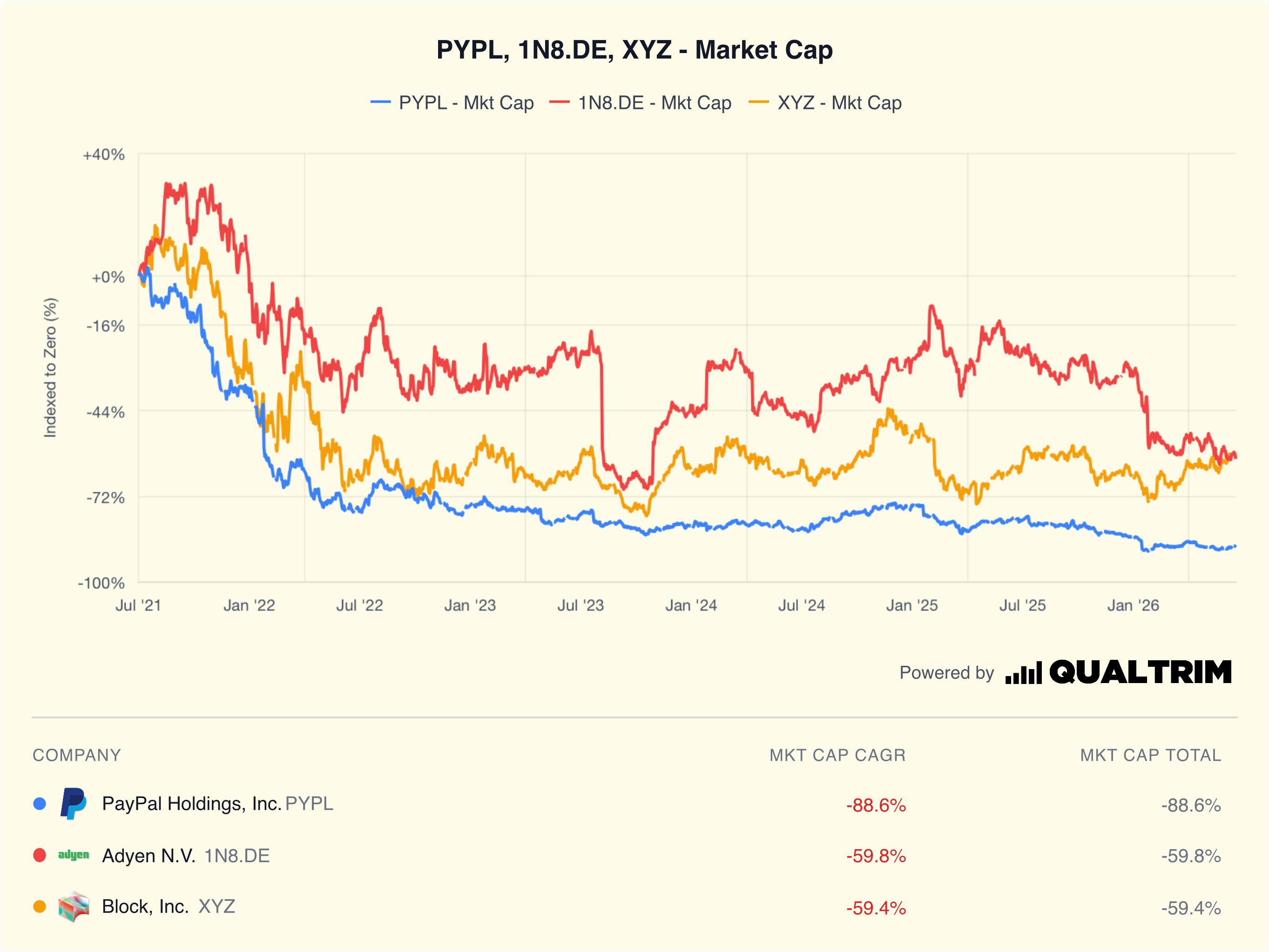
For the majority of those reading, PayPal was the go to online payment processor from its founding in 1998 for the next two decades. At its peak in July of 2021, PayPal was worth approximately $360 billion. In the past five years, however, PayPal’s stock has dropped by nearly 90%. At the same time, Stripe has risen from a company worth $36 billion in 2020 to almost $160 billion in 2026.
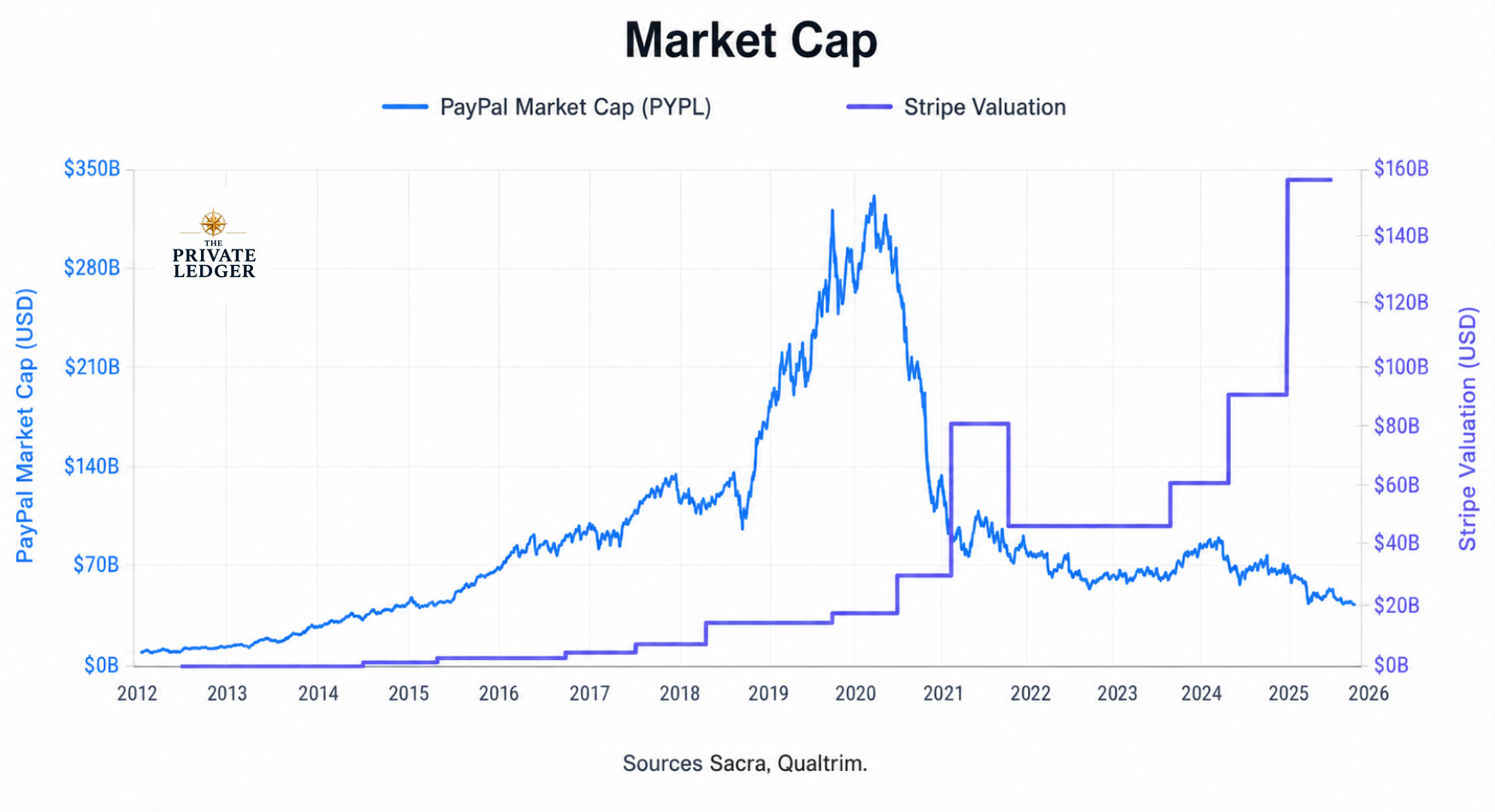
The way that Stripe took over the online payments world and usurped PayPal should be the content of a full article and I will attempt to do it justice in the next few paragraphs.
The first thing that Stripe did is focus on developers and making their product as seamless to integrate as possible. By targeting developers, they managed to integrate their product naturally into different companies through developers recommending a product they actually liked. This form of advertising was absolutely brilliant and is likely a large reason Stripe grew so quickly.
Furthermore, while the internet and PayPal began accepting online payments in the early 2000’s, the third party method PayPal used, which was once unique and innovative instead quickly became “ancient news”.
This is something that didn’t happen by chance. In a podcast with Stripe’s founder John Collison, while discussing agentic AI and shopping using AI (a topic we will dive into later in the piece), John spoke about the importance of technology moving to become more frictionless and how low-friction options usually win out long term.4
Our bet is that people will want the lower friction option. I think in the history of technology the lower friction option tends to win out.
John Collison, Odd Lots Podcast.
Second, while PayPal focused on traditional merchants and the consumer wallet, Stripe struck deals with startups and SaaS companies such as DoorDash, Shopify and more recently OpenAI. The expansion of the internet (and I might add the integration of AI into the internet) has made it so that it is easier and easier to create and build platforms and companies.
Lastly and perhaps most importantly, PayPal had been around for longer than Stripe. While this might sound like an advantage, in the extremely fast-paced and ever growing internet era, a clean slate was likely easier to develop than PayPal’s existing system. Redesigning a company with hundreds of millions of users likely causes a huge amount of friction that Stripe didn’t have to deal with.
It is also notable that PayPal had a number of its key figures also known as the “PayPal mafia” leave the company. Just as a few examples, Elon Musk left/was pushed out of the company and instead decided to focus on SpaceX and Tesla. Peter Thiel left after the Ebay acquisition and later co-founded Palantir and runs a venture capital firm. David Sacks left to found Yammer and Geni and eventually find himself in Trump’s cabinet as the “crypto czar”. Reid Hoffman left and went on to found LinkedIn.5
While PayPal continued to be successful long after Musk and Thiel left, when you have that amount of talent which essentially served as both the brain and the soul of the company leave for their own business ventures rather than have a core of the company steering it in the right direction, the company will likely lose its direction and be lapped by other companies like Stripe whose founders have had the same vision from day one.

What Does the Company Do?
Stripe is a “full stack payment processor.” Simply put, Stripe allows business owners to accept payments from almost every credit or debit card in the world in most currencies.
Instead of the old “PayPal” method of forcing users to create a third party account, transfer funds into that account and then paying, Stripe makes the process much easier allowing users to pay directly using their bank cards into the business owner’s bank account.
Stripe is also relatively easy for business owners to set up with options to set up the platform in hours or even just minutes for a basic Stripe integration. They did this by allowing instant account creation that can be powered with Stripe’s easy to integrate powerful API - Application Programming Interface.
Because of these factors, Stripe has quickly become an extremely attractive option for small businesses and websites across the globe. As of May 2025, 1.35 million websites had chosen to use Stripe and in the last 14 months that number likely has increased significantly.6
While before we mentioned that Stripe originally built everything in-house, due to their massive scale Stripe now partners with other companies such as Amazon (particularly AWS), and banking networks (such as Goldman Sachs and Wells Fargo) in order to route actual funds.
That being said, Stripe does still keep a massive amount of proprietary software in-house such as fraud detection (Radar) and their intelligent routing API i.e. the code that figures out the fastest way to route payments.
The Business Breakdown:
Stripe is no longer just a payment network and in order to truly understand the company it is important to look at the main facets of their business.
Payments:
Payments is Stripe’s main revenue stream and their primary cash cow. Simply put, this is the commission that Stripe takes every time a payment goes through. This revenue stream makes up the vast majority of Stripe’s revenue with estimates varying between 75-85%.7 Stripe’s business model is simple, charging 2.9% + $0.30 per online transaction and 2.7% + $0.05 for every in-person transaction.
Simply put, the more payments that move online, the more Stripe and its payment processing network benefit.
Billing:
Besides one-time payments, Stripe also offers recurring subscriptions which are used by many companies including Substack. Anytime a recurring subscription happens, such as on Substack or X, Stripe takes commission.
One of the reasons why this is so effective and why Stripe is so sticky is because as a service, you actually have a relationship where you like/don’t mind Stripe. The fact that they process and handle the payments and only take a relatively low commission allows you to make money from your business. As a Substack writer, I prefer the ease in which payments automatically enter my bank account from the other side of the world rather than having to use a third party tool in order to accept payments. Any business where the client likes the service more than they dislike the party taking fees is likely a strong business with a wide moat. Mastercard and Visa are good examples of this.
Connect:
Stripe Connect is Stripe’s partnerships with some of the largest corporations in the world to enable embedded payments directly into their apps. These huge businesses include Shopify, DoorDash, Salesforce and more.8 Stripe connects automatically handles the split between a large corporation, its workers and Stripe itself.
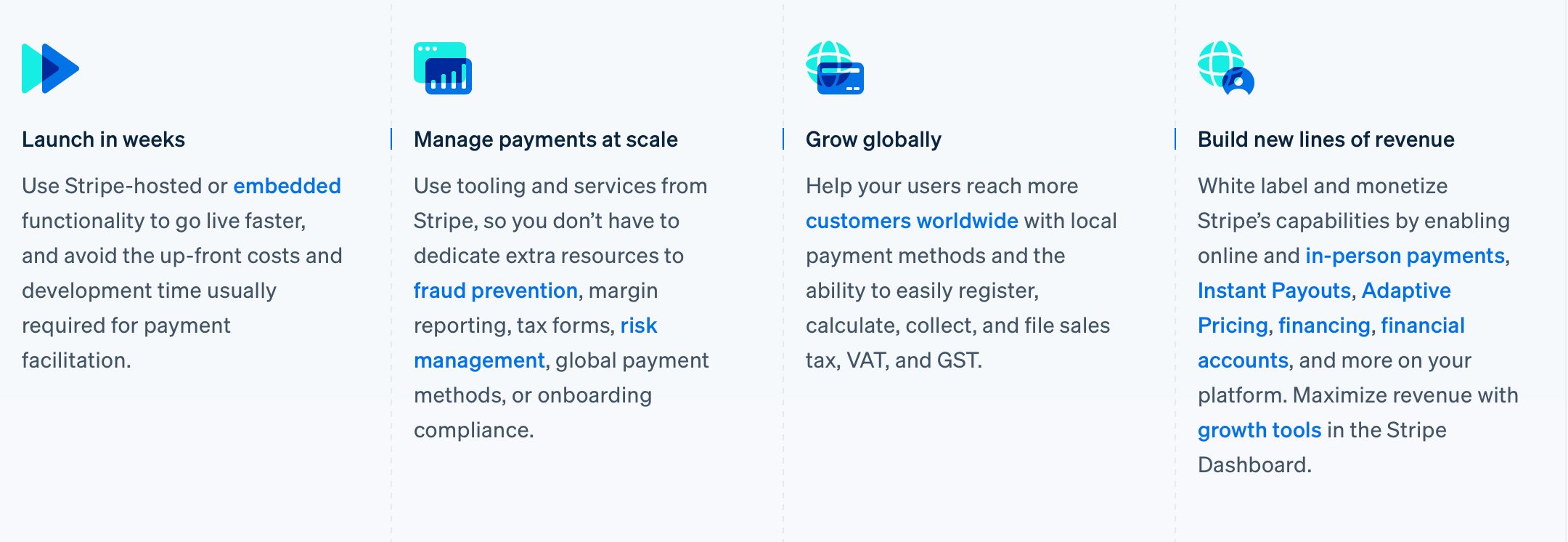
In a matter of weeks, Stripe allows businesses to embed and incorporate payment systems directly into their platforms while avoiding upfront costs.
Stripe allows businesses to “manage payments at scale”, “grow globally” and helps with fraud prevention, taxes, payouts, financing and more.
Issuing:
Stripe now allows companies to launch debit or credit cards through Stripe. This service has been adopted by dozens of different businesses around the world and through them Stripe has created over 275 million credit cards.9 While it’s still not at the level of Visa or Mastercard, it is almost double as much as American Express, the third largest provider of credit/debit cards in the US.10
By competing with credit and debit card companies as well, Stripe is hoping to increase their TAM and shift more consumers towards them - not just online but in person as well.
As their customers become more and more entrenched in the Stripe ecosystem, it becomes increasingly difficult to leave and their other products become more attractive as they fit with your existing uses.
Radar:
In addition to payments and credit cards, Stripe also offers fraud protection to their customers. The machine learning system that Stripe uses is trained on over $1 trillion in annual payment volume.11
As AI becomes more prevalent and adept at potential fraud, prevention and detection is becoming more important. Stripe’s Radar is used by thousands of online businesses across 5 million websites and companies including OpenAI, MindBody, Etsy and Slack.
Tax:
Another feature Stripe offers is Stripe Tax which automates global taxes across countries. This allows businesses to focus on growth and the product itself rather than get bogged down focused on the accounting of their products. This product is extremely sticky once integrated and is used by thousands of companies including Duolingo, OpenAI, Fico and our very favorite, Substack itself.12
The Other:
Incredibly, these aren’t the only products Stripe offers. They also offer additional services such as:
Atlas, a service that helps startups incorporate and has been used by the likes of Cursor, Lovable and Runway. More than one in five Delaware C-Corporations startups are incorporated through Atlas.13 These startups often end up incorporating Stripe into their business down the road.
Identity, a service becoming more important in the fintech world that helps companies confirm the identity of users across the world. Used by Discord, Clubhouse and more.14
Capital, a service that funds eligible businesses through loans using a one-time flat fee rather than long-term loans.15
Press, an independent publishing press that writes thought provoking content on technology, society and progress.16
There are more services that Stripe offers but these are the main ones. While the vast majority of their revenue likely comes simply from Payments and Billing, the other products that they offer are to make the Stripe suite as a whole more appealing and the overall product more sticky.
Once a company has Stripe fully integrated into their business, it is often not worth the switching cost even if they find an appealing alternative.
It is also the case that a customer who only needs one product offered is significantly more likely to use the entire Stripe suite. One of their products is enough to attract customers and potentially keep them within the entire Stripe ecosystem.
Total Addressable Market (TAM):
In order to properly understand Stripe and its TAM, you have to look at it as a digital tollbooth that companies use in order to process payments.

First, it’s important to backtrack a little. We weren’t always huge online spenders. Human beings are creatures of habit. But sometimes even humans are forced to abandon their habits due to situations out of their control.
COVID-19 was one of these examples.
Because the virus meant people were staying at home at rates significantly higher than they normally would, people began shopping online significantly more often.
More shopping online meant more business to Stripe, and they took advantage in a massive way. Stripe’s revenue grew by 167% in 2020 during the peak of the pandemic.17 In 2021, even as the pandemic was cooling down, Stripe grew revenue by 56%.
Importantly, once the pandemic “ended”, Stripe’s revenue growth continued. While it did slow down slightly, it still grew consistently at a rate of between 25-28% in the three years following the pandemic. Last year, in 2025, the revenue again accelerated.
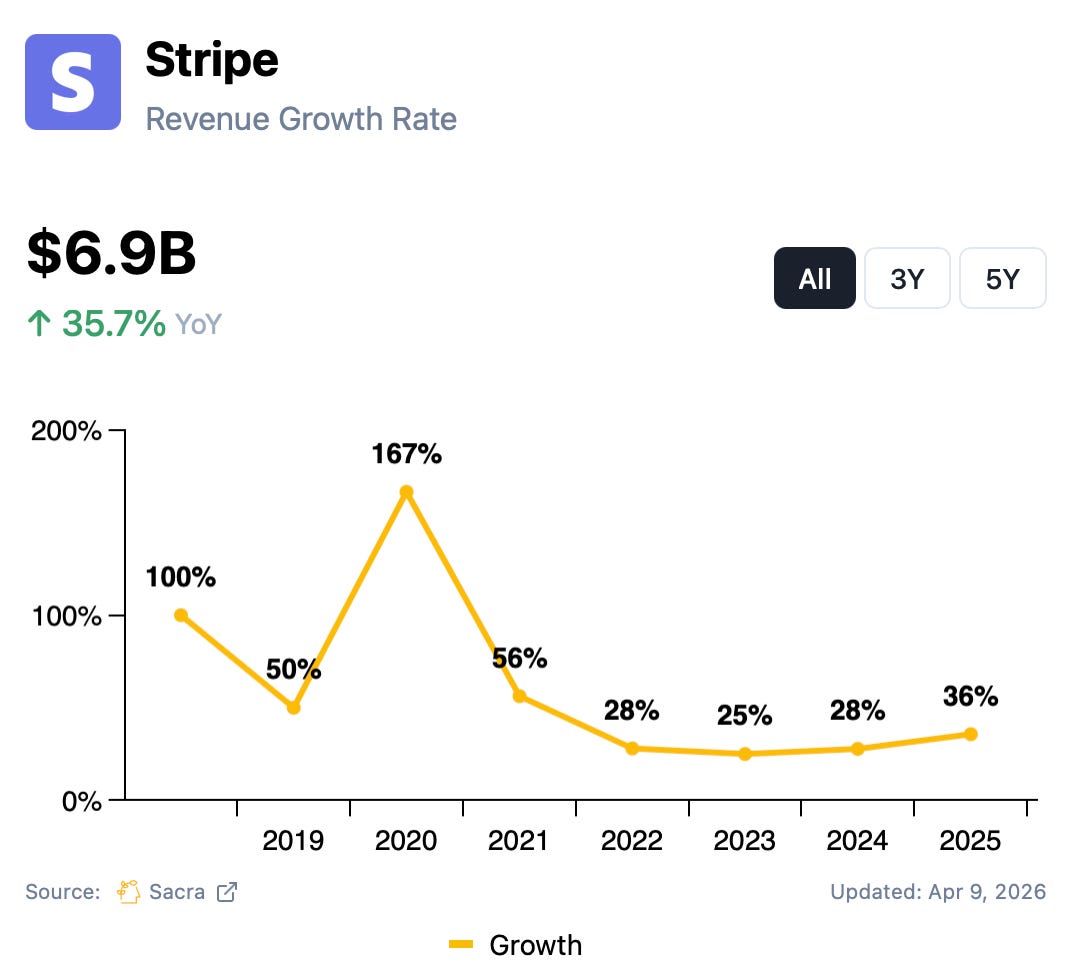
What is important to note here is that once people became familiar with online shopping for everything from clothing to groceries during the pandemic, they never reverted back to their prior ways of going to the store.
In fact, today, more people are shopping online than ever before. In 2025, online sales accounted for roughly 25% of all retail sales, up from only 10% in 2017.18
And recently, another factor has sprung up which has made online shopping more common and effective. It’s also a factor that drives people online and makes it more efficient for companies to advertise online rather than have physical stores.
Artificial Intelligence.
For example, a human salesperson isn’t able to reference every single book in existence. An AI trained to make sales is. So when I am searching for a book and decide to buy Crime and Punishment, the machine learning can immediately recommend The Brothers Karamazov if I want another Doestoyevsky classic or The Stranger if I want another existentialist masterpiece.
It is for this reason, Amazon has successfully integrated AI into their website to “reinvent online shopping and make it faster and easier”.19 Meta is using AI to increase revenue generation by 33% a year.
Overall, last year, AI influenced a total of 19% of online purchases and this number will only continue growing.20 And as AI becomes more prevalent and more efficient at recommending purchases for shoppers, the number of total online shoppers will likely continue to increase.
And online shopping isn’t the only place where people are moving their spending online.
More people are using Kindles than ever to read books - of which Stripe takes a commission.
More people are replacing newspapers with online newsletters, Substack is the perfect example of this of which again, Stripe is taking a commission.
More people are using food delivery apps to have food delivered to them instead of eating at restaurants of which once again, Stripe takes a commission.
The use of AI in shopping is only expanding with the introduction of Agentic AI or AI systems that can potentially do tasks like ordering things for you. In the aforementioned podcast linked below, Stripe’s founder John Collison believes that LLMs like Claude and ChatGPT recommending shopping options to different customers will become increasingly common going forward. When pressed and asked whether this is a good thing, he responded with the following:
Our view is that at a very minimum, leave aside any agent decision-making that is happening just the final step of buying something you know you might have researched a product in an AI app before… When you find the product at the end, do you really want to be filling out all the web form fields and things like that? Or do you just want to say “Yeah, that sounds good, buy it for me in this size.”
This is the world that we live in today and Stripe is positioning itself to dominate it. Agentic AI doesn’t need to plan your trip to Italy, but it can be used to order your food for a recipe that you found online - or increasingly a recipe generated by AI.
As Stripe continues to dominate online payments, the simplest bull case becomes stronger daily. An increasing amount of people are using online services to complete a growing number of purchases. Stripe benefits from their TAM increasing and by being the de facto online payment processor.
Competition:
While Stripe is without a doubt the leader in online payments, there are a number of serious competitors who are all trying to take market share away from Stripe.
PayPal:
First and foremost is PayPal, the payment giant who Stripe originally uprooted as the de facto online payment processor.
PayPal, and specifically Braintree (which they acquired in September of 2013 in an all-cash $800 million deal) provides an alternative with no monthly fees and is ideally tailored to customers who want to pay with PayPal, which despite a 4% decrease from the previous year still reported 25.4 billion transactions over a total payment volume of $1.79 trillion - similar to the amount Stripe processed in 2025.21
For small businesses looking for a known name to boost credibility and trust among customers, having a PayPal option for checkout can boost conversion. The downsides are that Braintree is more complex and time-consuming to set up than Stripe, even for developers and there is a high risk of funds being seized and held.
PayPal's fee of 2.89% + $0.29 for Braintree and 3.49% + $0.49 for Venmo are relatively similar to Stripe’s 2.9% fee depending on the exact product being used. PayPal also offers high volume customers the ability to negotiate better rates, the rate mentioned before is the standard rate.
As an aside, there have been rumors that Stripe is actually considering purchasing PayPal in order to further their dominance over worldwide payments.22 Due to PayPal’s considerable drop in stock price - largely due to the rise of Stripe, PayPal is currently valued at around $40 billion, roughly 15-20% of what it was worth at its peak. When rumors of the potential takeover surfaced, the stock rose more than 10% where it has stayed since then.23
Block:
Square, started by Jack Dorsey (original founder of X i.e. Twitter) and Jim McKelvey was founded in 2009 after McKelvey, who was working at the time as a glassblowing artist, lost a sale over not being able to accept credit cards. His call to Dorsey, which has become a thing of legend, is quoted below.24
“I’ve just lost a $3,000 sale because I couldn’t accept credit cards.”
The call that led to the founding of Square.
Block, originally known as Square before a name change in 2021 is now valued at $47 billion and has quickly become one of the most popular alternatives to Stripe. Block offers an easy to implement plug and play system that is meant to work without a developer. This ease of implementation makes it specifically useful for small businesses that want to accept payments without having to hire an external developer.
Block matches Stripe’s charge of 2.6% + $0.10 in-person, 2.9% + $0.30 online. The downside for using Block (Square) is that it includes a monthly $49 fee, there exists a risk of funds being frozen and human support is relatively limited in case of problems.
Interestingly enough, Block’s valuation has nearly doubled ever since they announced massive layoffs due to AI replacing employees leading to ethical questions that we covered in depth during our Anthropic article.

Adyen:
The last competitor that I will mention is Adyen, the Dutch payment company founded in 2006. Adyen, which processed $1.6 trillion in payments in 2025 and is used by thousands of companies including Meta, Uber and Microsoft specializes in large enterprise customers and processing high volumes across different regions. Adyen also has lower chances of funds being frozen - think of them as quality service for high paying customers.
The drawback with Adyen is that it is not built for small businesses at all and is relatively expensive unless running a massive corporation. Pricing is strictly quote-based for larger corporations, automatically excluding smaller companies.25 As companies become easier to fund and build, this is an increasingly important niche which I believe Ayden is missing and will hurt the company long term.
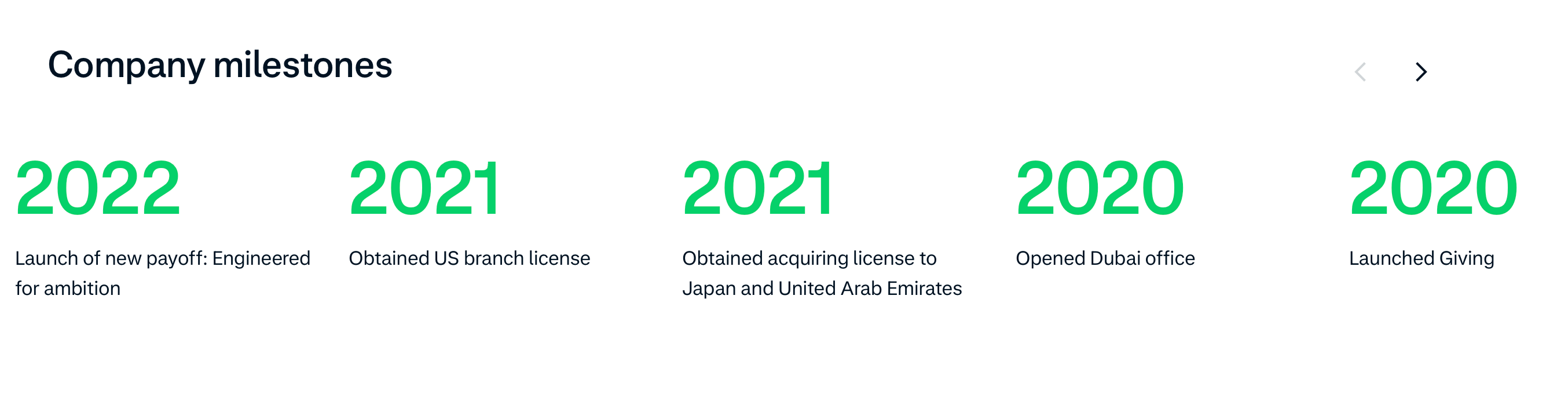
This is perhaps the reason that Adyen, which trades on the stock market under the ticker ADYEN, is currently valued at just over $26 billion, almost a third of its all-time valuation. Perhaps proof of the fall of grace that the company is going through lies directly on Adyen’s website which lists the company milestones which stop showing abruptly after 2022.26
Overall Competitive Summary:
An important thing to think of as a business is that while much of the focus goes to the slight differences in pricing, often it is the risk of funds being frozen that really drags a company back long term. Fund freezes disrupt the flow of your business and divert resources, causing them to be frustrating to deal with. Stripe, which has an automated algorithm is often known for freezing funds more aggressively which may turn customers towards their competitors.
Overall however, all three of these companies have been outpaced by Stripe. This fact is reflected in the stock prices of all three aforementioned competitors. All three stocks mentioned above have seen significant declines in the past five years during a time that Stripe has more than doubled. This isn’t a shrinking of the general TAM of the industry, it’s a significant outperformance by one company that has become dominant in its sector.
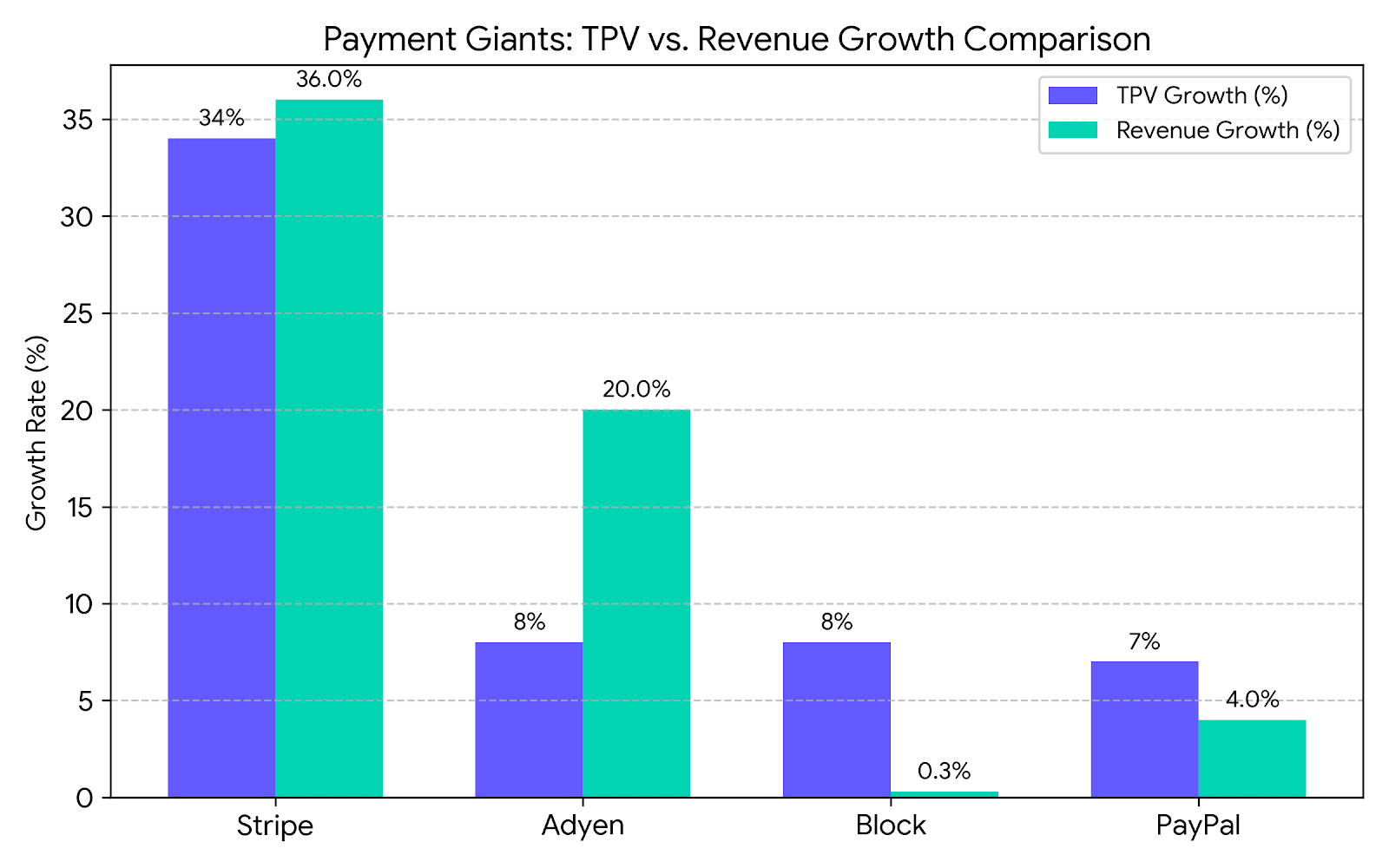
The numbers tell the clearest picture. Stripe is racing by all three of these competitors in both total payment volume growth and revenue. If the numbers below are a little hard to comprehend, the chart below is much easier to read.
Stripe - 34% TPV growth - $1.9 trillion total TPV. Revenue: $6.9B revenue growth 36%.
Adyen - 8% TPV growth - $1.6 trillion total TPV. Revenue: $3.05B revenue growth 20%.
Block - 8% GPV growth - $260 billion. Revenue: 24.19B revenue growth 0.3%.27
PayPal - 7% TPV growth - $1.79 trillion total TPV. Revenue: $33.2 billion 4% revenue growth.
The Collison Brothers:

Stripe’s leadership is the total opposite of the PayPal fiasco we previously mentioned. While PayPal had massive turnover in its leadership, the Collison brothers have been incredibly solid and consistent in their leadership.
John and Patrick Collison who founded the company on day one are still with the company guiding it forward and constantly doing interviews and leading the charge. They clearly see the company as their project and are constantly working to improve it.
Businesses that don't have to sing for their supper every day, I think they get a bit flabby and lazy. We still have a list four times longer of the things we would like to do.
John Collison
The company that was born out of a desire to fix a broken experience is still led by the same duo, continuously innovating and improving both the company as a whole and the quality of the workers within the company.
“Stripe really did come about because we were really appalled by how hard it was to charge for things online.” - John Collison28
While John runs the public relations side of the business, his brother Patrick is just as busy behind the scenes focusing on engineering, product management and general strategy.
Overall they are a powerhouse duo that propels Stripe forward with their innovation, creativity and work ethic and are one of the largest reasons for Stripe’s continued success.
The Ethical Questions
Unlike most companies that I write about, the ethical questions with Stripe are relatively few and far between.
As one of the safe providers of payments around the world, Stripe is actually battling against unsafe, untested fintech companies and provides a complete safe financial infrastructure.
Stripe even goes as far as prohibiting certain types of legal businesses including adult websites, cannabis and allegedly gambling - although as an aside when I was diving deeper into the research I saw that Stripe actually does actively partner with Kalshi.29 How exactly that is not considered gambling blows my mind and is a clear miss on Stripe’s part but the ethics of gambling and prediction markets in general are the subject of another piece, luckily one that I already wrote and highly recommend.

One thing that is problematic is the fact that Stripe’s algorithm automatically seizes or freezes funds when flagged for potential problems. This is partly caused by the fact that Stripe has an “approve first, check later” mentality trying to get customers and businesses’ funds into their accounts as quickly as possible and only checking afterwards.
While not hugely damaging to large corporations, these temporary freezes can be hugely damaging for small businesses who are relying on the consistent cash flow. This is something that Stripe is aware of and Patrick Collison has spoken about.
“With Stripe, each individual business is so important that like each mistake really matters and every time we get something wrong it really pains us.”
Patrick Collison
While not at all belittling the importance of these business owners, the fact that the main ethical questions include accidental temporary freezes (again which can be hugely damaging) shows how the company is really not bogged down in ethical questions the same way some of the other companies I have covered have been.
One other problematic issue with Stripe is that it is only available in certain parts of the world. For certain businesses, like Substack this means that a creator can go through all the work of researching, writing and growing their Substack and have no ability to monetize their product. That being said, I think this is more a problem with Substack not offering an alternative option but it is notable that Stripe is only available in 46 countries.
Crypto and Stablecoin:
Stripe originally became one of the first major crypto adopters when it began accepting Bitcoin payments in 2014. Ultimately, due to insufficient usage, the volatility surrounding Bitcoin, payments taking hours, and other issues Stripe eventually made the tactical decision to remove Bitcoin from its services in 2018.
Again if you are looking for examples of Stripe’s fantastic leadership, this is one. Be an early adopter in an expanding market, try your best to make it work and pull out despite the sunk cost when it didn’t work out.
In fact, even as they were pulling out of using Bitcoin John Collison was still talking about the future potential he sees with crypto.30 While some might think of this as hypocrisy, I see it as model leadership. Keep all doors open long term, focus on the ones that are most beneficial today.
“We’re very excited by [the] longterm potential for the payments use cases of crypto…. Especially not in the U.S... But as you go to a lot of far-flung countries, if we wanna offer easy APIs to pay out to long-tail countries, we think there could be a bunch of interesting ideas there.”
John Collison bullish on Crypto back in 2019 while his company pivoted away from Bitcoin.
And for the next few years Stripe waited for the tides to turn in the crypto world while focusing on the part of the business that was working, tripling their valuation in between 2019 and 2021.
The emergence of stablecoin and in particular USDC fundamentally shifted Stripe’s outlook on crypto.
For those who don’t follow stablecoin, the goal is to have a currency that moves at the speed of cryptocurrency i.e. instantly but is tied to a tangible currency - usually the U.S. dollar. Hypothetically, what you are left with ideally is a perfect combination. A currency that moves instantly and doesn’t have the wild fluctuations that crypto traditionally has. In addition, stablecoins remove the friction of currency exchange making them ideal for cross border currency. As an aside, I fundamentally disagree with this view, something I write about more in the footnote below.31
And in a world where attention spans are shrinking which is increasingly trying to minimize everyday friction, stablecoins are seen as the solution to the typical slow-moving currencies.
In 2022, spurred by their belief in stablecoin, Stripe founded their crypto division. They included new products, invested in crypto startups and built the stablecoin infrastructure in the same way they did for digital payments. This belief was led by Patrick Collison who is particularly bullish about the future of stablecoin.
“In the coming years, everyone programmatically moving money will likely want a stablecoin strategy.” - Patrick Collison
In 2023, they continued focusing on crypto, emphasizing the ability to use stablecoin specifically focusing on the uses in emerging markets such as cross-border transactions and lower international fees.
And then in 2024, Stripe began focusing full time on crypto. They had their “Stablecoin Payments Launch” allowing customers to officially use stablecoins to pay for transactions up to $10,000.32
In October of 2024, Stripe agreed to purchase Bridge for $1.1 billion, the largest crypto acquisition by a fintech company ever.33 With the acquisition of Bridge, a company that helped companies integrate stablecoin without having to deal with the complicated blockchain technology behind it, Stripe positioned themselves as leaders in the crypto payment sphere.
“(The Purchase) validates stablecoins as a primary use case for blockchain technology” Bernstein analysts said.34
At a time when PayPal launched their own stablecoin, Stripe was positioning themselves through an acquisition to stay ahead of its competitors. The acquisition proved that Stripe saw stablecoin usage as a huge player in the future of payments.

In 2025, Stripe continued building out their stablecoin infrastructure expanding their stablecoin treasury service, integrating stablecoin business accounts and adding developer APIs, particularly for stablecoin.
Stripe is investing so heavily because of how strong their belief is in stablecoin as a payment mechanism for the future.
“Stablecoins have four important properties relative to the status quo: they make money movement cheaper, they make money movement faster, they are decentralized and open-access, and they are programmable. - Patrick Collison35
However, long term there are still hurdles to pass before stablecoins see worldwide adoption. John Collison put it bluntly in an Ask Me Anything that I highly recommend.36
“Everything is still a little junky today… The experience still isn’t as quick as the card experience”
That being said, both brothers were overall extremely bullish on stablecoins as a whole long term.
“There is going to be a lot of stablecoin native financial services that do extremely well”. - Patrick Collison
When asked if Stripe was going to launch their own stablecoin, Patrick answered that while not ruling out the possibility, their current focus is not on launching their own stablecoin but rather “catalyzing stablecoin adoption” and becoming the payment infrastructure rails long term.
And this is a goal they will likely succeed in. By becoming the go-to company not just for online payments but for the stablecoin ecosystem as a whole, Stripe invests time and resources today into becoming the industry leader for the future. If stablecoins pan out, Stripe could generate massive returns on their current investments, if stablecoins don’t, Stripe will continue to expand in other areas that they are already succeeding in. Stablecoin is a high upside low downside asymmetric play for Stripe.
Valuation:
As mentioned previously, Stripe’s payment business model where the majority of revenue is made is simple, they charge 2.9% + $0.30 per online transaction and 2.7% + $0.05 for every in-person transaction.
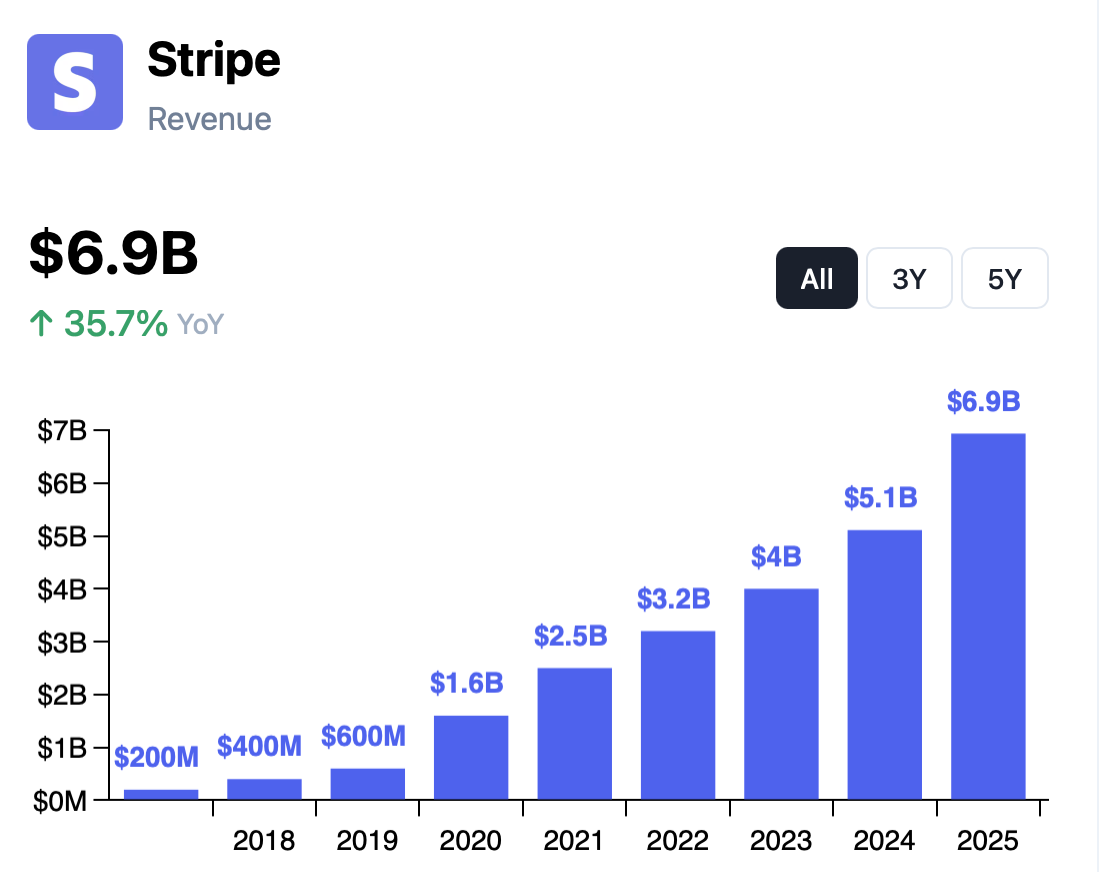
In 2025, that business model generated $6.9 billion in revenue, a 35.7% increase from the $5.1 billion in 2024. More importantly, they have increased their revenue by a factor of more than 10x in the past six years since 2019 and more than 30x in the past decade.37
And Stripe (riding on the backs of an increasing TAM in general) has been incredibly successful during sales season. 2025’s Black Friday through Cyber Monday weekend was Stripe’s largest four-day period ever with 578 million transactions and over $40 billion in TPV. Cyber Monday alone reported over $10 billion in TPV.
What is particularly unique about Stripe and why their valuation has gone up so much is that their TAM is significantly expanding every year.
“People always forget that 50% of a stock’s move is the overall market, 30% is the industry group, and then maybe 20% is the extra alpha from stock picking.” - Stanley Druckenmiller
As their TAM expands, as the industry leader they are uniquely positioned to take advantage and continue growing. Their valuation expansion has fit with this narrative.
Stripe’s valuation of $159 billion is also backed by some of the largest and most respected VC funds in the world. Sequoia Capital, Thrive Capital, Andreessen Horowitz, and Founders Fund have all invested billions of dollars. In addition, at their most recent funding round, Stripe actually repurchased some of the shares itself performing a sort of “share buyback” that signifies a large conviction in their stock. This is a healthy fast growing company with a balance sheet that most companies would envy.
Today, Stripe is currently valued at a EV/Revenue multiple of 23x which is slightly higher than what they have traded at previously. This is likely due to the fact that Stripe has been growing both TPV and revenue at over 30% a year and are clearly pushing ahead of competition. Currently, Stripe holds 29% of online payment market share globally and 45% in the US.38
With Stripe now trading well above $150 billion, they are trading at a valuation similar to companies like IBKR and BlackRock despite trading on the private market. While it is hard to say that Stripe is cheap at 23x EV/Revenue, the premium being paid is because of the health of the company mixed with fast growth.
A Potential IPO:
As with all attractive private companies, retail investors are waiting for the IPO. Unfortunately, Stripe is showing no rush to go public anytime soon. In fact, as recently as February of this year John Collison said that Stripe has no intention to go public in the short term saying that “an IPO would be a solution in search of a problem…We have a self-funding business that’s growing very well with lots of new products that we want to go create and so we just don’t need the extra capital right now.”
If that’s not clear enough, he went a step further.39
Going public isn’t “one of our top five or ten or twenty priorities.”
While this is potentially frustrating for retail investors unable to invest in the private market, management choosing the good of the company over enriching themselves is a great sign especially in a world shifting more and more to focusing on self enrichment.
Unfortunately for now, this is one company that will only be available in the private market in the near-medium future.
Final Thoughts:
The most telling part of this piece in my opinion is that in the past five years, Stripe’s major competitors have all gone down significantly in valuation while Stripe has grown its valuation considerably.
Stripe’s moat is due to the fact that they have built an online ecosystem for finance that is simply better and easier to integrate than their competitors. By targeting developers, they often manage to have their products recommended from within the company rather than searching for a way into a business. Their scale advantages and innovation continue to push them ahead of their competitors and they are growing significantly faster than the competition by every metric. If stablecoins achieve mainstream adoption, Stripe is perfectly set up to capitalize on that as well.
When you mix competent leadership with a best in class product in an expanding industry, you get the rapid growth that Stripe has experienced over the past few years. Take away any of those pillars, and you get a shrinking company. Don’t believe me? Check out the competition.
Author's Note:
As I was writing the piece, I was increasingly impressed with the Stripe team and the website, which made it significantly easier to pull raw data and research the company instead of having to look into third-party sources - which I did of course anyway. In particular John and Patrick Collison impressed me with their mix of being both brilliant and down to earth, something rare among top tech founders. I highly recommend listening to any podcasts or videos with them, some of which are linked below.
Disclaimer: The information shared in this publication is for educational and informational purposes only and should not be considered financial, investment, legal, or tax advice. Nothing published here constitutes a recommendation to buy, sell, or hold any security. While I strive to provide accurate and well-researched information, I cannot guarantee its completeness or accuracy. Always conduct your own due diligence and consult a qualified professional before making any investment decisions. Finally, I don’t hold any position in Stripe and was not commissioned to put out this piece.
https://stripe.com/it/newsroom/news/stripe-2025-update
Comparing TPV to GDP isn’t exactly apples to apples. My point is more to convey the massive payment volume that Stripe handles.
https://thefinanser.com/2018/12/untold-story-stripe
Link to the podcast which I highly recommend.
https://www.businessinsider.com/paypal-mafia-members-elon-musk-peter-thiel-reid-hoffman-companies
https://redstagfulfillment.com/how-many-businesses-use-stripe/
https://www.untaylored.com/post/how-stripe-makes-money-business-model-explained
https://stripe.com/connect
https://stripe.com/issuing
https://coinlaw.io/american-express-statistics/
https://stripe.com/radar
https://stripe.com/tax
https://www.linkedin.com/posts/ayushsharma01_stripe-atlas-now-incorporates-1-in-5-delaware-activity-7429198480587403264-0Pxf/
https://stripe.com/identity
https://stripe.com/capital
https://press.stripe.com
https://sacra.com/c/stripe/
https://sqmagazine.co.uk/online-shopping-statistics/
https://www.aboutamazon.com/news/retail/amazon-agentic-ai-gen-ai-shopping
Same source as #16
https://s205.q4cdn.com/875401827/files/doc_financials/2025/q4/10-K.pdf
https://www.reuters.com/business/stripe-is-considering-acquisition-all-or-parts-paypal-bloomberg-news-reports-2026-02-24/
https://www.airwallex.com/en-us/blog/paypal-acquisition
https://www.technologyreview.com/2011/02/18/260197/the-new-money/
https://finix.com/resources/blogs/best-stripe-alternatives
https://www.adyen.com/about
Note, Block uses GPV (gross payment volume) rather than TPV. GPV Block’s internal name for TPV, for all intents and purposes they are the same.
https://medium.com/@vihanga.himantha/the-overnight-success-myth-how-stripes-14-year-instant-payment-revolution-redefines-patience-e54e97848b71
https://stripe.com/en-mx/legal/restricted-businesses
https://www.vox.com/2018/9/17/17871884/stripe-john-collison-bitcoin-code-commerce-cryptocurrencies
Not for the contents of this article, I fundamentally disagree with the idea that the customer is majorly benefited from payments being instant. In fact, I believe the opposite and think that one of the biggest bull cases for Mastercard is the fact that the payment isn’t instant. The simplest reason why is that the unregulated payment goes through instantly with no ability to prevent fraud, something that has been rampant in South America and Brazil where stablecoin is becoming increasingly prevalent. For more on this, click the link here. I will also hedge my previous statement and say that I do think that stablecoin does have uses and can be extremely beneficial just that I don’t think it will be the primary currency in use in the next few years and that it will replace all payments.
One more worry I have is that as an investment it is losing value because it is tied to the U.S. dollar and therefore loses value constantly due to inflation as all currencies do.
That being said, I will happily admit that I am not an expert on stablecoin and could be wrong on this issue - the fact that Stripe is investing in it heavily probably means that it will be a huge industry going forward my hypothetical objections aside.
https://support.stripe.com/questions/get-started-with-stablecoin-payments
https://stripe.com/newsroom/news/stripe-completes-bridge-acquisition
https://www.dlnews.com/articles/snapshot/stripes-11bn-bridge-deal-just-the-beginning-for-buyouts/
https://www.theblock.co/post/343830/stripe-founders-john-patrick-collinson-stablecoins
https://stripe.com/ae/sessions/2025/ama-with-patrick-and-john-collison
https://sacra.com/c/stripe/
https://fueler.io/blog/stripe-usage-revenue-valuation-growth-statistics
https://www.cnbc.com/2026/02/24/stripe-value-stock-sale-tender-offer.html
Well written Article!
First I didn’t even know that Elon Musk and Peter Thiel were angel investors of Stripe so this is really cool to see.
Second, the competition in the payments industry just strengthens my thesis about Shift4 and how well positioned it is in the longterm. PayPal and Square are not competitors to Shift4, but Adyen certainly is which you’re correct they process payments for enterprises, but Shift4 targets SMBs and in person experience so I definitely received some valuable knowledge about Stripe and the industry.
What stands out to me is that Stripe seems to have turned low friction into a moat.
Payments were the entry point, but the real strength may be everything built around them—billing, fraud, tax, issuing, and now stablecoin infrastructure. Each added product makes Stripe more useful and harder to replace.
The open question is valuation. At $159 billion, investors are no longer just betting that Stripe remains a great company. They are betting that its growth and expansion into new financial rails stay exceptional for a long time.