
The Breakdown: Substack
Inside Substack: A social media for intellectuals.

One of the greatest benefits of the technological development that has taken place with the internet is the ease of information at your fingertips. Today, information is easier than ever to access and nowhere is this more true than on Substack.
One of the great parts of Substack is that you have thousands of writers from many different areas that are writing about their respective perspectives.
Ray Dalio, one of the greatest hedge fund managers of all time, writes on Substack entirely for free. Nate Silver, the elections and sports forecaster also writes his insights on Substack and recently, Thibaut Courtois, long-time Real Madrid goalkeeper and Belgium #1 began to share his thoughts.
Overall, there is a wealth of knowledge on this platform that would make Aristotle jealous. I personally have felt very lucky learning from and making connections with an officer on a polar ice cap, PhD researchers, hedge fund veterans and brilliant writers.
This has all been enabled through a platform which allows its writers to share their knowledge for free with an ability to make money from their knowledge. Today’s breakdown will be on the platform that we are currently using.
Welcome to The Private Ledger - an independent, research publication that focuses weekly on breaking down companies in the private market.
📈 You’re reading my latest breakdown into a private company. If you enjoy the research, make sure to like & subscribe to receive much more like this, weekly!
The Birth of Substack:
Substack was founded in October of 2017 by three founders with a simple goal.
“To build a new economic engine for culture by breaking writers and creators away from broken, ad-driven media models and giving them total ownership over their audience and income.”
The three founders, Chris Best, Jairaj Sethi and Hamish McKenzie all brought their own unique skills to create a website that gives power to the writers and chooses the user’s mental health over making them spend as much time as possible on the platform.
In our piece on ByteDance last week, we mentioned that Zhang Yiming, the founder of the Chinese media empire wanted to develop the most effective algorithm as possible in order to maximize user retention.

Chris Best, the man with the idea, created Substack due to his frustration around exactly this. Media companies like ByteDance and Instagram were using an algorithm focused on addicting their users. Chris thought that these platforms focused on outrage and superficial content and used advertisements to maximize monetization efficiency.
“These networks compete for users in a war for attention by making systems that spit out superficially compelling content.”
Chris Best in his essay: Two Futures of Media
Chris wasn’t new to founding media companies. He previously co-founded and became the Chief Technology Officer (CTO) at Kik Messenger, a popular platform he helped scale from zero to three hundred million users.
Chris believed that the type of media that was dominating the 2017 landscape was detrimental both to the user and to society as a whole and create a “drug future: a wire to your head that drips dopamine, co-opts your mind, and steals your life.”
Instead of that, Chris left Kik with the goal of creating a different kind of platform. A platform where the network is created in order to best serve its users. A platform where the creators own their audience and choose how to best help their audience. In contrast to other social media companies, writers can choose to pick up and move over to a different platform - and more importantly they can take their audience with them. This is fundamentally different from a platform like Instagram or TikTok, where accounts can be banned and deleted, their audience wiped away forever.
“Creators own their platform, their work, and their connection with their audience. They can make real money and keep the vast majority of the revenue their work brings to the network.”Chris Best in his essay: Two Futures of Media
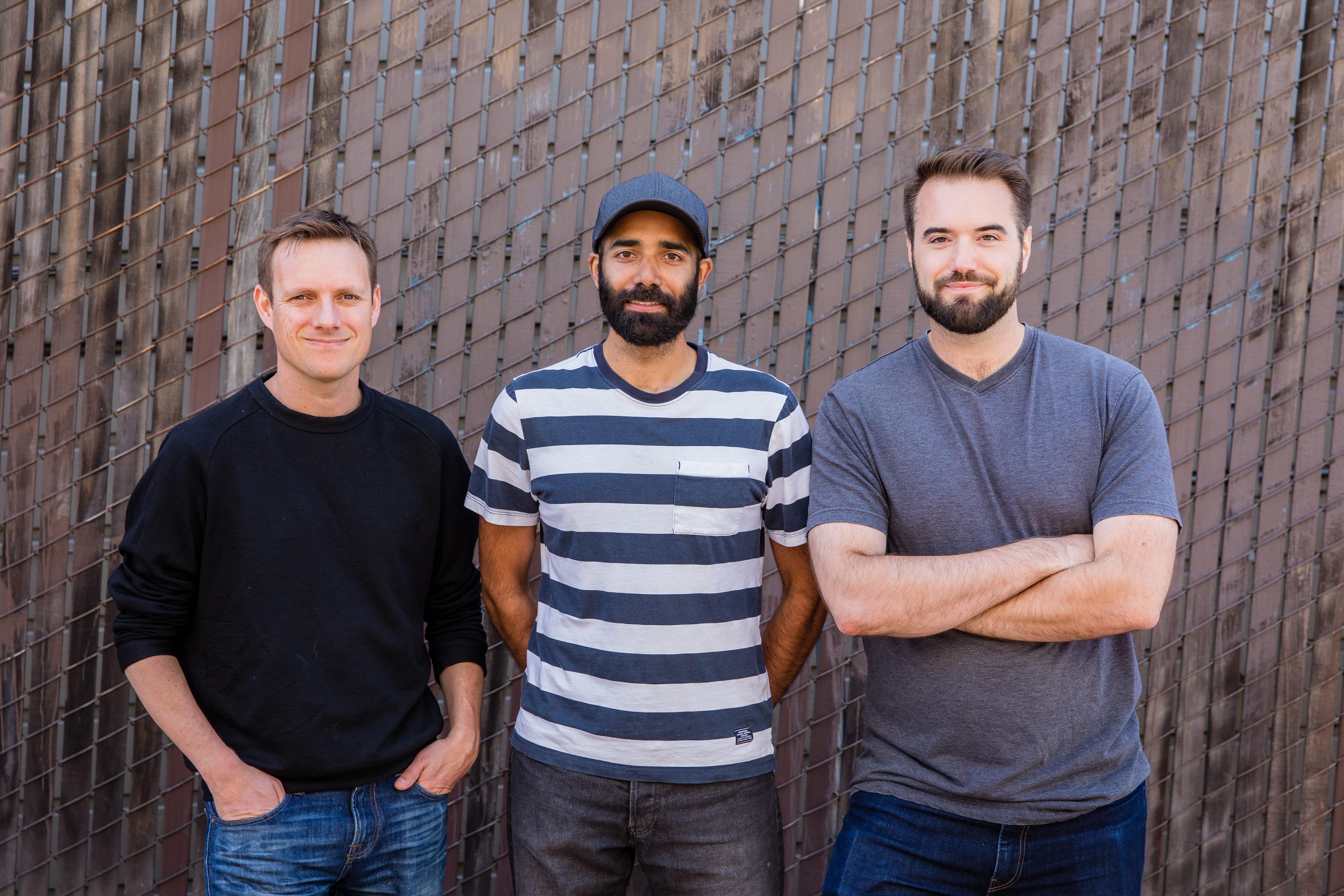
Along with Chris joined Hamish McKenzie - who became the “Chief Writing Officer” a title which he created and is unique to Substack in order to put an emphasis on the importance of writing rather than just general content. Hamish, who previously worked as the Lead Writer at Tesla often notes that he is a writer at heart, rather than a tech founder. A former journalist, Hamish often provides the moral compass that Substack uses including a very pro free speech approach, something we will dive into later in the piece.
In addition, Jairaj Sethi joined and quickly became the behind-the-scenes architect of the whole platform. Jairaj previously worked alongside Chris at Kik as the “Head of Platform and Principal Developer”. Jairaj became the lead engineer and head of product development at Substack, a job he still leads today almost a decade later. Jairaj focused on quickly creating a minimum viable product (MVP) that both allowed users to write articles that were emailed directly to the readers and immediately make money off of that.
Together, they created Substack which instantly became a success. Within a year they had over 25,000 paid subscribers and 150,000 weekly active readers.1 By November of 2021 Substack had surpassed one million paid subscriptions and a year and a half later in February of 2023, they crossed the two million threshold.2
Today, Substack has more than 50 million active subscribers including 5 million paid subscriptions.3 Substack had 164.5 million monthly visits in April and has now become one of the 250 largest websites in the world by web traffic.4 Substack now hosts more than 100,000 authors earning money directly through the app including the top ten authors making over $100 million collectively.5

What does Substack offer?
For solo writers, often the hardest part of writing isn’t the writing itself but trying to write while simultaneously managing distribution, payments and growing your audience. Substack offers the whole suite with only a simple fee for those already generating revenue. The huge appeal as a writer is an ability to start from scratch and be able to instantly grow an audience.
Substack is one of the only apps where a creator can begin earning money on day one, without needing millions of impressions or hitting content based milestones. And this isn’t rare on Substack, I myself had my first annual subscriber only a month after I began this account. More than that, I often see people with hundreds of paid subscribers building accounts that turn their fun hobbies into legitimate business operations.
For the readers, Substack offers some of the highest quality in the world, often for free with a twist. If you have been reading on here for a while, you may have noticed a subtle difference between Substack and other social media platforms. The lack of advertisements. While most social media companies have the vast majority of their revenue from advertising - for example Meta had 97.6% of their 2025 revenue come from advertising - Substack uses a business model entirely different.
Substack offers their users an ability to monetize their newsletters and Substack takes a 10% commission on each purchase. For example, if someone upgrades to my yearly plan which costs $200 a year, Substack will take 10% of that or $20 and Stripe (who will be the subject of a future breakdown) takes another roughly 3%. Post fees, the author still receives more than 85% of each subscription while having the ecosystem around them that allows them to flourish.
Product Roadmap:
Besides long-form content like this article, Substack has also moved to other forms of media content moving them from a platform purely for articles to a media app.
Substack added an option for video posts in 2022 and has since continued to expand the ability of creators to upload videos of all types. In 2024, they added Substack shorts, and in 2025 they added swipeable shorts that readers can scroll through. Importantly, these haven’t been pushed to users in the same way that Meta pushes their shorts and truth be told I didn’t know they existed until doing research for this article.
Notes, which launched in 2023, has become an integral part of the Substack ecosystem. Notes allows creators to share short-form content similar to X. Notes is one of the big drivers of subscriber growth and the community feeling as it allows the creator to post daily content and the readers to interact and share their own thoughts as well.
Substack also rolled out livestreams in early 2025 which allows creators to go live, either by themselves or with another creator. In May of 2025, they allowed creators to go live using a faceless option for the content creators who preferred to keep their face anonymous.
With all of these apps, Substack’s goal is to become an all-in-one media company while keeping the emphasis on long-form articles. With video posts and live streams they allow users an alternative to YouTube, with notes an alternative to X and with their articles an alternative to traditional news articles.
The Creator Sphere:
While Substack’s top ten creators make over $100 million a year, it is much less simple for those who are middle of the pack. For those who aren’t at the top of the Substack game, it can be confusing finding the balance between trying to grow and trying to monetize.
Even those who have 100 paid subscribers charging $10 a month - considered by Substack as a best seller - are only making $12,000 before Substack and Stripe take their fees or $10,500 a year after fees, far below the median income for an individual. While Substack isn’t a full-time job, it often takes dozens of hours weekly to research, write, distribute and attempt to connect with other subscribers in order to grow. For those who aren’t best sellers, they are often working in addition to their jobs without any real financial compensation.
Anecdotally, as someone who is now at 1,000 subscribers but has yet to turn on any real type of paywall, it can feel confusing trying to navigate the tension between treating Substack as a part-time passion and a legitimate hypothetical job.
This can often cause burnout when the financial incentive doesn't arrive, creating something called the “Trough of Sorrow" which typically kicks in at two hurdles at 3 months and one year once the hype and excitement cools down.
TAM:
Substack has a number of competitors, but the more important number to begin with is their total addressable market or TAM.
With every platform, there is a finite amount of users who are interested in that platform or service and with Substack it is no different.
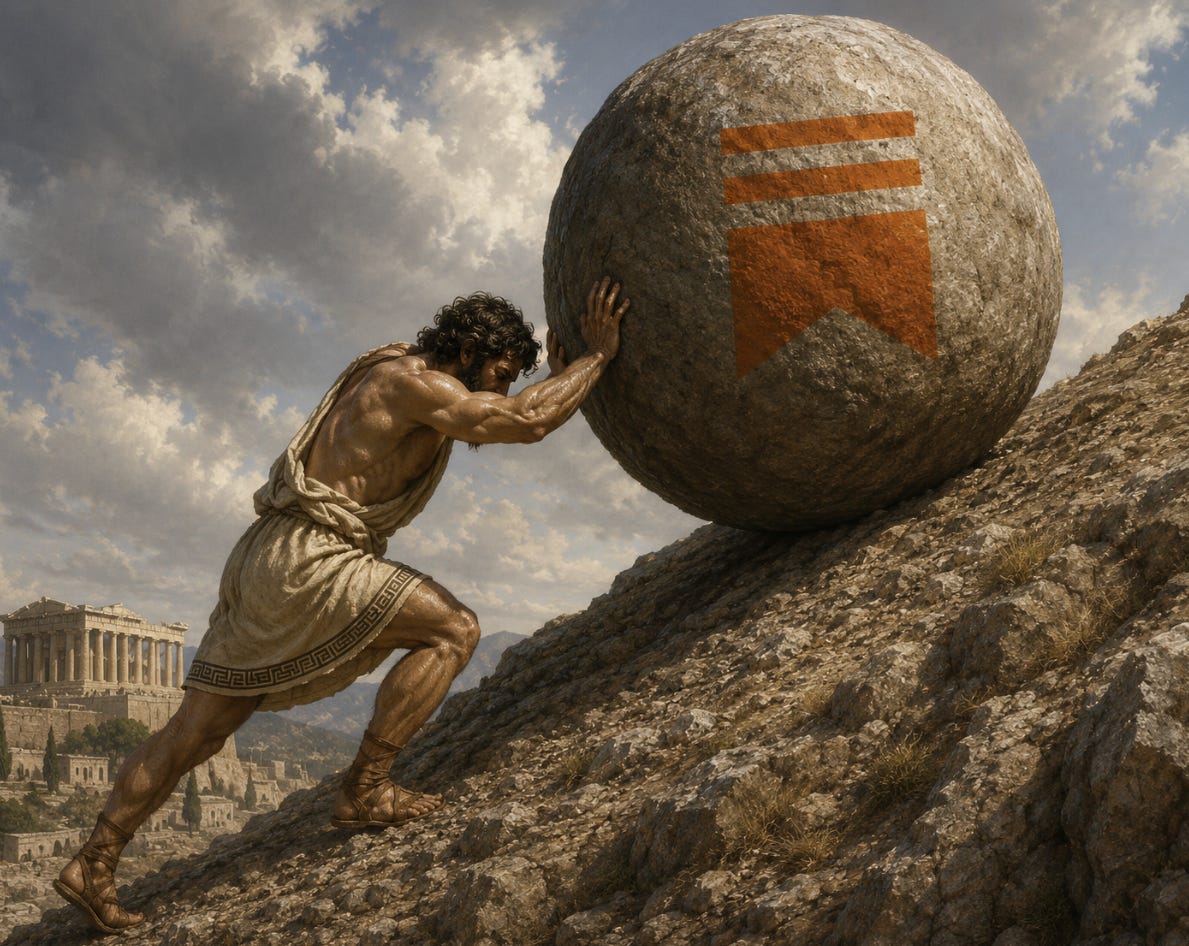
Substack is fighting a greater battle. The battle to move from type one i.e. fast-paced addictive content to type two i.e. slow-paced quality content that leaves the readers more intelligent and fulfilled rather than less.
And so far, they have proven to be a massive success. Substack has fought against the shift towards short-form content and readers on the platform often spending hours reading pieces that make them more intelligent is proof that the website is working. Anecdotally, I can say that Substack went from a platform I hadn’t heard of to one of the main sources of my information in a few short years.
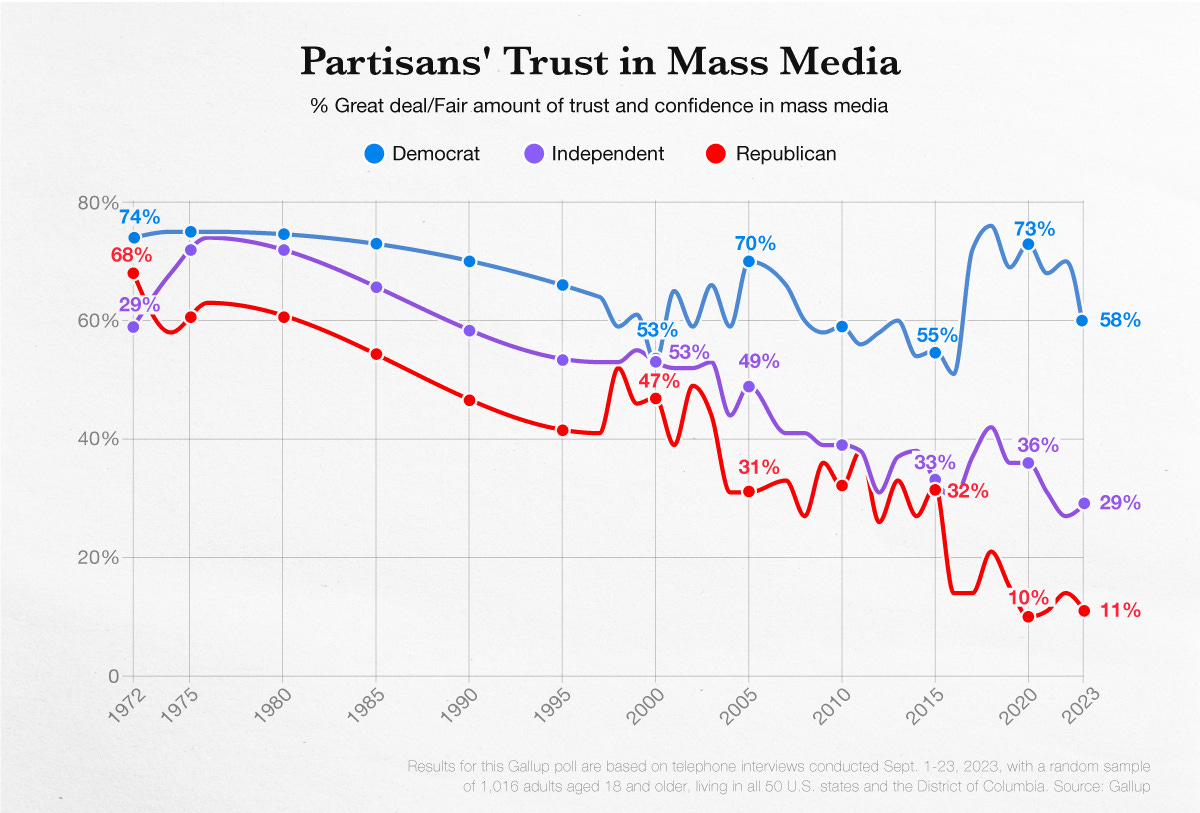
And in a world where the world’s trust in mainstream news is becoming less prevalent among the masses, independent writers and on Substack are perhaps filling the gap of long-form news content. In addition, as mentioned previously, Substack is full of award-winning journalists and writers not just in the politics sphere, but also in business, economics and even one of the greatest chess players of all time, Garry Kasparov.
All this means that Substack’s battle is fighting a two-pronged battle.
Converting readers that already exist onto their platform.
Introducing new readers who only know “type one” social media onto a better more insightful platform.
And the readers have been converting, we mentioned some impressive numbers earlier but one that stands out is that Substack added 32 million new subscriptions in only a three month period.6
Competition:
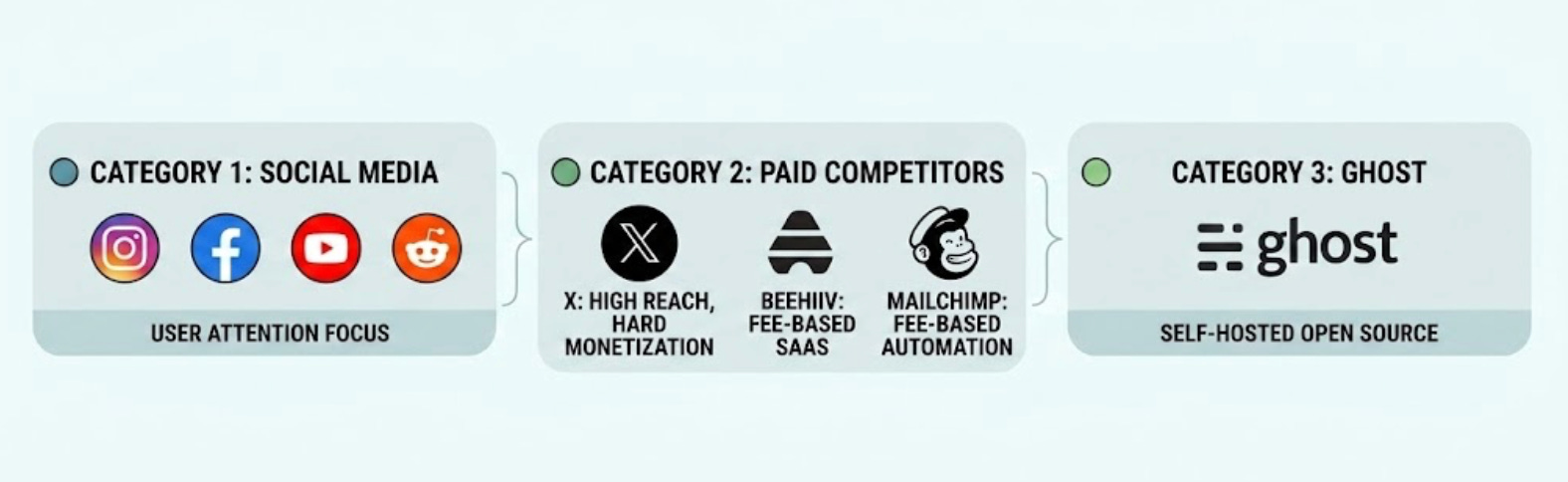
As can be inferred from the previous section, Substack’s competition is made up not just of other newsletters, but of social media companies in general. Instagram, Facebook, Reddit and YouTube are all major competitors to Substack, not directly in the newsletter section but as general competition in trying to capture user attention.
Substack also has other competition with other newsletters.
Beehiiv is one of the most popular newsletter platforms specifically for those who are at the top of the Substack game. Beehiiv charges a flat monthly fee similar to a SaaS model depending on the amount of subscribers you have. Importantly, it is not possible to monetize an account on their free plan meaning for the majority of writers starting out without major subscriber bases, they will likely prefer Substack’s free option. Still, Beehiiv is a legitimate competitor especially for those who are Substack’s most valuable customers.
Mailchimp, now an Intuit platform, that has 14,000 users sign up daily is another popular option for those looking to begin a mailing list.7 Mailchimp is known for their easy-to-use platform that also offers editing tools, built-in AI assistants and helps creators automate their platform. The drawback is again the pricing. Mailchimp’s pricing tier is expensive and charges even for users who are inactive.
Ghost is a non profit open source option that gives creators the full revenue of whatever they earn. Ghost allows you to truly own your platform with the option to customize your website and move your subscriber list and your website whenever you choose. Similar to Substack, Ghost allows you to create tiered subscription tiers and create articles that are only for paid subscriptions. The downside with Ghost is that it is harder to use than Substack and has a smaller profile making growth more dependent on the user than the platform.
Alternatively, for those who are looking for a larger user base, X (previously Twitter) provides a relatively cheap option. The pro in X is that the user reach is massive. X has 561 million monthly active users and over 250 million daily active users.8 For those only looking to spread their content and reach the maximum possible user base, X is a good option. For premium users, X now has an article feature that allows articles to be posted directly to X. The downside, X monetization is difficult to achieve requiring both a paid subscription and achievement of milestones (5 million impressions + 500 premium followers) in order to qualify. Once qualified, monetization is dependent on the X algorithm rather than the user’s choice. That being said, for those looking for maximum reach, X has around 10x the reach that Substack has.
As you may have noticed, what Substack does best is they offer users a free option that they can immediately monetize together with a recommendations network that helps creators grow quickly. My first paid subscriber came after dozens of hours of hard work but also after zero financial commitment. Substack’s recommendation feature drives 50% of new subscriptions and 25% of new paid subscriptions.9 Alongside that, notes has become increasingly more popular giving X a space for creators to share short-form content. The combination of free to begin and the ability to grow through the Substack notes and recommendations algorithm makes it an increasingly more attractive option.
The Growing Migration:
One of the best things Substack can do and the quickest ways for it to grow, is to have creators from other apps join Substack and bring their following with them.
This is a playbook that is mutually beneficial both for the creators and for the platform and one that is becoming more prevalent as creators realize the value Substack offers.
For the creators, they are able to instantly add another income source and connect to their followers in a more intimate way.
For Substack, each creator who transfers brings a dedicated user base who become engaged users, both with the original creator and likely with other creators as well. In addition, it solidifies Substack’s position as a cash generating bottom of the funnel playbook for creators who have massive followings, creating a flywheel that brings additional creators and users to the platform.
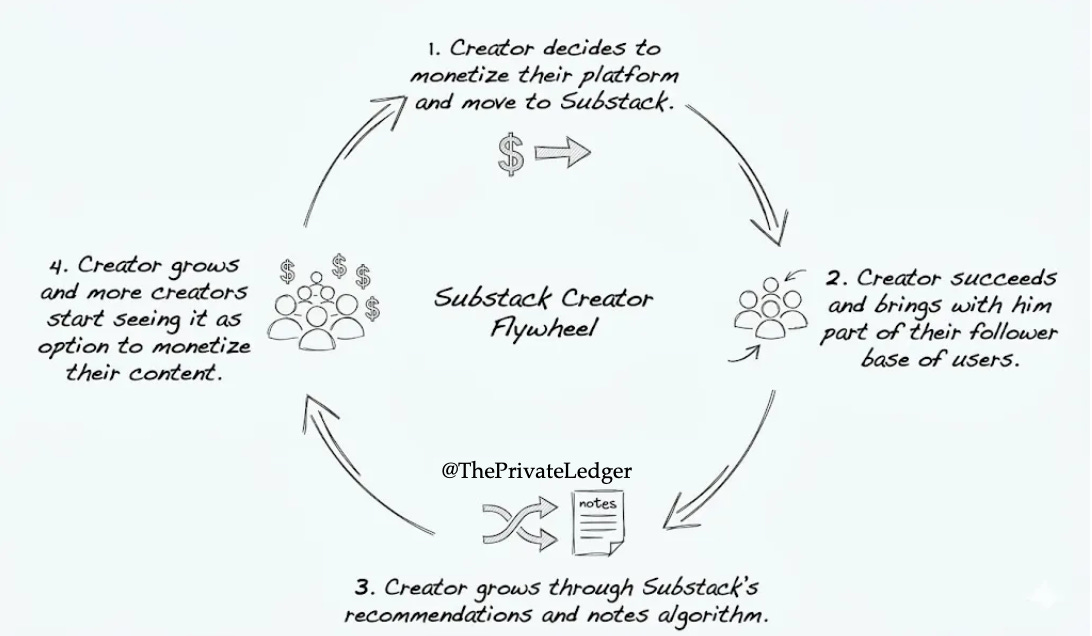
I spoke with two content creators who joined Substack and brought part of their audiences with them.
Trader Joe began his social media career after managing a multi billion dollar fund for a Goldman Sachs spin off. His content was quickly appreciated and he built up a user base of over 250,000 followers across Instagram and TikTok. In February, he joined Substack where he quickly became a bestseller and fantastic source of in depth information.
“For me I use video content (Instagram/TikTok) as my top of funnel. You can only get across so much in a 1-2min clip. For people that want more in depth research I refer them to my Substack which is the type of work I like doing more. I think many traders are introverted and don’t naturally desire to be on camera so I found that I’m one of the few with an institutional background that is doing video.”
Uninvited joined with a following on both X and a website. While she originally began writing articles on X, she found that she had started enjoying writing on X less and less. She moved to Substack, where she has gained 3,300+ subscribers in only six weeks. She views Substack as a bottom of the funnel platform that she can use in order to go more into niche depths and connect more directly with her followers.
The Ethical Questions:
Every company has its ethical questions and Substack is no different.
With Substack, the biggest question is freedom of speech and how it should be regulated. Substack’s founders are very openly pro freedom of speech but some people believe that they have taken this belief too far.
The main backlash began in 2023, when Substack was accused of hosting and allowing pro-Nazi and white supremacists to monetize on the platform and benefiting directly from that.
Hamish McKenzie came out and said that the platform “doesn’t like Nazis” and that they wished that “no one held these views” but he importantly didn’t say that removing them from the platform was the right idea.10 Substack’s initial response was that they would remove accounts who made tangible threats of violence but not those promoting violent ideologies. Substack’s approach was that by removing the extremists from their platform, they would just make the problem worse and draw additional attention to those with extreme beliefs.
“We believe that supporting individual rights and civil liberties while subjecting ideas to open discourse is the best way to strip bad ideas of their power.”
Hamish McKenzie’s response to writers with extremist views.11
Meanwhile, a number of prominent writers came out and said that Substack’s handling of these accounts wasn’t sufficient. Casey Newton, one of the most prominent writers on the platform decided to leave Substack for the aforementioned Ghost, and published a thought-provoking article called “Why Platformer is leaving Substack”.12 In the article, which I highly recommend, Newton announces his reasons for leaving Substack including saying:
“I’m not aware of any major US consumer internet platform that does not explicitly ban praise for Nazi hate speech, much less one that welcomes them to set up shop and start selling subscriptions.”
Important to note that Newton wasn't leaving behind a small account with some potential. He had thousands of paid subscribers and over 172,000 total subscribers. Additionally, 247 prominent writers signed a letter to Substack asking them to clarify their policy.13
Substack ended up banning some of the publication that overtly supported Nazis partially walking back their stance that the best way to strip bad ideas is to subject ideas to open discourse.
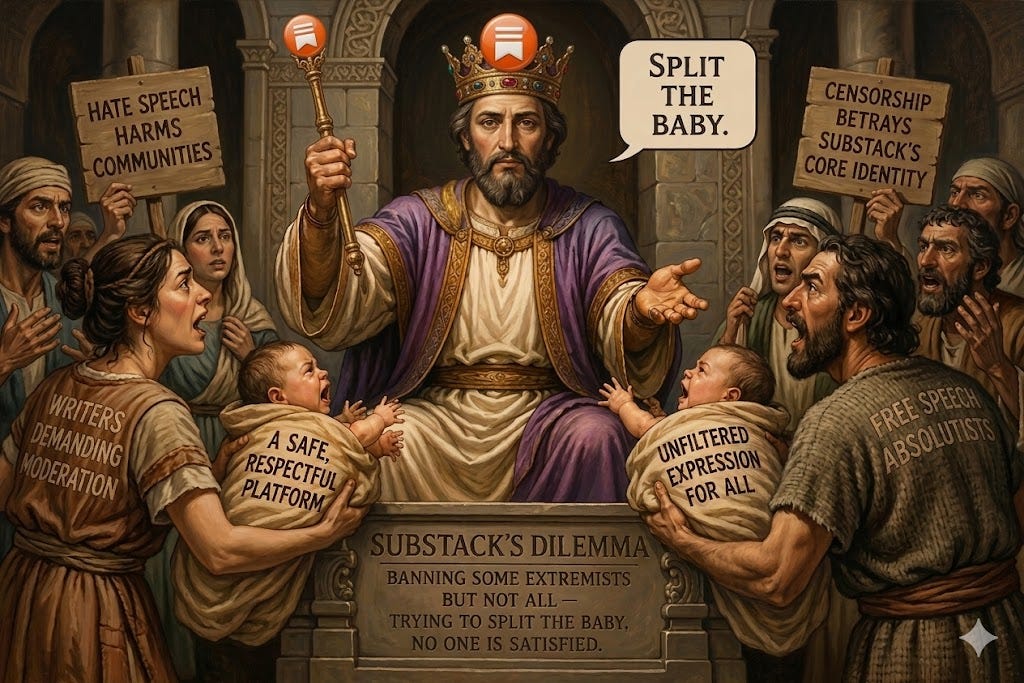
Substack is stuck here in a Catch-22, on the one hand, critics of moderation say that freedom of speech should include all opinions.
Freedom only for those who conform to Substack’s views is freedom of agreement rather than freedom of speech.
Proponents argue that as a private platform, Substack is not obligated to follow freedom of speech laws and that the platform shouldn’t be supporting writers that are unethical.
In the end, both sides left unhappy with Substack banning some extreme writers while other writers who were pro-censorship chose to anyways leave the platform.
In addition, Substack has partnered with Polymarket, a problematic prediction platform (read gambling) which is something I covered in depth in my Polymarket article.

Valuation:
Despite the controversy surrounding Substack which caused many writers to leave the platform, Substack continued to grow and more and more writers began newsletters on the platform.
Currently, Substack is not profitable at least as of 2025. This isn’t due to a revenue problem but rather due to an increasing investment into new features.
Hamish McKenzie, one of Substack’s founders, told The New York Times that it could choose to be profitable but is focusing instead on “investing in and continuing to grow the business.”14
This is a playbook that is common in media companies, Twitter (now X) took twelve years to turn its first profitable quarter.15
“As of early 2025, Substack has not yet achieved profitability. The company has experienced significant revenue growth, with estimates indicating $29 million in revenue for 2023, up from $19 million in 2022.” Despite this growth, Substack continues to prioritize investment and expansion over immediate profits.
This, along with their revenue growth has caused Substack’s valuation to climb and in July of 2025 they officially crossed unicorn status with their Series C funding round raising $100 million at a $1.1 billion valuation.16 Substack’s previous Series B funding round had them valued at $650 million in March of 2021 meaning the company grew by almost 70% in slightly more than two years and from zero to $1+ billion in eight years.
When looking at a future valuation and room for growth, it is important to look at valuations of other media companies to understand what the potential could be. Reddit, the online forum app is currently valued at over $32 billion while the New York Times is worth roughly $12 billion.17
At a current valuation of $1.1 billion, Substack is still very much at the beginning of its growth stage.
In order for Substack to grow its valuation, it needs to continue growing its users and move from a niche platform for intellectuals to a mainstream media corporation.
The Bear Case:
Creator Emigration:
While Substack is an extremely attractive platform with lots of room for creators, there are a number of downsides that can cause creators to move to different platforms taking their users with them.
First, Substack’s 10% Revenue cut is something that large creators will want to get around. This creates a problem for Substack as it’s most valuable creators have an active reason to leave the platform once they grow their audience. It is also important to note that a creators email list is owned by the writer, not by Substack making migration to different platforms easy for creators who want to move.
This is a phenomenon that has already happened among many of Substacks top creators including Matt Brown who moved his 71,000+ Substack account over to Beehiiv in order to save over $20,000 in fees.18
“Given the size of my publication right now, I would need to pay Substack over $25,000 a year in fees,” “I pay Beehiiv around $3,000-ish in fees.”
Molly White was another prominent Substacker who moved her platform from Substack to Ghost and using some simple “napkin math” demonstrated how expensive Substack can become for those with massive audiences.19
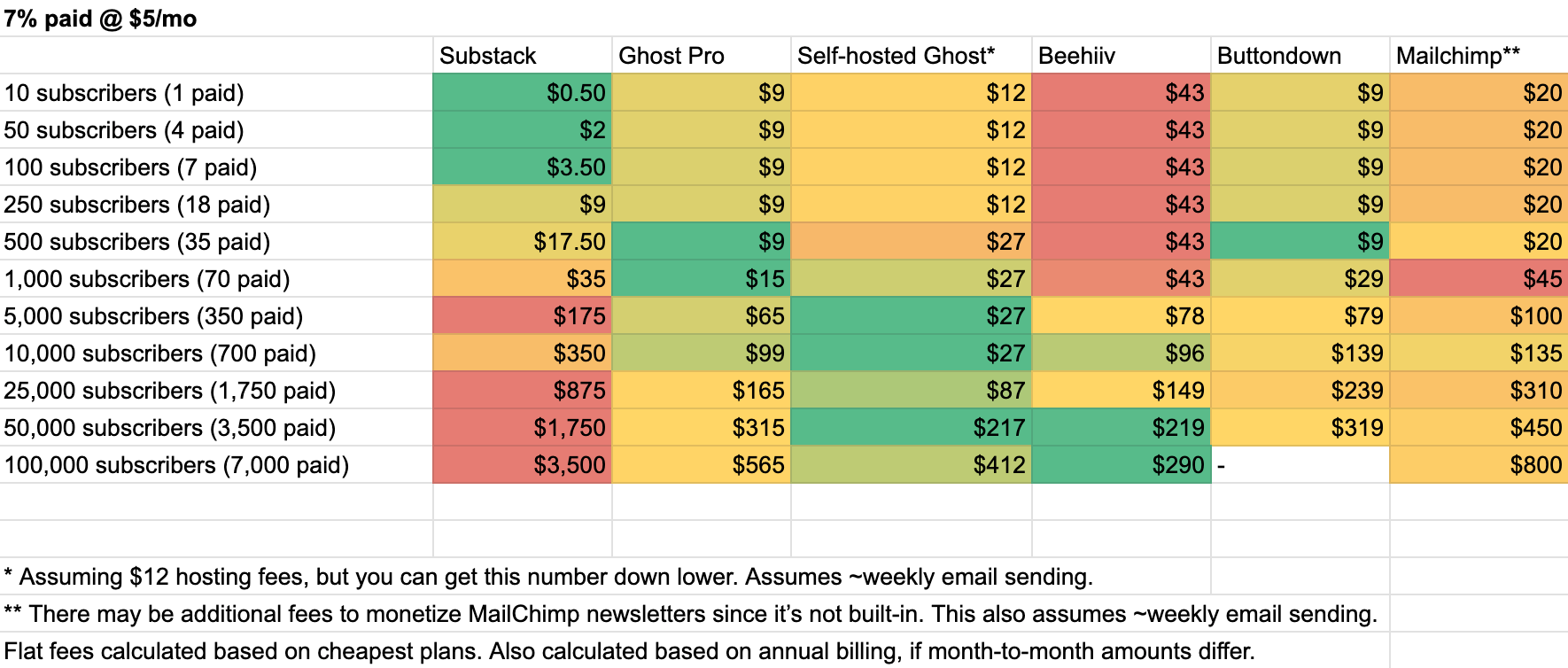
Substack does have a major advantage over those platforms namely that the Substack algorithm and recommendations features allow creators to grow at a rate they couldn't when writing through other platforms. Still, for those with huge audiences already, saving tens of thousands of dollars a year can be a big enough incentive to switch over.
In response to major creators switching over, Substack has recently rolled out Subscriber kits which allow Substack bestsellers for creators with more than 100 subscribers.20 These kits allow creators to directly partner with Substack sponsors and have brand deals come to them as opposed to have to search for them.
Loss of Attention Span:
The other potential bear case for Substack is their TAM shrinking as people become more and more addicted to short-form content like scrolling on Instagram and YouTube. This is something that is already happening. Attention span shrinking is now a fact, not a theory.21
According to much-cited research (that is often disputed), the average human attention span has dropped from around 12 seconds in the early 2000s to about 8 seconds today. Even more telling, studies show that when people work on digital devices, they switch tasks every 40 to 50 seconds on average.22
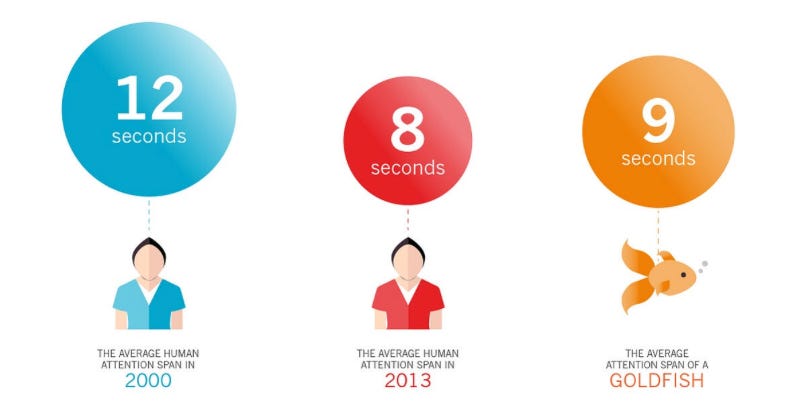
Substack is fundamentally built around long-form articles which require enormous amounts of attention to consume. When the average person switches tasks every 40-50 seconds, a long-form article with a ten or even twenty minute reading time is becoming more and more rare daily.
In fact, if you are reading this, you are likely one of the few who made it this far and for that, I applaud you.
This is likely one of the reasons why Substack released their shorts feature, but this is far from the core of the platform and actually feels antithetical to why the platform was created.
If Substack’s TAM shrinks, and attention spans continue contracting, eventually fewer people will frequent Substack’s website.
The Moderation Problem:
Another potential downside with Substack is the moderation problem we discussed earlier that caused Casey Newton to leave the platform. I won’t go into it again but Substack is constantly trying to find the balance when performing content moderation that inevitably frustrates both sides.
The Hack:
In addition to the bear case, in February of 2026, Substack announced that they had suffered a data breach in October 2025 that was only discovered months later. The breach importantly didn’t include financial information or passwords and was resolved by Substack only after months of the hackers running rampant with the emails, phone numbers and addresses of nearly 700,000 users.
“It takes 20 years to build a reputation and five minutes to ruin it”
Warren Buffett
With the breach, Substack users had their data exposed for months without their own knowledge, a fact that is particularly worrisome. Included in those breached were government officials and journalists. Importantly, while the email was leaked, it was not leaked with the password meaning user’s emails themselves weren’t compromised.
With the advancement of AI models like Anthropic’s Mythos, data attacks will likely become easier for individual users to partake in. The fact that Substack already had a major data leak in a world that is becoming more and more dangerous is worrisome to say the least.
In Substack’s defense, these types of leaks happen relatively often among top companies and are considered standard costs of using the internet. Yahoo had three billion in a four year long data leak, Meta had 500+ million users have their data leaked and even Marriott International had the information of up to 500 million guests leaked.23
The IPO and Final Thoughts:
Substack currently doesn’t have any near term plans to IPO. Their most recent Series C funding round which was led by BOND and The Chernin Group now gives them ample capital to work with.
For now, it seems like Substack is focused more on private funding and growing the platform rather than going public and having to deal with the headaches of life as a public company which include investor calls, additional financial scrutiny and short term investor pressure.
With its most recent funding round and its entry into unicorn status, Substack has officially stopped being a small media company and has officially become a website recognized for its use and influence. That being said, it is still early in its growth process and likely will want to become profitable and increase its user base before considering an IPO.
On a personal note of gratitude, I want to thank Substack as a platform for providing me a platform to write and share, to grow and flourish. Substack might not be perfect, but their monetization structure makes it free to start and to grow and for that I am thankful.
To the readers, thank you for reading my work, your support means the world to me.
https://qz.com/substack-newsletters-media-business-history-trends-1851734109
https://www.forbes.com/sites/daveywinder/2026/02/06/substack-hacked---what-50-million-users-need-to-know/
https://www.similarweb.com/website/substack.com/#overview
Article from Chris Best titled “A business model that works for creators.”
https://blogherald.com/blog-platforms-tools/n-substack-reported-32-million-new-subscribers-from-inside-the-app-in-three-months-most-bloggers-are-missing-what-that-means/
https://www.emailtooltester.com/en/reviews/mailchimp/
https://worldpopulationreview.com/country-rankings/twitter-users-by-country
Article about the power of recommendations from Hamish McKenzie.
https://www.theguardian.com/media/2024/jan/03/substack-user-revolt-anti-censorship-stance-neo-nazis
https://www.nytimes.com/2023/12/22/business/substack-nazis-content-moderation.html
Casey Newton’s article, “Why Platformer is leaving Substack.”
https://www.nbcnews.com/tech/internet/pressure-builds-newsletter-company-substack-stop-paying-nazi-writers-rcna132593
https://www.theverge.com/2024/11/18/24299484/substack-newsletters-politics-not-profitable-frustrated-investors
https://www.theguardian.com/technology/2018/feb/08/twitter-makes-first-quarterly-profit-history
https://sacra.com/c/substack/
Both of these are as of June 19th i.e. the time I am writing this article.
https://companiesmarketcap.com/cad/media-press/largest-media-and-press-companies-by-market-cap/
https://companiesmarketcap.com/internet/largest-internet-companies-by-market-cap/
https://www.theverge.com/tech/927294/substack-tax-ghost-beehiiv
https://www.mollywhite.net/micro/entry/202504111009
For those who want to read Substack’s full article, click on this link.
https://www.apa.org/news/podcasts/speaking-of-psychology/attention-spans
https://medium.com/@katyayini/brain-rot-is-real-how-the-endless-scroll-is-stealing-our-focus-37839a667f37
https://panorays.com/blog/largest-data-breaches-in-history/
Thank you🙏🏽
Awesome work, as always!! A private company I am sure we all are rooting for to do well. 👏